
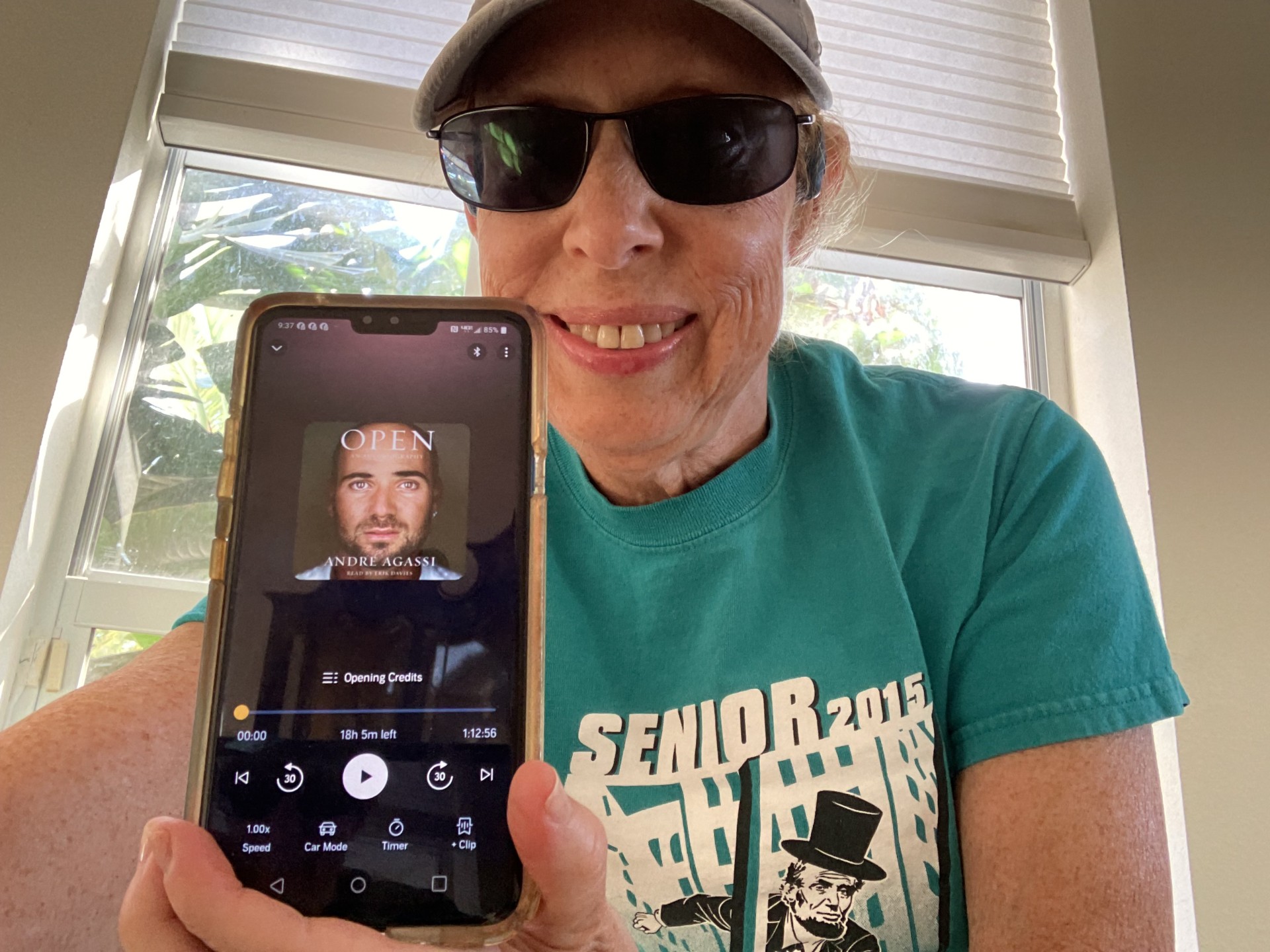
Open is compelling, dramatic and raw
I hate finishing a memoir—I always miss the author. I want to tell you about the one I just finished, Open, because Andre Agassi’s memoir teaches memoir authors a lot of lessons, and because I’m missing the tennis legend and writing this drags out the goodbye.
Audiobook Issues
Do yourself a favor, though—read it, don’t listen to it. I listen to celebrity memoirs while I run, and it’s like having the celebrities running next to me and telling me about their lives. Not this one. Instead of narrating it himself, Agassi has actor Erik Davies doing the narration for the audiobook. I understand why non-actor authors conclude that they’re not the best choice to read the book aloud. Keith Richards didn’t read his excellent memoir, either. So let’s start out with the benefit of the doubt and say fine, let this Erik Davies do the audiobook.
Davies does an adequate job until there’s dialogue. Then he uses one higher-pitched voice for all the women and one lower-pitched voice for all the men except for Agassi’s father, for whom he must add an Assyrian-Iranian accent, which I doubt he does very accurately. It sounds ridiculous when this man goes into a higher pitch every time a woman speaks and fakes a deep voice for all the men. It’s what you do when you’re eight years old and playing house and you’re supposed to be the mom or the dad. In at least one instance I noted, he also changes the voice for Andre himself. So wait a minute. You’re reading this memoir, written in the first person, as if you’re the person who wrote it. But in dialogue, your voice is different?
Excellent Ghostwriter
Agassi farmed out the writing as well, hiring a “collaborator” to ghostwrite the book. I don’t really have a problem with that. I ghostwrite or heavily edit memoirs for people, and I think that’s fine. Interviews with Agassi and his collaborator indicate that they worked very closely together, and I believe their contention that Agassi went over every word and gave input.
And unlike the narration, the writing is really good. It should be, since collaborator J.R. Moehringer is a Pulitzer Prize-winning journalist. Published in 2009, Open is widely regarded as one of the best pro athlete memoirs ever released. So what can Agassi and Moehringer teach us about writing our own memoirs?
- Present tense can be effective in some cases. Despite my preference for past tense in a memoir, Open works well written in present tense probably because there’s so much point-by-point tennis play. The present tense still began to wear thin with me, but I can understand the choice in order to create excitement during the sports action.
- Rely on records. Every match Agassi played as a professional tennis player most likely is available on video somewhere. I picture Moehringer and Agassi watching the match together as Agassi describes what he was thinking at every moment, and then Moehringer writes it up. In all likelihood, you do not have video footage of key moments of your life. If you kept a journal, you are one lucky memoir author. Otherwise, gather what you can—letters, artifacts, photos, home movies. Your memory is not as good as the contemporaneous records.
- Stay honest, forthcoming, candid. In some places, I would say Agassi overshares. That doesn’t mean we hear about any sexual exploits. We don’t, and graphic descriptions are not necessary in a memoir unless they’re pertinent to the theme. But fearless, raw candor is the lifeblood of memoir. If you deliver that, the reader will understand your motivations and vulnerabilities, accept your mistakes in life and continue to root for you. In Open, it often seems as though the author doesn’t realize how off-putting some of his actions are. That’s okay. At least he’s not hiding them.
- Remember the four descriptors. In my last post, I suggested four adjectives to keep in mind as you write your memoir. I advised you to make your book entertaining, relatable, informative and accurate. Open is all of that. You wouldn’t think a memoir stuffed with sportscaster-level competition descriptions would be entertaining, but somehow it is. That’s compelling writing. These accounts go up to the precise line of where compelling turns to boring without ever reaching that line. It’s relatable because of the raw honesty. No one knows more about the game of tennis than Andre Agassi, so it’s informative. While his first wife Brooke Shields disputed some of the facts, the reader understands that every memoir is told from the author’s point of view, and this narrative comes across as accurate.
- Be careful with your account of other people in your life. Agassi’s life is intricately involved with the lives of his parents, then his coaches, one lifelong friend and, at different times, an early girlfriend and his two wives. He talks a lot about all of them, and while nearly all of it is positive, I still feel that he must have asked them for their blessing before publishing, because some of what he tells us about them could be considered private. One coach has a very sick daughter for a while, for example, and Brooke Shields reportedly asked him to change some parts. She comes across brainy and small-minded all at the same time; tennis great Jimmy Connors is the other one portrayed as less than appealing. But that’s about it. So be honest about people who matter in your life, but don’t dwell on the negative more than necessary.
- Every life, every journey, is significant. Agassi has a nearly groupie admiration for the late Nelson Mandela, whom he gets to meet. He sits and listens to a speech Mandela gives, and he quotes Mandela as telling the audience that every life is worthy. That’s a great thing to keep in mind as you write your memoir. Your life is worthy in telling and worthy in itself.
Sometimes I review memoirs on Goodreads. You’ll see that I gave this one a lot of stars.