
An analysis of the iconic, quintessential example of bad writing.
You’re told to give readers visual images—“show, don’t tell.” In his 1830 novel Paul Clifford, Edward George Bulwer-Lytton did just that. Yet the first seven words of his opening sentence have become the quintessential example of bad writing. Is there anything wrong with beginning a story, “It was a dark and stormy night”?
History of the Phrase
Madeline L’Engle didn’t think so. She began her 1962 young adult novel, A Wrinkle in Time, with the very same wording. And the phrase’s French version appears in the famed 1844 Alexandre Dumas story, The Three Musketeers.
Bulwer-Lytton may or may not have come up with the phrase. According to Wikipedia, “a dark and stormy night” was mentioned in an 18th century journal about a shipwreck. But Bulwer-Lytton was a successful novelist and did originate the saying, “The pen is mightier than the sword,” so it’s conceivable that the same phrase came into two minds independently.
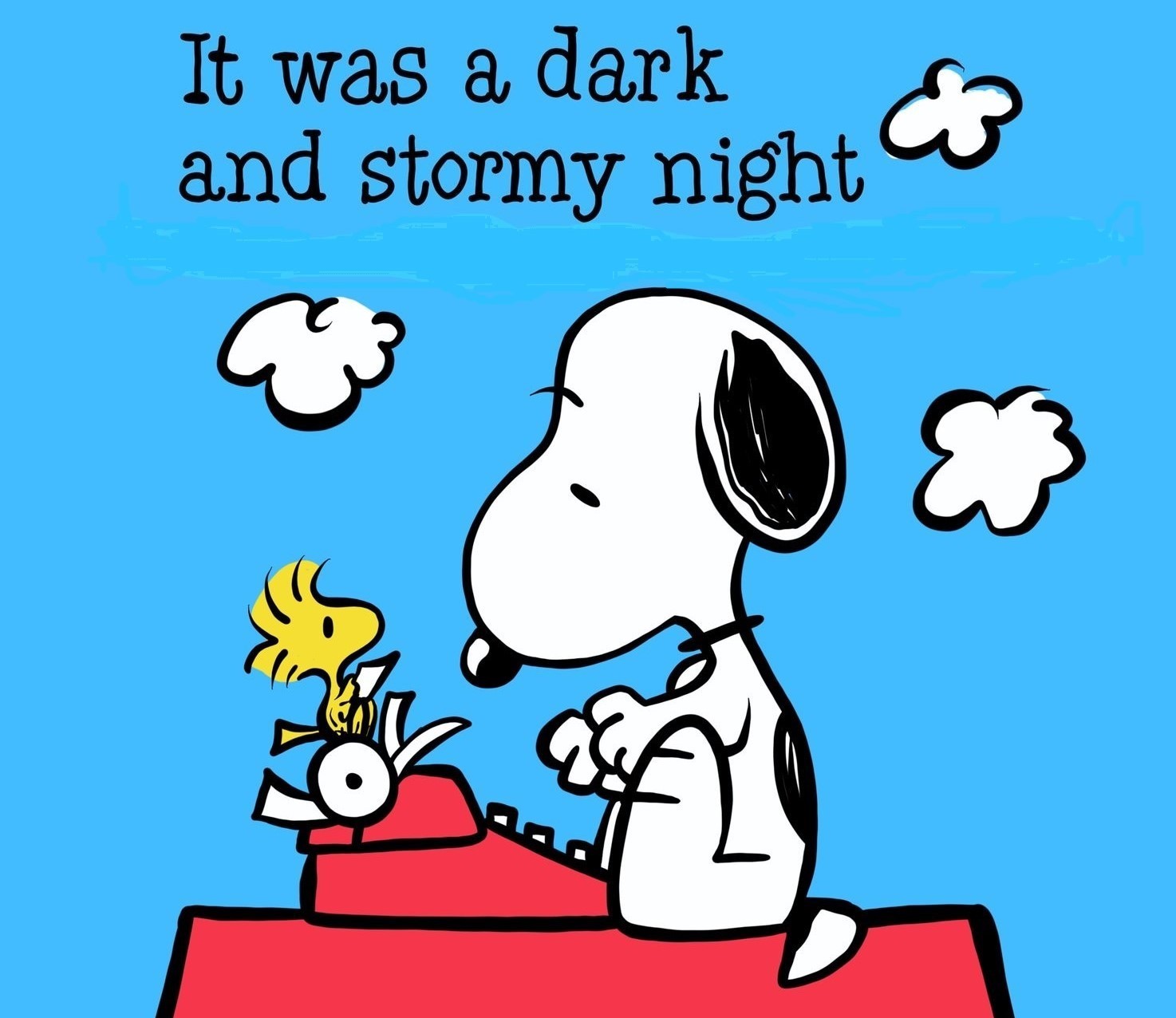
It was Peanuts cartoonist Charles Schulz who brought broad awareness to “it was a dark and stormy night” as the trashy writing cliché that it has remained to this day. In his multiple depictions of Snoopy, in the company of his pet bird Woodstock, sitting at the typewriting and tapping out his war-time memoir, Schulz showed his favorite beagle beginning his work with, “It was a dark and stormy night.” Schulz even released a short book with the phrase as the title.
In 1982, Scott Rice, a professor at San Jose State University, built upon the phrase’s unflattering reputation by launching the Bulwer-Lytton Fiction Contest, named after the earliest known author of the phrase and welcoming writers to submit dismally florid opening sentences for pretend novels. Prizes are still awarded annually.
How Bad Is It?
In evaluating whether the disparaged phrase deserves its lowest-bar standing, let’s consider the entire sentence:
“It was a dark and stormy night; the rain fell in torrents—except at occasional intervals, when it was checked by a violent gust of wind which swept up the streets (for it is in London that our scene lies), rattling along the housetops, and fiercely agitating the scanty flame of the lamps that struggled against the darkness.”
For me, that is pretty bad in just the way Charles Schulz implied—overly dramatic with too many adjectives and a resulting passage that becomes laughingly overwrought. I also have some technical issues with the sentence.
Parsing the Sentence
Granted, my critique is from the perspective of American English in 2025. With that caveat, I take exception to the very first two words. Try not to start your book with “It was” or “There is.” A sentence here and there can read that way, but I advise writers to minimize “be” verbs like “is,” “are,” “was” and “were.” You may think that the “it was” and “there is” structure is passive voice, but “be” verbs are intransitive verbs, so neither active nor passive voice applies. Still, “is” is not compelling.
While I admit there are times I do start a sentence with “there is,” “there was” or even “it was,” I wouldn’t start a whole book that way. The structure can create drama in a good way, but in Bulwer-Lytton’s sentence it sets up a foreboding that feels cheesy. And then we come to a semicolon. If you have a semicolon in your opening sentence, you most likely use too many semicolons. Just give in and use a period.
I’m okay with “the rain fell in torrents.” The author then goes into a little wordiness about the occasional intervals, the checking, the violent gust—but I probably would hang in there through all of that. It does create a visual image.
Next, I’d replace “which” with “that,” but I recognize that this is an American distinction. In the U.S., we use “that” to introduce a restrictive clause and “which,” preceded by a comma, to introduce a nonrestrictive clause. I can see this clause being either restrictive or nonrestrictive. It’s either “a gust of wind that swept up the streets,” or it’s “a gust of wind, which swept up the streets.” In the first case, the restrictive clause indicates that it’s not just any gust of wind but the one that swept up the streets. In the second, it’s a gust of wind, and by the way another fact about it is that it swept up the streets. If the author intended it to be read as nonrestrictive, using “which” correctly, he needed a preceding comma. If he intended it to read fluently without the comma, he should have used “that.”
I have long been on a rampage to ban most parentheses, so you can imagine I am not pleased with what comes next in this sentence. Find another way to tell us this takes place in London. Don’t refer to “this scene” in a contrived, breaking-the-third-wall manner. Furthermore, Mr. Bulwer-Lytton, have you never been to Chicago? Boston? Dallas on a bad night? I assure you that London does not hold the unique claim of either streets or dark and stormy nights rife with violent gusts of wind accompanying torrents of rain.
The end of the sentence just tops off the ornate description. If you’re already thinking this sentence is a lot, the end becomes too much. If not, then I suppose it’s not terrible. But the final comma is wrong. The “gust of wind” is the sole subject that was both rattling and agitating. Throwing in “along the housetops” and “fiercely” doesn’t change the fact that this is not a compound clause with separate subjects. It requires no comma before “and.”
Decision About the Sentence
Is this the worst sentence ever written? Or even the most elaborate? Heavens, no. That’s what makes it the perfect foil for our amusement. Professionally crafted and well-intentioned, “a dark and stormy night” becomes a cliché precisely because it’s viable. But don’t begin your memoir with anything like it!