
Breaking Some Rules You Learned in School Can Enhance Your Writing.
You might think of grammar as black and white—correct grammar and incorrect grammar and nothing in between. But some grammatical structures fall into a gray area. Maybe the thinking on them has changed over time, or there might be examples of great writing taking opposite choices. So let’s explore some tricky grammar. Here are the first two controversial grammar points, and I’ll follow up with more in the coming weeks.
Serial Comma
People keep wanting to die on this hill, typically in favor of the serial, also called the “Oxford,” comma, but some stalwarts against the damn thing stake their claim to higher ground as well. The serial comma is the comma before and when you’re naming three or more items.
Outside of the United States, the serial comma has generally been accepted as proper. But Americans, especially American journalists, have been more likely to contend that the serial comma is, at the very least, unnecessary. In “my day,” standard stylebooks advised dropping the comma, and journalism schools taught that you’re always trying to save space, even the space of a tiny punctuation mark.
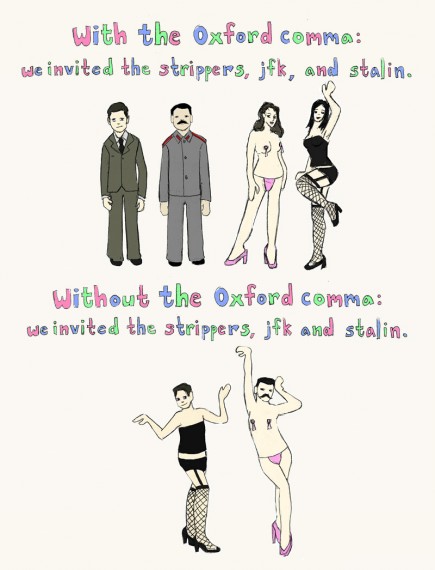
But then the Internet came along, with its eclectic and global mix, and Americans saw that they were in the minority not only in the world but also among academics, who tended to go with the comma. The meme above depicting JFK, Stalin and strippers became the rallying image against the serial comma. The idea is that without the comma, JFK and Stalin become identified as the two strippers. With the comma, you’ve invited two people and an indefinite number of strippers:
We invited the strippers, JFK and Stalin.
vs.
We invited the strippers, JFK, and Stalin.
What never went viral is a meme showing how inserting the comma can create an ambiguous meaning. In the following example, JFK could be your uncle, whereas without the comma it’s clear that you’ve invited three people:
We invited my uncle, JFK, and Stalin.
vs.
We invited my uncle, JFK and Stalin.
For many years after getting my master’s degree in journalism in the U.S., I held fast to omitting the serial comma as I was taught. But when times change, I change. Today, even here in my country the serial comma has become relatively standard, and the AP Stylebook no longer bans the comma and, in fact, recommends using it in a long, complicated series. I still drop it in a short and simple series:
On my birthday, I received three cards, some makeup and a necklace.
But in anything longer or more complex, I usually throw in a comma before the and.
Sentence Fragments and Run-ons
A proper sentence requires a subject and a verb. Sometimes it’s an implied subject, as in a command. “Go away!” is a sentence with you as the implied subject.
But skilled writers do not always have to be proper in their writing. Run-on sentences and sentence fragments used to indicate a lack of sophistication. Today, they can signal just the opposite. When you break rules with knowledge and purpose, you’re molding the language to fit your writer’s voice. That’s a good strategy for developing your style. With that approach, you can justify inserting a period after a phrase that has no subject and, therefore, is not really a sentence. Or you can use the once reviled comma splice instead of a period or semicolon to create what technically is a run-on sentence.
Look at these examples of sentence fragments (in bold). I think they’re just fine within the context of their paragraphs:
My sister stared at me but said nothing. Nothing at all. She didn’t even blink.
I looked away and thought of all the things I could do. Accept the ring. Give him reasons for not accepting the ring. Tell him I still loved him. Tell him why I hated him. At least give him a hand so he could get up off his knee. Instead I walked away, slowly at first and then more quickly, not once looking back.
Let’s twist that second example and turn it into a run-on, comma-spliced sentence:
I looked away and thought of all the things I could do. I could accept the ring, tell him I still loved him, head into some imagined and unlikely sunset with him. Or I could decline his proposal, tell him why I hated him, push him to watch him fall completely to the ground. I could at least extend a hand, help him get up off his knee. But all I did was walk away, slowly at first and then more quickly, not once looking back.
I routinely use both devices—the fragment and the run-on. Fragments are the way we speak; they’re useful for connecting with the reader. With run-ons, I like the cadence of omitting the and or the or. I like the way you say it in your head when it’s a complete thought without being a proper sentence.
Come Back for More Torture
Next time, I’ll tackle ending a sentence with a preposition and using the possessive with gerunds. You don’t have to know anything about it ahead of time to understand—you’ll see!