
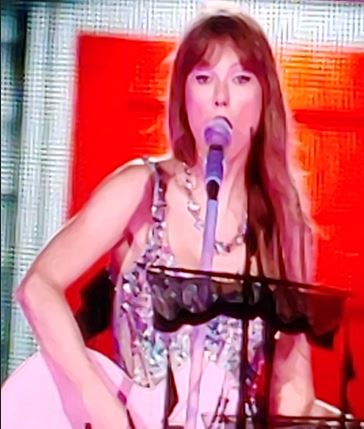
She’s a master of writing and marketing.
I’m not the biggest Swiftie out there, but I did take the above jumbotron photo when I saw her in concert during the Eras Tour, and now I’m doing a heavy listen of the new album, “Life of a Showgirl.” Mulling over the lyrics, the storytelling, the marketing and the work ethic, I’ve come up with 10 things memoir authors can learn from Taylor Swift.
- Supply details that create a visual. I’m just using other words for “show, don’t tell.” This is probably the biggest takeaway from Taylor’s music. You don’t need the video, because you can picture every moment of the story she’s telling. And the descriptive details she supplies are not cliché or tired, old descriptions you’ve heard a million times, something such as, “Her eyes, the clear blue of a quiet lake, held the promise of a better tomorrow.” No, they’re surprising but precise:
“She wears high heels, I wear sneakers. She’s cheer captain, and I’m on the bleachers.”
“Spinning like a girl in a brand new dress.”
“I can see us twisted in bedsheets.”
“I was walking home on broken cobblestones.”
“The dominoes cascaded in a line.”
“See me nervously pulling at my clothes and trying to look busy.”
“I’m drunk in the back of the car and I cried like a baby coming home from the bar.”
“When we’re on the phone and you talk real slow ’cause it’s late and your mama don’t know.” - Bring readers into your life on an emotional level. And this is the second most important lesson. From listening to her songs, Taylor’s fans feel as if they’re her friends; she shares her thoughts and her experiences with them directly. From reading your book, your readers should feel that they know you well and have an emotional connection with you. These lyrics from Taylor give you an idea of how language facilitates that:
“Well, you stood there with me in the doorway. My hands shake. I’m not usually this way. But you pull me in and I’m a little more brave.”
“In a box beneath my bed is a letter that you never read from three summers back.”
“When my depression works the graveyard shift, all of the people I’ve ghosted stand there in the room.” - Be authentic. I think most memoir authors understand this one. Most likely you’re not writing a memoir to prop yourself up or establish some version of yourself that isn’t true. Just the opposite—most writers I know find that memoir brings them closer to their most authentic self. Through the research and soul-searching that memoir requires, you may feel that you’re in touch with parts of you that either had never before surfaced or had been long forgotten or neglected. Taylor is so overly authentic that conjuring up stories about completely fictional characters in the “Folklore” album introduced a new angle to her music.
- Build suspense or anticipation, and later reveal the outcome. One of my favorite Taylor Swift songs, “The Last Great American Dynasty,” tells the story of a quirky woman who, after marrying her way into wealth and real estate, “ruined” the last great American dynasty, according to the townspeople. Her house sat idle for 50 years until, Taylor tells us, “it was bought by me.” And then she had a good time being loud and scandalous and ruining things all over again. So that was a surprise ending. Readers will turn the pages of your memoir to find out what happens. Write your story in a way that makes readers unsure of how precarious situations will turn out.
- Drop “Easter eggs” along the way. In building that anticipation, you can mimic Taylor’s habit of hiding clues or what’s come to be called “Easter eggs.” Taylor’s fans are always on the lookout for any hint of what’s next, because she’s become associated with this device. Let’s say in your teens you meet someone who many years later becomes your spouse. You can write something like:
In the group of friends was a guy who caught my eye for just a moment. At the time, we didn’t have a conversation, but somehow I knew I’d run into Paul again someday. - Invent new metaphors and conflate idioms to create a mashup. “I’m a mirrorball,” Taylor sings. “I’ll show you every version of yourself tonight. I’ll get you out on the floor. Shimmering, beautiful. And when I break it’s in a million pieces.” You don’t hear someone comparing herself to what I picture to be a disco ball every day. But I think it works, perhaps not as easily in a memoir as in lyrics, but my point is to take risks with your writing. In Taylor’s song “Cancelled” from the new album, she asks whether you brought a tiny violin to a knife fight. I really like that mashup. In my own writing, I frequently take a common saying and either twist it or mash it up with another one. What I mean is something like:
The prodigal daughter had become a son of a gun. Or:
After a while, I started arriving at work right on time like the rest of the staff, accepting that all being an early bird would ever get me was the promised worm. - Use humor. Many authors write about a dark time in their lives and the redemption that followed. Humor seems out of place in that type of memoir. But if there is a way to inject even a little humor, try doing that. It gives the reader a break from the heavy subject matter. The lyric I’ll cite from Taylor Swift is from the new album’s song “Actually Romantic.” She’s talking about how someone has been throwing shade at her on social media, and it’s sort of cute—“like a toy Chihuahua barking at me from a tiny purse.” Well, it made me laugh, anyway.
- Create a brand. Engage with potential readers even before your book comes out. Publishers today are risk-averse and more likely to offer you a contract if you already have a definable following. Taylor understood fan engagement while still a teen, and obviously it’s served her well.
- Capture your genius moments. According to numerous reports, Taylor was riding in a car with her then boyfriend, now fiancé, Travis when their conversation about a particular late great actress inspired the song “Elizabeth Taylor,” now track three on the new album. So they parked the car, and she popped out to get some quiet in her head so she could sing a tune into her phone. That’s how she began to write that song. If you’re writing a memoir, it’s always on your mind. Whether you’re daydreaming some lines in the shower or an interesting aspect to your life story wakes you up in the middle of the night, don’t lose the opportunity to grab some paper or your phone and get your thoughts down. They can be fleeting!
- Be fearless. Look, you’re writing a memoir. This is not a project born of timidity. You’re already doing something very bold. Don’t be afraid of the writing, don’t be frightened of the ordeal of finding a publisher, and don’t fear the reaction from family or the public. You’ll never finish this project if you glance over at Fear Fiend. So take that lesson. From the name of one of her albums to the way she manages her career, “fearless” is an apt label for Taylor Swift and can be for you, too.