
Writing Through the Wreckage: The Unbearable Weight of Telling My Story
by our guest contributor Adriene Caldwell
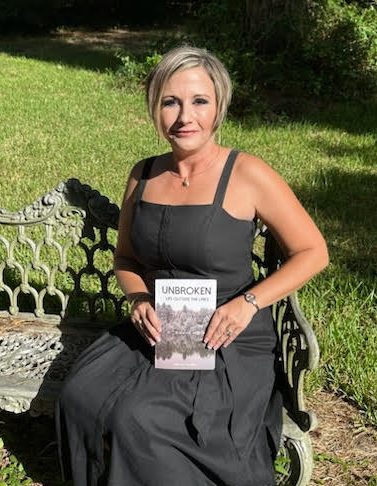
Writing Unbroken: Life Outside the Lines has been the most harrowing journey of my life—more painful, more vulnerable, and more exhausting than I could have ever imagined. And that is saying something, considering the life I’ve lived.
Brutally Honest Overview
This book is not a story. It is a reckoning. It is a coffin I’ve had to reopen again and again, not to bury what happened but to breathe through it—to make space for the wounds that never stopped bleeding and the girl inside me who never stopped screaming.
Writing this memoir meant returning to the scenes of the most unthinkable traumas: witnessing the sexual assault of my young friend, seeing a child drown, surviving foster care so abusive it bordered on sadistic, growing up in extreme poverty and mental illness, battling addiction and bulimia, and being raised in the aftermath of a home ruled by violence and untreated psychosis.
These weren’t chapters to be revised. They were ghosts I had to confront to stay alive.
Memory as a Battlefield
There’s a particular cruelty in trauma that lives in your nervous system rather than your memory. You forget what happened, but your body remembers. Your breath shortens. Your hands shake. You cry and don’t know why. Writing each chapter felt like plunging into freezing water with no guarantee I’d come back up.
I didn’t just survive trauma—I bore witness to it. I saw my young friend sexually assaulted. I didn’t have the power to stop it. I didn’t even understand what I was seeing until years later, when the guilt caught up to my understanding. That memory alone could have unraveled me. But it was only the beginning. I watched a little girl drown. I remember the chaos, the silence that followed, the disbelief.
It wasn’t a movie moment; it was slow, confusing, and then over. But it stayed in my body. And writing about it meant sitting with the realization that I would never unknow what it looked like to watch life slip away.
The Shame that Shadows the Page
Of all the emotions I expected to encounter while writing this memoir, shame was the most persistent and the most venomous. The drug use, the desperation, the people I gave myself to in hopes of feeling something other than emptiness—it all painted a version of me I had spent years trying to erase.
But that’s the lie trauma teaches you: if you admit what happened to you, you become what happened to you. And I believed that lie for far too long. Every page I wrote, I felt shame whispering: Who are you to share this? Who will love you when they know? Yet I kept writing. Not to silence the shame, but to exhaust it. To give it a voice until it had nothing left to say.
Grieving in Real Time
Some traumas are decades old. Others still burn like fresh wounds. Writing about the deaths of people I loved, as well as my own suicide attempts, meant confronting a different kind of violence: the one we do to ourselves when we believe we are unworthy of life. I didn’t write about suicide from the sidelines. I wrote it as someone who attempted it. More than once. I had to revisit the scenes: the overdoses, the razors, the gun, the stillness, the moments I hoped would be the last. I had to write about the part of me that didn’t want to be here. And then I had to write about why I stayed.
I also wrote about being homeless—when my mother, brother, and I lived at the Salvation Army shelter in downtown Houston. Each morning, the shelter would evict its occupants onto the blazing hot Houston streets. The pavement scorched the soles of my shoes. The sun was merciless. I carried my childhood in a plastic bag and my shame in my throat. Writing those scenes meant remembering the sting of invisibility, the constant fight to simply endure the day.
And always, in the background, there was my mother. She was schizophrenic. Unmedicated. And she was physically abusive. Her rage was untethered, and her mind was often lost in a world I couldn’t access. But her beatings were all too real. The last one came with a wooden dowel rod—the kind you hang clothes on in a closet. Thick. Heavy. Unforgiving. A makeshift bat in her hands. I remember her swinging it with precision. I remember the bruises that didn’t fade and the realization that I had to leave or I would not survive.
Telling the Truth When It Could Ruin You
Some truths are not just difficult—they’re dangerous. Writing about pedophilia, abusive foster homes and family secrets meant risking everything. I worried about legal fallout. I worried about people I once loved reading their own reflections in the mirror of my pain. I worried about being disbelieved—again.
But writing this memoir wasn’t about revenge. It was about reclamation. And I had to ask myself every day: Am I willing to be free even if it costs me everything? The answer, eventually, became yes.
The Loneliness of Writing What No One Wants to Hear
Writing a trauma memoir is a solitary act. It’s not a trending genre. There is no applause for this kind of vulnerability. People will say it’s “too much,” “too graphic,” “too hard to read.” And to that, I say: Imagine how hard it was to live.
I didn’t write Unbroken to entertain. I wrote it because the silence was killing me. I wrote it because too many people are still living what I survived. And someone needs to go first.
The Unexpected Grace
Despite all the pain, there have been moments of light. Writing has allowed me to meet the girl I was, the one no one protected, and offer her what she never had: truth. I’ve written prayers into paragraphs. I’ve stitched together sentences that somehow made my brokenness feel sacred.
When I wrote about choosing not to die—when I reached for life even in the depths of despair—it didn’t feel like writing. It felt like remembering. Remembering that I am not just what happened to me. I am what I survived. I am who I became.
A Memoir as a Mirror
Unbroken: Life Outside the Lines is not just a book. It’s a mirror. It reflects back the parts of me I tried to hide—the rage, the grief, the shame—and it allows me to say: I am still here. I am not clean. I am not healed. But I am whole, in the way a tree is whole after a lightning strike—scarred, yes, but alive.
This book cost me everything: my comfort, my certainty, my illusion of safety. But it gave me back my voice. And maybe, if even one person reads it and feels seen, it will have given something to them, too.
The Truth: It Was Never Just Writing
People ask what it’s like to write a trauma memoir. I wish I could say it was cathartic. Sometimes it was. But mostly, it was excruciating, like pulling out a knife still embedded in the wound, over and over, until I remembered that I was the one holding it now.
This book wasn’t therapy. It was survival. It wasn’t healing. It was truth. And I am not the same woman who began it.