
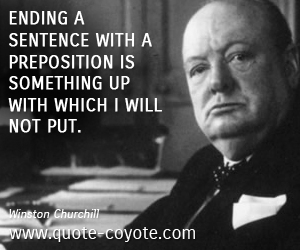
Can you end a sentence with a preposition?
Continuing from my last post, here’s another controversial grammar point.
Ending with a Preposition
Grammar-type people love to haggle over this one, and the meme above shows one of the several versions of a quote widely, but probably erroneously, attributed to Winston Churchill. No matter who really said it, the quote is perfect for making the point that in some cases you tie yourself in knots trying to avoid ending a phrase or sentence with a preposition.
The easy-to-understand sentence, “That’s something I will not put up with,” ends with the preposition “with,” and according to the rule, must be addressed in some other way. That leads you to, “That’s something with which I will not put up,” which still ends with a preposition. So you have to take one more step to reach the unwieldy, “That’s something up with which I will not put.”
As with everything in English, you can reword a thought to avoid the problem. For example, you can say, “I won’t put up with that.” Problem solved. But do you have to do that every time?
I think in some cases you should and in some it’s not necessary. In a memoir, you probably will include a lot of dialogue. Make your dialogue sound natural. A lot of grammar rules go out the window when you’re quoting people in the way they truly talk.
Apart from dialogue, let’s look at sentences that you might end with a preposition but don’t really have to. Before we start, consider that sentence you just read. It ends in “to.” Rewording that is a bit of a nightmare. No matter how many “which” devices you use, you can’t just stick the “to” somewhere else; it doesn’t work to say, “Let’s look at sentences that you might end with a preposition but to which you really don’t have” or “….a preposition but have to which you really don’t.” To avoid ending with a preposition, you would have to totally rework it. I’d say, “Let’s look at sentences that you might end with a preposition, but you can choose not to do that.”
Here are examples of sentences that you might end with a preposition but, instead, you can reposition the preposition:
- I didn’t know which category I should place that into.
vs.
I didn’t know into which category I should place that. - I didn’t know which half I should take my slice from.
vs.
I didn’t know from which half I should take my slice. - He was head of the committee I eventually took charge of.
vs.
He was head of the committee of which I eventually took charge.
In all of those sentences, I would use the “which” device and avoid ending with a preposition.
I’d choose differently for the next sentences. Even though it’s not difficult to avoid ending with a preposition, I don’t think that improves the sentence. Sometimes you improve the grammar at too high a price to the language or the communication:
- Her own situation was what she wanted to talk about.
vs.
Her own situation was about what she wanted to talk. - I know I wasn’t exactly the kind of person they were hoping for.
vs.
I know I wasn’t exactly the kind of person for whom they were hoping.
I would just use the first option in those sentences. In some cases, you’re dealing with an idiom of some sort. Take this:
- I didn’t know where that comment came from.
vs.
I didn’t know from where that comment came.
In that sentence, too, the first option sounds more natural.
Let’s try “with” as in the meme quote:
- They told me to bring a “plus one,” but I don’t have anyone to go with.
Sure, you could say, “…but I don’t have anyone to bring.” That’s what I would do, at least in writing. But if you’re writing a memoir from the heart, and you want to write in a natural way that ends some phrases and sentences with a preposition, I certainly will not stop you.
This whole line of thought applies when you’re talking about a clause rather than a full sentence. If you say, “I didn’t know which half I should take my slice from, so I let the other person go first,” you still have to decide where “from” goes. It’s exactly the same as if it ended the sentence.
Note to anyone who stuck with me through this long lesson: I have one more coming, and then we’ll be done with grammar for a while.