We are experiencing issues with our Contact form.
Please Email Us Directly at: Su*****@************rs.com.

Every ordinary life story is extraordinary!

PLEASE NOTE:

oUR CONTACT US Form HAD A MALFUNCTION.
IF YOU HAVEN’T RECEIVED A REPLY, PLEASE FILL IT OUT AGAIN OR WRITE US DIRECTLY.

Every ordinary life story is extraordinary!

Possessive with the Gerund

Hang in there to learn this last grammar point

No one knows this structure.

You may not remember learning this rule about using the possessive with a gerund, but I assure you it was in an English grammar book you had at some point. It goes like this: some words ending in “ing” should be introduced with a possessive rather than an object pronoun. That’s the case when the “ing” word is a gerund, which is a noun.

To make this easy for you to understand, here are sentences that naturally seem to follow this construction correctly:

Their whispering disturbed everyone who was trying to watch the movie.
You probably don’t say, “Them whispering disturbed…..”

They took my arriving early as a sign of eager participation, which was not the case.
Again, it doesn’t sound right to say, “They took me arriving early….”

My constant apologizing only made them angrier.
Would you say, “Me constant apologizing….?” Unlikely.

His dancing was fun to watch.
Was “him dancing” fun to watch? We tend to say/write this correctly.

I think these examples sound correct because a word like “dancing” or “singing” is recognizable as a noun. But in many cases, using the possessive is not as intuitive, even though it is still correct:

He didn’t appreciate my commenting on his new facial hair.
vs. the error of:
He didn’t appreciate me commenting on his new facial hair.

I hope you don’t mind my interrupting you.
vs. the error of:
I hope you don’t mind me interrupting you.

To prevent my mom’s having to drive home late, I insisted she stay overnight.
vs. the error of:
To prevent my mom having to drive home late, I insisted she stay overnight.

You may have chosen the second choice in each example, but technically that would be incorrect. All three should take the possessive. So your ear is often an unreliable ally in this decision.

Sometimes It’s Not a Gerund

However, sometimes an “ing” word is not a gerund; it can be a participle. When it’s a participle, which is a verb form rather than a noun, you shouldn’t use the possessive:

I saw them still waiting for the bus after I’d circled the block twice.

I get annoyed at people claiming to be someone they’re not.

On the first example, your ear won’t let you write, “I saw their still waiting for the bus….” In that case, you can trust yourself to recognize that “waiting” is a participle.

On that second example, you could make an argument either way. Could “claiming” be a gerund and then it would be “people’s claiming”? I suppose so. But even highly educated readers may stop and have to look at that sentence if it has the possessive, and when you write a book, you don’t want to stop the reading fluidity.

Then there are sentences that require the possessive to be correct, but I’ll opt for making an error instead. Examples:

My basketball team’s winning the competition gave us all confidence as we prepared for the next challenge.
vs.
My basketball team winning the competition gave us all confidence as we prepared for the next challenge.

In some sentences, it’s important to figure out whether the “ing” word is a gerund or a participle, because using the possessive will change the meaning:

I wanted more info on the man juggling three jobs.
vs.
I wanted more info on the man’s juggling three jobs.

Did I want more info on the man, as the first sentence implies, or did I want more info on how to juggle three jobs?

Get It Write has a good explanation of this. In general, though, I am not judgy about it. If you want to drop that possessive, in most cases I’m okay with that decision. But as with so many grammar rules, I usually reword a questionable sentence. I would never write a sentence like the above “basketball” example. I’d say: Winning the competition gave everyone on my basketball team confidence as we prepared for the next challenge.

There are so many ways to convey the same thought that I try not to get trapped into these gritty choices.
One More Controversial Grammar Point Explained

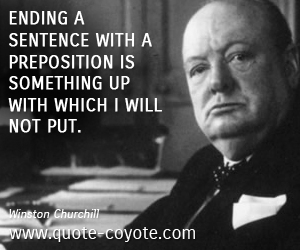
Winston Churchill quote meme

Can you end a sentence with a preposition?

Continuing from my last post, here’s another controversial grammar point.

Ending with a Preposition

Grammar-type people love to haggle over this one, and the meme above shows one of the several versions of a quote widely, but probably erroneously, attributed to Winston Churchill. No matter who really said it, the quote is perfect for making the point that in some cases you tie yourself in knots trying to avoid ending a phrase or sentence with a preposition.

The easy-to-understand sentence, “That’s something I will not put up with,” ends with the preposition “with,” and according to the rule, must be addressed in some other way. That leads you to, “That’s something with which I will not put up,” which still ends with a preposition. So you have to take one more step to reach the unwieldy, “That’s something up with which I will not put.”

As with everything in English, you can reword a thought to avoid the problem. For example, you can say, “I won’t put up with that.” Problem solved. But do you have to do that every time?

I think in some cases you should and in some it’s not necessary. In a memoir, you probably will include a lot of dialogue. Make your dialogue sound natural. A lot of grammar rules go out the window when you’re quoting people in the way they truly talk.

Apart from dialogue, let’s look at sentences that you might end with a preposition but don’t really have to. Before we start, consider that sentence you just read. It ends in “to.” Rewording that is a bit of a nightmare. No matter how many “which” devices you use, you can’t just stick the “to” somewhere else; it doesn’t work to say, “Let’s look at sentences that you might end with a preposition but to which you really don’t have” or “….a preposition but have to which you really don’t.” To avoid ending with a preposition, you would have to totally rework it. I’d say, “Let’s look at sentences that you might end with a preposition, but you can choose not to do that.”

Here are examples of sentences that you might end with a preposition but, instead, you can reposition the preposition:

  • I didn’t know which category I should place that into.
    vs.
    I didn’t know into which category I should place that.
  • I didn’t know which half I should take my slice from.
    vs.
    I didn’t know from which half I should take my slice.
  • He was head of the committee I eventually took charge of.
    vs.
    He was head of the committee of which I eventually took charge.

In all of those sentences, I would use the “which” device and avoid ending with a preposition.

I’d choose differently for the next sentences. Even though it’s not difficult to avoid ending with a preposition, I don’t think that improves the sentence. Sometimes you improve the grammar at too high a price to the language or the communication:

  • Her own situation was what she wanted to talk about.
    vs.
    Her own situation was about what she wanted to talk.
  • I know I wasn’t exactly the kind of person they were hoping for.
    vs.
    I know I wasn’t exactly the kind of person for whom they were hoping.

I would just use the first option in those sentences. In some cases, you’re dealing with an idiom of some sort. Take this:

  • I didn’t know where that comment came from.
    vs.
    I didn’t know from where that comment came.

In that sentence, too, the first option sounds more natural.

Let’s try “with” as in the meme quote:

  • They told me to bring a “plus one,” but I don’t have anyone to go with.

Sure, you could say, “…but I don’t have anyone to bring.” That’s what I would do, at least in writing. But if you’re writing a memoir from the heart, and you want to write in a natural way that ends some phrases and sentences with a preposition, I certainly will not stop you.

This whole line of thought applies when you’re talking about a clause rather than a full sentence. If you say, “I didn’t know which half I should take my slice from, so I let the other person go first,” you still have to decide where “from” goes. It’s exactly the same as if it ended the sentence.

Note to anyone who stuck with me through this long lesson: I have one more coming, and then we’ll be done with grammar for a while.

Two Controversial Grammar Points Explained

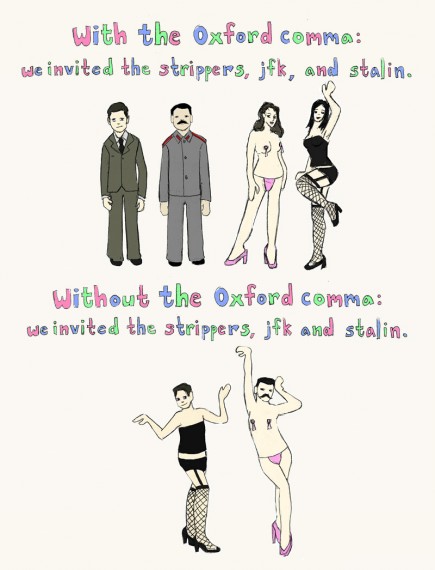
Meme demonstrating use of the Oxford comma

Breaking Some Rules You Learned in School Can Enhance Your Writing.

You might think of grammar as black and white—correct grammar and incorrect grammar and nothing in between. But some grammatical structures fall into a gray area. Maybe the thinking on them has changed over time, or there might be examples of great writing taking opposite choices. So let’s explore some tricky grammar. Here are the first two controversial grammar points, and I’ll follow up with more in the coming weeks.

Serial Comma

People keep wanting to die on this hill, typically in favor of the serial, also called the “Oxford,” comma, but some stalwarts against the damn thing stake their claim to higher ground as well. The serial comma is the comma before and when you’re naming three or more items.

Outside of the United States, the serial comma has generally been accepted as proper. But Americans, especially American journalists, have been more likely to contend that the serial comma is, at the very least, unnecessary. In “my day,” standard stylebooks advised dropping the comma, and journalism schools taught that you’re always trying to save space, even the space of a tiny punctuation mark.

But then the Internet came along, with its eclectic and global mix, and Americans saw that they were in the minority not only in the world but also among academics, who tended to go with the comma. The meme above depicting JFK, Stalin and strippers became the rallying image against the serial comma. The idea is that without the comma, JFK and Stalin become identified as the two strippers. With the comma, you’ve invited two people and an indefinite number of strippers:

We invited the strippers, JFK and Stalin.
vs.
We invited the strippers, JFK, and Stalin.

What never went viral is a meme showing how inserting the comma can create an ambiguous meaning. In the following example, JFK could be your uncle, whereas without the comma it’s clear that you’ve invited three people:

We invited my uncle, JFK, and Stalin.
vs.
We invited my uncle, JFK and Stalin.

For many years after getting my master’s degree in journalism in the U.S., I held fast to omitting the serial comma as I was taught. But when times change, I change. Today, even here in my country the serial comma has become relatively standard, and the AP Stylebook no longer bans the comma and, in fact, recommends using it in a long, complicated series. I still drop it in a short and simple series:

On my birthday, I received three cards, some makeup and a necklace.

But in anything longer or more complex, I usually throw in a comma before the and.

Sentence Fragments and Run-ons

A proper sentence requires a subject and a verb. Sometimes it’s an implied subject, as in a command. “Go away!” is a sentence with you as the implied subject.

But skilled writers do not always have to be proper in their writing. Run-on sentences and sentence fragments used to indicate a lack of sophistication. Today, they can signal just the opposite. When you break rules with knowledge and purpose, you’re molding the language to fit your writer’s voice. That’s a good strategy for developing your style. With that approach, you can justify inserting a period after a phrase that has no subject and, therefore, is not really a sentence. Or you can use the once reviled comma splice instead of a period or semicolon to create what technically is a run-on sentence.

Look at these examples of sentence fragments (in bold). I think they’re just fine within the context of their paragraphs:

My sister stared at me but said nothing. Nothing at all. She didn’t even blink.

I looked away and thought of all the things I could do. Accept the ring. Give him reasons for not accepting the ring. Tell him I still loved him. Tell him why I hated him. At least give him a hand so he could get up off his knee. Instead I walked away, slowly at first and then more quickly, not once looking back.

Let’s twist that second example and turn it into a run-on, comma-spliced sentence:

I looked away and thought of all the things I could do. I could accept the ring, tell him I still loved him, head into some imagined and unlikely sunset with him. Or I could decline his proposal, tell him why I hated him, push him to watch him fall completely to the ground. I could at least extend a hand, help him get up off his knee. But all I did was walk away, slowly at first and then more quickly, not once looking back.

I routinely use both devices—the fragment and the run-on. Fragments are the way we speak; they’re useful for connecting with the reader. With run-ons, I like the cadence of omitting the and or the or. I like the way you say it in your head when it’s a complete thought without being a proper sentence.

Come Back for More Torture

Next time, I’ll tackle ending a sentence with a preposition and using the possessive with gerunds. You don’t have to know anything about it ahead of time to understand—you’ll see!

How to Use Pronouns Correctly in Your Memoir, Part 2

Person planting white flag to show surrendering

You can avoid these four common errors in pronoun use, so don’t give up!

I’m not sure I can make a lesson in how to use pronouns correctly fun, but I hope I can make it comprehensible. Sit down. You’re going to be here a while.

Error 1: Using the subject pronoun as the object pronoun and vice versa

It’s not that either subject pronouns or object pronouns are falling out of favor. They’re all still as popular as ever, but people insert them in the wrong places. First, a reminder of which is which:

  • Subject Pronouns: I / he / she / you / we / they / it / who
  • Object Pronouns: me / him / her / you / us / them / it / whom

Subject nouns/proper nouns/pronouns cause the action. They’re the main thing. Object nouns/proper nouns/pronouns receive the action. They can be direct objects, indirect objects or objects of the preposition.

With a noun, you don’t have to know whether it’s a subject or object, because it will be the same word. The little boy started kindergarten last month. The teacher called on the little boy. The word doesn’t change until you use a pronoun:

  • She started kindergarten last month.
  • The teacher called on him.

Easy, right? You wouldn’t say, “Him started kindergarten last month,” or “The teacher called on he.”

But for some reason, when constructing a sentence with two subject pronouns or two object pronouns, people often choose one from each category. The results are wrong: “Her and I went to school together” or “The teacher called on him and I” or “The teacher called on he and me.” Sometimes both of the two pronouns come out wrong, as in “Me and her went to school together” or “The teacher called on he and I.”

Stick with all subject pronouns for the subject and all object pronouns for the object, and if “I” or “me” is one of the pronouns, put it last. The trick is to first construct the sentence with one pronoun at a time. Then you’ll choose the correct pronouns when you combine two or more.

  • She and I went to school together.
  • The teacher called on him and me.

Here are more examples to show you that it works the same way with “who” and “whom” and whether the object is a direct object, indirect object or object of the preposition:

  • I don’t know who will attend the program, but I hope it will be people to whom the information applies.
  • They and we brought the salad and dessert, so you can thank them and us for healthy greens and a sweet ending to the meal.
  • They gave her and me the notes to read, but time ran out before she and I could share them.

Notice that “you” and “it” use the same form no matter what function they serve:

  • I made dinner for you, and you brought me flowers.
  • When I read this book, it changed my life, but I still returned it to the library.

Error 2: Using an apostrophe with a possessive pronoun

Possessive pronouns never take apostrophes. Again, let’s start with identifications:

  • Possessive pronouns: mine / yours / his / hers / its / ours / theirs / whose
  • Possessive adjective pronouns: my / your / his / her / its / our / their / whose
  • Reflexive pronouns: myself / yourself / himself / herself / itself / ourselves / yourselves / themselves

Not one apostrophe on that list! If you remember just that rule of punctuation, you will avoid this common error.

Possessive nouns and proper nouns, however, do take apostrophes. Maybe that’s why so many people are confused about this. We say, “Maria’s brother will be here shortly,” “The hurricane damaged both Colin’s house and Jen’s house” and “My dog’s tail got caught in the door.” But drop the apostrophe when you replace the noun or proper noun with its pronoun substitute:

  • Her brother will be here shortly.
  • Your brother will be here shortly.
  • Whose brother will be here shortly?
  • The hurricane damaged both of their houses.
  • His tail got caught in the door.
  • Its tail got caught in the door.

There is no word “his’s,” “her’s,” “their’s” or “your’s,” but there are the words “hers,” “yours” and “theirs,” three of the possessive pronouns:

  • The wallet is his.
  • That shirt is mine.
  • This document is hers.
  • The car is ours.
  • These gifts are yours.
  • The idea was all theirs.

The word “it’s” with an apostrophe doesn’t indicate an exception to the rule of no apostrophes in possessive pronouns. This rule has no exceptions. It means that “it’s” is not a possessive but a contraction. In contractions, an apostrophe replaces one or more letters. We write “doesn’t” for “does not,” for example.

With nouns, proper nouns and pronouns, the contraction shortens words like “is” or “has,” as in “Sam’s driving very well,” or “Olivia’s received the highest honors.” You can shorten a pronoun with another word the same way:

  • You’re [you are] trying too hard.
  • We’re [we are] doing our best.
  • He’s [he is] driving very well.
  • She’s [she has] received the highest honors.
  • It’s [it is] going to be a nice day.
  • It’s [it has] been a long time since I’ve [I have] seen you.
  • Who’s [who is] coming with me?
  • Who’s [who has] been making that noise?

Test the word you’re using to see whether it’s a shortened form of two words. If you’re shortening two words and one of the words is a pronoun, that’s a contraction and you need an apostrophe. If you’re not shortening two words, then the pronoun you’re using is a possessive and you should not use an apostrophe.

Error 3: Using the object pronoun with “be” verbs

As language evolves, this rule is gradually disappearing. So it’s up to you whether you want to apply it to your writing; sometimes it makes the sentence sound awkward.

Here’s a list of “be” verbs, from the family of the infinitive “to be”: am / is / are / was / were / will be / may be / might be /ought to be / could be / would be / should be / might be / all “been” combinations

If you’re old enough to remember land line phones, you may have been taught to respond, “This is she” or “This is he” when someone asked to speak to you. That shows the correct use of the subject pronoun with a “be” verb. But it can sound wrong, especially since you now know that you should use objective pronouns in the object position. Examples of the subject pronoun with “be” verbs:

  • It might have been he who asked for help, but I don’t remember.
  • If either of us gets into trouble for this, it will be I.
  • The ones who hosted the party were we.

My best advice is to never use those constructions but also not to write the technically incorrect “it will be me” or “it might have been him.” Instead, you can switch the order and possibly simplify the sentence:

  • He might have been the one to ask for help, but I don’t remember.
  • Of the two of us, I will be the one who gets into trouble for this.
  • We hosted the party.

Error 4: Being imprecise in choosing a pronoun that ends a clause.

Don’t get thrown by the word “clause”—it just means a full thought with a subject and verb. A sentence can be a single clause or comprise two or more clauses.

For precision, you may have to draw out the sentence in your mind to determine whether to use the subject pronoun or the object pronoun. For example, would you say, “I love you more than she” or “I love you more than her”? Your decision depends on your intended meaning:

  • Don’t marry her! I love you more than she [does].
  • My ex-girlfriend? Of course I love you more than [I love] her.
  • He’s not as tall as I [am], but he plays tennis better than I [do].
  • I won’t give you as much of a raise as [I’ll give] him, but I predict that you’ll advance in the company faster than he [will].

Learn Grammar at Your Own Pace

Want more grammar and punctuation? We offer an 8-lesson grammar course that combines video instruction, quizzes and explanations. Go at your own speed.

Getting Punctuation Correct in Your Memoir

Get grammar correct - write without fear, edit without mercy.

Learn the rules once and use punctuation correctly forever.

Experts will recommend that when you sit down to write, just keep going and don’t worry about grammar or getting punctuation correct in your memoir. That’s good advice. You want the ideas to flow out of you without roadblocks that interrupt you when you’re on a good writing roll.

But that freedom at the beginning doesn’t mean you can neglect the mechanics as you polish your writing. When you go back and read what you’ve written, the editing begins, and you may find that you’re not sure about how to use commas, apostrophes and semicolons. So let’s review. I’ll try really hard to use plain English and not throw in a lot of esoteric grammatical terms.

Commas

There are so many uses of commas, and some are a matter of taste and even custom of the particular English-speaking country. I won’t list every reason to use a comma, but here are the comma’s biggest hits.

Insert a comma between two independent clauses that could be complete sentences themselves but instead are joined by a conjunction. How do you know whether they’re complete sentences? Each has a subject and a verb.
She’s writing a memoir, and she hopes to publish it traditionally through a book publishing company. Each side of that comma could be a complete sentence.

When you delete the second subject “she,” you no longer have two independent clauses and, therefore, no longer use the comma.
She’s writing a memoir and hopes to publish it traditionally through a book publishing company.

Whether you use a comma in a series is up to you. That “Oxford” or “serial” comma goes in and out of fashion. Currently, it’s in fashion.
He’s writing three books—a memoir, a novel, and a guidebook.

I’ll get a little off-topic to mention that a modern way of presenting a series lets you drop the conjunction and.
He’s writing three books—a memoir, a novel, a guidebook—and hopes to finish all of them this year.

Use a comma after a prepositional phrase that comes at the beginning of a sentence.
Before you sit down to write your memoir, make sure you have a comfortable chair and enough time to really focus.

Now I will inject a grammatical term—nonrestrictive parentheticals. That just means words that interrupt a sentence to add a fact. Since they can be deleted without changing the sentence, it makes sense that you would set off nonrestrictive parentheticals with commas.
My friend and colleague, Joe Shmo, is writing a memoir.
My friend Joe, the brother of my former coworker, is writing a memoir.

Apostrophes

The abuse of the apostrophe is well-documented, mostly in social media memes. Apostrophes are used for only two things—in the place of missing letters, which occurs in a contraction, and to indicate possession. The contraction use is the easier of the two, occurring in common words like can’t, weren’t, they’ll, you’d and I’m to shorten cannot, were not, they will, has not and I am. Common occurrences of the contraction apostrophe take the place of the i in is and the ha in has, as in:
She’s planning to throw a party when her brother’s in town, because she’s wanted her friends to meet him.

Possessives give people more trouble, probably because apostrophes are necessary in possessives except where they’re prohibited. So that’s confusing, but at least they’re prohibited only for pronouns. Possessive pronouns take no apostrophe: your, yours, my, mine, his, her, hers, our ours, their, theirs, its, whose. For all other nouns and proper nouns, use an apostrophe to indicate possession. Here’s how it works:
My son’s gloves and my daughter’s scarf are missing, but their coats are right here next to yours and mine.

Two especially confusing words are it and who, which are pronouns and follow the rule of not taking an apostrophe when they’re used as possessives, but remember that they do need the apostrophe when they’re part of the contraction it is, it has, who is or who has:
My memoir’s nearly finished, and it’s [contraction: it has] been a great experience working on each of its [possessive: belonging to it] chapters. Who’s [contraction: who is] going to read it? I hope my memoir will resonate with everyone whose [possessive: belonging to whom] life has had challenges to overcome.

Semicolons

When the semicolon is used incorrectly, the error typically is that it’s used where a comma should be. The only time commas and semicolons are interchangeable is in a long or complex series. You can choose to write this sentence with either commas or semicolons:
I hope to study a variety of subjects, including creative writing, European and Asian history, earth science and biology, sociology, accounting, and Spanish language and culture.
I hope to study a variety of subjects, including: creative writing; European and Asian history; earth science and biology; sociology; accounting; and Spanish language and culture.
Notice that I inserted a colon in the second example, because when you use semicolons in that series it’s traditional to introduce the series with a colon.

The other common use of the semicolon is to replace not a comma but a period. When you have two sentences that relate closely to each other, you can choose to separate them with a semicolon instead of a period:
I’m writing my memoir; I hope to finish by June.
Another option is to connect the two sentences with a comma followed by and. The error people tend to make is to use the semicolon when one of the parts is not a complete sentence—that is, it doesn’t have its own subject and verb.

Feel Like Taking a Course?

Then there are dashes, hyphens, colons, parentheses—let’s save those goodies for another day. Or, hey, I’ll plug our grammar course, available right here on Write My Memoirs. It’s just $59 and covers not only punctuation but verb issues, agreement challenges, word mixups and more.

Grammar in Memoirs: What Are Flat Adverbs?

list of flat adverbs in squashed font

I learn a lot about people’s current grammar concerns from the Facebook page “Grammar Matters,” which I help to admin. Recently someone asked why adverbs are being sloppily replaced by adjectives. Examples:

  • Drive slow.
  • Act quick.
  • Play safe.
  • And the kicker: You did amazing.

The complaint was that the “ly” is missing. The word answers the question “how,” which calls for an adverb. How should I drive? How should I act? How should I play? How did I do? These people wanted the adjectives slow, quick, safe and amazing replaced by the adverbs slowly, quickly, safely and amazingly so that the phrases would read: drive slowly, act quickly, play safely, you did amazingly.

But it’s not as simple as that.

Adjectives vs. Flat Adverbs

“They’re not adjectives,” other members of the page schooled the complainers. “Those are flat adverbs.”

According to the MacMillan Dictionary Blog, “flat adverbs may sound less formal, but grammatically they’re fine.” The blogger explains it further:

“Indeed, flat adverbs have a venerable history. Centuries ago in Old English, they were marked by inflections (usually –e), which were gradually dropped. This left the adverbs resembling adjectives, so –ly was sometimes added to mark them more explicitly as adverbs again. And so we ended up with pairs like bright and brightly, slow and slowly, soft and softly, wrong and wrongly.”

Keep in mind that flat adverbs are also adjectives. You are a “safe driver”—here, safe is an adjective describing the noun driver. The blogger further notes that the pairs are “sometimes interchangeable (drive safe/safely); in other cases their meanings have diverged, as with late and lately, right and rightly, hard and hardly. We might kick a ball hard, but if we hardly kick it we mean something quite different. Sometimes one form appears in certain idioms and expressions while the other form does duty elsewhere.”

Our Approach to Flat Adverbs

At Write My Memoirs, do we think that flat adverbs have earned their place in formal writing and, specifically for our purposes, in memoir writing? As you may know from taking our Writing and Grammar Course, we approach formal writing pragmatically. We apply grammar rules as they are generally regarded by people who make it a point to use proper grammar. That means people who know just enough about grammar but not more than that.

What do we mean by that? Flat adverbs are a good example. Most people who believe they use proper grammar will prefer drive slowly or shine brightly, choosing the traditional adverb safely over the flat adverb safe. So our editors at Write My Memoirs advise writers to mostly avoid flat adverbs. However, if you’re writing dialogue, you did amazing might sound more natural than you did amazingly so, in that case, you might want to choose the flat adverb.

English grammar is always a moving target!

Memoir Writing Tip: Avoid Parentheses

Meme about use of parentheses

No matter how you’re structuring your memoir, I can predict one thing about it: you don’t need parentheses to write a good memoir.

Now, I’m not talking about brackets, which look like this: [ ]. In academic writing and for other reasons, you may need to use brackets. Let’s say you’re quoting a note someone wrote to you, and you want the reader to know that the word spelled incorrectly is from the original note rather than your typo. To indicate that, after the word you can use: [sic].

But ordinary parentheses look like this: ( ). They come in handy when you’re trying to give the reader information pertinent enough to include at that moment of reading but extraneous enough that it sort of interrupts the flow. Enclosing that information within parentheses lets the reader know that you are aware it’s not directly related to what they just read.

Why Writers Use Parentheses

Memoir authors and other writers use parentheses for one of three bad reasons:

  1. The information is essential, but the writer is trying to wedge it into the wrong spot. This is lazy writing. As you’re writing, something has come to mind that is tangentially related to the topic at hand, but it would work much better somewhere else.
  2. The information is so non-essential that it doesn’t belong in the book at all. You’re indulging yourself with something you want to include that has little to do with the narrower memoir topic.
  3. The writer is just a parentheses person, and the parentheses serve as a crutch. We all tend to have our go-to punctuation, whether it’s an em dash, a semicolon, a comma, or parentheses. By relying heavily on em dashes and parentheses to set off phrases and clauses, you’re just revealing that you don’t know how to use commas. I admit to being a fan of what these days has become the hardworking em dash; I also like mixing it up and not relying on the same punctuation all the time. But so often parentheses and em dashes are the writer’s way of not having to figure out where commas would go.

Examples of Parentheses

When I google examples of parentheses use, I see sentences that I would edit to drop the parentheses. So let’s do that exercise together. I’m taking these examples either verbatim or edited from grammar.monster.com and grammar.yourdictionary.com. I have nothing against these websites; they’re just two that came up in my search.

Here’s a justified use of parentheses for some audiences, although it can be condescending if the target reader already knows the explanation. The information contained within the parentheses gives a quick explanation without taking up its own sentence:
Sometimes numerals (1, 2, 3) are used instead of writing out the numbers (one, two, three).

Often, you can’t express the thought as succinctly without the parentheses. Still, unless you’re under a restrictive word count, I don’t consider that a good enough reason to use the parentheses.
I got a great deal on a used camper (just $500).
I would rewrite it:
At just $500, the used camper I bought was a great deal.
Or:
I got a great deal on a used camper, which cost me just $500.
Even the em dash works better, I think:
I got a great deal on a used camper—just $500.

Take this quote from H.L. Mencken:
The whole aim of practical politics is to keep the populace alarmed (and hence clamorous to be led to safety) by menacing it with an endless series of hobgoblins, all of them imaginary.
This is the use I see the most. All it does is avoid commas or using two sentences instead of one. Why? I have no idea. Mencken sticks “hence” in there, which connects the parenthetical to the rest of the sentence. Why also set it off so dramatically? Another problem is that “hence” should be enclosed in commas. I would edit it to be:
The whole aim of practical politics is to keep the populace alarmed and, hence, clamorous to be led to safety by menacing it with an endless series of hobgoblins, all of them imaginary.

One last example:
This month’s sales figures are sure to wow you. (Chances are, you’ll be really impressed.)
Oh, come on! Repeating what you just said in a new way is the worst reason to use parentheses. The parentheses mean you’re admitting that the sentence is completely unnecessary.

I urge you to look over your memoir and see whether you can eliminated any parentheses. I bet you’ll find at least a few instances.

Like these tips? You’ll love our grammar course. Just $39.

Grammar Help: Subjunctive/Conditional Tense

As we get closer to offering a complete online grammar course here at Write My Memoirs, I want to give you a sneak peek at some of the topics we’ll be covering. The subjunctive tense, also called the conditional tense, is a minor grammar point in real life and conversation. But when you put your name as author on a book, you want your words to reflect current best practices in grammar and writing. So let’s go over this.

The subjunctive tense is a verb tense just like present, past and future. Instead of concerning a time perspective, however, the subjunctive tense applies to any hypothetical situation. Typically, you can identify a hypothetical situation by the use of a word like “if,” “suppose” or “imagine.” When you’re just imagining something might occur, or you’re wondering whether it could happen, rather than the singular “was” you should use the past tense plural “were” to construct this type of sentence, even when the subject is singular.

Probably the most easily recognized example is the phrase, “If I were you.” In any other context, you’d pair the singular pronoun “I” with the verb “was” to indicate past tense. You’d say, “I was going to ask you a question,” or “I was happy that we had a nice day for the picnic.” It’s not natural to say “I were…,” but it does sound natural in the phrase “If I were you” because it’s correct. You’re imagining “if I were you.” If it’s not hypothetical, you’d say, “I’m pretty sure that I was you in my past life.” In that case, you’re stating an assumption, not posing a hypothetical. Another recognizable example of the correct construction is the song from Fiddler on the Roof, “If I Were a Rich Man.”

So if I were going to make sure I learned the finer points of grammar, I would practice the conditional/subjunctive tense. Suppose a man were to sign up on Write My Memoirs, and imagine that a woman were intending to do the same—they both would be welcome here, where correct grammar is always appreciated!


My “Strongly-Expressed” Mandate: No Hyphens After Adverbs!

Sometimes a grammar error seems to catch on as if it’s contagious. I suppose people see something in writing, think they’ve been doing it wrong and obliviously copy the error. This is how these epidemics spread. I’ll begin to notice the error more often and in more respectable places, and then finally just about everywhere. We all have our grammar pet peeves, and mine intensify when the error starts to blanket the universe. This is currently happening with hyphens following adverbs.

The key term in this blog’s headline, Strongly-Expressed, provides the example of the erroneously inserted hyphen. Strongly is an adverb, and an adverb’s entire job is to modify. That’s what adverbs do. They modify verbs, adjectives and other adverbs. Sometimes they modify an entire clause. They don’t need a hyphen to do their job. Let’s stuff a sentence with adverbs and see what we have:

Luckily, a genuinely nice person found Lola’s wildly colorful jacket and very kindly immediately returned it to her before Lola had a chance to miss it too desperately or to sob uncontrollably at discovering it inexplicably gone.

Luckily: modifies the clause that follows
Genuinely: modifies the adjective nice. How nice? Genuinely nice.
Wildly: modifies the adjective colorful. How colorful? Wildly colorful.
Very: modifies the adverb kindly. How kindly? Very kindly.
Kindly: modifies the verb returned. How was it returned? Kindly.
Immediately: modifies the verb returned. How else was it returned? Immediately.
Too: modifies the adverb desperately. How desperately? Too desperately.
Desperately: modifies the verb miss. Miss in what way? Desperately.
Uncontrollably: modifies the verb sob. Sob in what way? Uncontrollably.
Inexplicably: modifies the verb missing. In what way was it gone? Inexplicably.

The error of my obsession occurs when the adverb modifies an adjective. In the sample sentence, the error would be to write “a genuinely-nice person” and “her wildly-colorful jacket.” That hyphen is not just unnecessary; it’s wrong. My guess is that it grew from the correct construction of hyphenating a two-word thought with an adjective or noun as the first word. I just did that—two-word. Here’s a sentence full of word duos with correct hyphens:

We typically arrive at each data-driven decision after a late-night, full-team, anxiety-filled session that leaves all of us mentally exhausted and emotionally drained but more closely knit within our committee as well as able to forge close-knit ties to the greater community.

In that example, the first word of the hyphenated pairs is either an adjective or a noun, whereas there is no hyphenation in mentally exhausted and emotionally drained, because in both cases an adverb is modifying a verb. I used both closely knit and close-knit to further illustrate the distinction.

If you go around hyphenating adverb-starting word pairs, I’m begging you to please stop. If you’re wondering whether the hyphen is correct and you should start using it, the answers are no and no. If I’m telling you something you already know and you would never insert a hyphen after an adverb, thank you so much and keep up the good work!

Login

Then just set up a chapter and start writing your memoir. Don’t worry about rules. There are no rules to writing your memoir; there are only trends. These trends are based on techniques and features identified in current top-selling memoirs. At best, they’re the flavor of the month. If you’re capturing your life in print for your family, for your own gratification or to inspire readers, rather than aiming to set off Hollywood screenplay bidding wars, these trends don’t even apply to you. You’ll write the memoir that suits you best, and it will be timeless, not trend-driven.There are no rules, but there are four steps:

1. Theme/framework
2. Writing
3. Editing/polishing
4. Self-publishing

You’ve researched this, too, and you’ve been shocked at the price for getting help with any one of those steps, much less all four. That’s because most memoir sites promise to commercialize your work. They’ll follow a formula based on current memoir trends, because they want to convince you that they can turn your memoir into a best-seller. These sites overwhelm you with unnecessary information not to help you, the memoir author, but to address Search Engine Optimization (SEO) algorithms so they can sell more.

That’s not what we do at Write My Memoirs. Our small community of coaches, writers and editors are every bit as skilled as any you’ll find, and we charge appropriately for their expertise and the time they’ll spend helping you craft a compelling, enjoyable read. But you won’t pay an upcharge for other websites’ commercialization, the marketing that follows, and the pages of intimidating “advice.” You can sell your book if you like—we have ISBNs available for you—but our organic process of capturing your story takes a noncommercial path.

If you want help with any or all of the four steps above, choose from our services or save money by selecting one of our packages. If you’d like to talk about what’s right for you, schedule a call. One year from now, you can be holding your published memoir in your hand. And at that point, it will be a big deal!