
We are experiencing issues with our Contact form.
Please Email Us Directly at: Su*****@************rs.com.

Every ordinary life story is extraordinary!

PLEASE NOTE:

oUR CONTACT US Form HAD A MALFUNCTION.
IF YOU HAVEN’T RECEIVED A REPLY, PLEASE FILL IT OUT AGAIN OR WRITE US DIRECTLY.

Every ordinary life story is extraordinary!

How to Use Pronouns Correctly in Your Memoir, Part 2

Person planting white flag to show surrendering

You can avoid these four common errors in pronoun use, so don’t give up!

I’m not sure I can make a lesson in how to use pronouns correctly fun, but I hope I can make it comprehensible. Sit down. You’re going to be here a while.

Error 1: Using the subject pronoun as the object pronoun and vice versa

It’s not that either subject pronouns or object pronouns are falling out of favor. They’re all still as popular as ever, but people insert them in the wrong places. First, a reminder of which is which:

  • Subject Pronouns: I / he / she / you / we / they / it / who
  • Object Pronouns: me / him / her / you / us / them / it / whom

Subject nouns/proper nouns/pronouns cause the action. They’re the main thing. Object nouns/proper nouns/pronouns receive the action. They can be direct objects, indirect objects or objects of the preposition.

With a noun, you don’t have to know whether it’s a subject or object, because it will be the same word. The little boy started kindergarten last month. The teacher called on the little boy. The word doesn’t change until you use a pronoun:

  • She started kindergarten last month.
  • The teacher called on him.

Easy, right? You wouldn’t say, “Him started kindergarten last month,” or “The teacher called on he.”

But for some reason, when constructing a sentence with two subject pronouns or two object pronouns, people often choose one from each category. The results are wrong: “Her and I went to school together” or “The teacher called on him and I” or “The teacher called on he and me.” Sometimes both of the two pronouns come out wrong, as in “Me and her went to school together” or “The teacher called on he and I.”

Stick with all subject pronouns for the subject and all object pronouns for the object, and if “I” or “me” is one of the pronouns, put it last. The trick is to first construct the sentence with one pronoun at a time. Then you’ll choose the correct pronouns when you combine two or more.

  • She and I went to school together.
  • The teacher called on him and me.

Here are more examples to show you that it works the same way with “who” and “whom” and whether the object is a direct object, indirect object or object of the preposition:

  • I don’t know who will attend the program, but I hope it will be people to whom the information applies.
  • They and we brought the salad and dessert, so you can thank them and us for healthy greens and a sweet ending to the meal.
  • They gave her and me the notes to read, but time ran out before she and I could share them.

Notice that “you” and “it” use the same form no matter what function they serve:

  • I made dinner for you, and you brought me flowers.
  • When I read this book, it changed my life, but I still returned it to the library.

Error 2: Using an apostrophe with a possessive pronoun

Possessive pronouns never take apostrophes. Again, let’s start with identifications:

  • Possessive pronouns: mine / yours / his / hers / its / ours / theirs / whose
  • Possessive adjective pronouns: my / your / his / her / its / our / their / whose
  • Reflexive pronouns: myself / yourself / himself / herself / itself / ourselves / yourselves / themselves

Not one apostrophe on that list! If you remember just that rule of punctuation, you will avoid this common error.

Possessive nouns and proper nouns, however, do take apostrophes. Maybe that’s why so many people are confused about this. We say, “Maria’s brother will be here shortly,” “The hurricane damaged both Colin’s house and Jen’s house” and “My dog’s tail got caught in the door.” But drop the apostrophe when you replace the noun or proper noun with its pronoun substitute:

  • Her brother will be here shortly.
  • Your brother will be here shortly.
  • Whose brother will be here shortly?
  • The hurricane damaged both of their houses.
  • His tail got caught in the door.
  • Its tail got caught in the door.

There is no word “his’s,” “her’s,” “their’s” or “your’s,” but there are the words “hers,” “yours” and “theirs,” three of the possessive pronouns:

  • The wallet is his.
  • That shirt is mine.
  • This document is hers.
  • The car is ours.
  • These gifts are yours.
  • The idea was all theirs.

The word “it’s” with an apostrophe doesn’t indicate an exception to the rule of no apostrophes in possessive pronouns. This rule has no exceptions. It means that “it’s” is not a possessive but a contraction. In contractions, an apostrophe replaces one or more letters. We write “doesn’t” for “does not,” for example.

With nouns, proper nouns and pronouns, the contraction shortens words like “is” or “has,” as in “Sam’s driving very well,” or “Olivia’s received the highest honors.” You can shorten a pronoun with another word the same way:

  • You’re [you are] trying too hard.
  • We’re [we are] doing our best.
  • He’s [he is] driving very well.
  • She’s [she has] received the highest honors.
  • It’s [it is] going to be a nice day.
  • It’s [it has] been a long time since I’ve [I have] seen you.
  • Who’s [who is] coming with me?
  • Who’s [who has] been making that noise?

Test the word you’re using to see whether it’s a shortened form of two words. If you’re shortening two words and one of the words is a pronoun, that’s a contraction and you need an apostrophe. If you’re not shortening two words, then the pronoun you’re using is a possessive and you should not use an apostrophe.

Error 3: Using the object pronoun with “be” verbs

As language evolves, this rule is gradually disappearing. So it’s up to you whether you want to apply it to your writing; sometimes it makes the sentence sound awkward.

Here’s a list of “be” verbs, from the family of the infinitive “to be”: am / is / are / was / were / will be / may be / might be /ought to be / could be / would be / should be / might be / all “been” combinations

If you’re old enough to remember land line phones, you may have been taught to respond, “This is she” or “This is he” when someone asked to speak to you. That shows the correct use of the subject pronoun with a “be” verb. But it can sound wrong, especially since you now know that you should use objective pronouns in the object position. Examples of the subject pronoun with “be” verbs:

  • It might have been he who asked for help, but I don’t remember.
  • If either of us gets into trouble for this, it will be I.
  • The ones who hosted the party were we.

My best advice is to never use those constructions but also not to write the technically incorrect “it will be me” or “it might have been him.” Instead, you can switch the order and possibly simplify the sentence:

  • He might have been the one to ask for help, but I don’t remember.
  • Of the two of us, I will be the one who gets into trouble for this.
  • We hosted the party.

Error 4: Being imprecise in choosing a pronoun that ends a clause.

Don’t get thrown by the word “clause”—it just means a full thought with a subject and verb. A sentence can be a single clause or comprise two or more clauses.

For precision, you may have to draw out the sentence in your mind to determine whether to use the subject pronoun or the object pronoun. For example, would you say, “I love you more than she” or “I love you more than her”? Your decision depends on your intended meaning:

  • Don’t marry her! I love you more than she [does].
  • My ex-girlfriend? Of course I love you more than [I love] her.
  • He’s not as tall as I [am], but he plays tennis better than I [do].
  • I won’t give you as much of a raise as [I’ll give] him, but I predict that you’ll advance in the company faster than he [will].

Learn Grammar at Your Own Pace

Want more grammar and punctuation? We offer an 8-lesson grammar course that combines video instruction, quizzes and explanations. Go at your own speed.
How to Use Pronouns Correctly in Your Memoir, Part 1

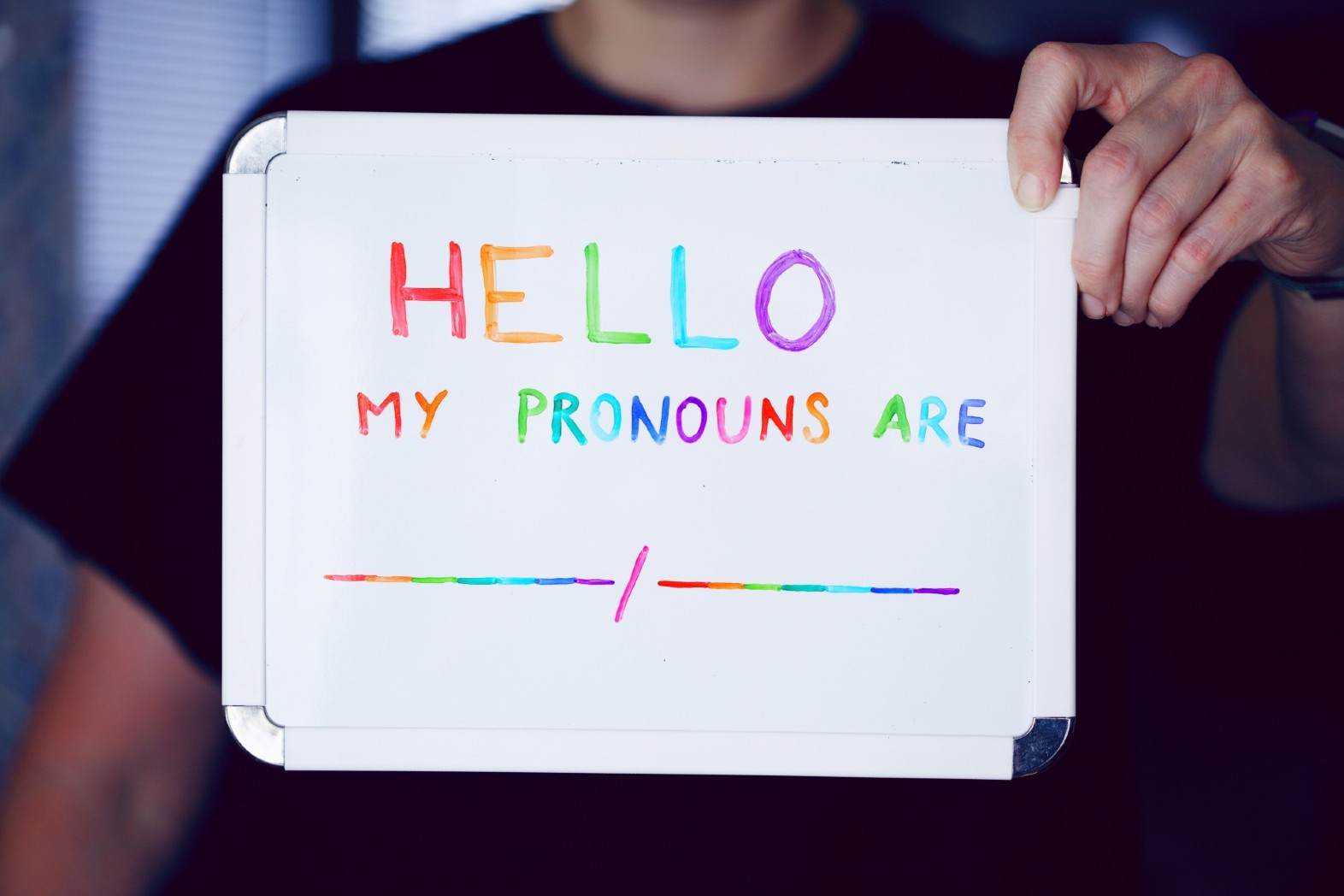
"Hello" badge announcing personal pronouns

The toughest part of speech is trickier than ever.

If you’re a writer, you may go through life cringing in public or constantly yelling at the TV, especially at unscripted reality shows and sometimes even the news. You’re correcting all of the “him and I” and “she and me” references. You’re rolling your eyes at “just between you and I.” You’re punching your monitor at “your” to mean “you’re.” Misuse of pronouns has become epidemic to the point that even though you’re a writer, you may be unsure of how to use pronouns correctly.

That’s okay, no judgment, especially since the option of the plural “they” as a singular personal pronoun has added a wrinkle to the whole business. Let’s tackle that first, starting with a history lesson.

The Absence of “Her”

Did you know that there used to be a gender-neutral singular pronoun? It was he/him/his. The masculine singular was considered the proper choice when the gender wasn’t known and with an indefinite pronoun such as everyone, nobody, or anyone. You’ve heard, “He who is without sin cast the first stone”? That’s the bible being male-centric.

Back then we would write:

  • Everyone who wants a cookie should raise his hand.
  • If you know anyone who’d like to join us, please invite him.
  • Nobody wants the car he drives to smell like old cheese.
  • I heard that someone came forward, saying he was an eyewitness.

This thinking also came with sayings like “every man for himself,” “man of the hour,” “teach a man to fish” and “dead men tell no lies.” When males were creating the sayings, there was not much thought to including females. So they decided that the male pronoun would be fine for all living beings. And I mean no offense to the bible, because this went on long after biblical times.

Then the women’s movement came along and introduced the concept of replacing “mailman” with “letter carrier,” “chairman” with “chairperson” and so forth until the conversation got around to pronouns. For a while, the feminists among us seemed to settle on some variation of these:

  • Everyone who wants a cookie should raise his or her hand.
  • If you know anyone who’d like to join us, please invite him/her.
  • Nobody wants the car s/he drives to smell like old cheese.
  • I heard that someone came forward, saying he/she was an eyewitness.

“Their” First Go-round

The “s/he” option doesn’t work in verbal communication, but it didn’t matter because people in general weren’t going with any of these clunky, cumbersome usages. But they weren’t using masculine-only pronouns, either. All along, there was some precedent and much will for using the plural they/them/their as the singular pronoun when a gender-neutral need arose:

  • Everyone who wants a cookie should raise their hand.
  • If you know anyone who’d like to join us, please invite them.
  • Nobody wants the car they drive to smell like old cheese.
  • I heard that someone came forward, saying they were an eyewitness.

Note that “they” in this construction takes the singular “an eyewitness.” That would change in a sentence with a plural noun:

  • I heard that several people came forward, saying they were eyewitnesses.

Educated Guesses

Grammarians never accepted the plural followup pronoun to a singular noun, proper noun or indefinite noun. The singular everyone should take the singular his or the singular her, they reasoned. Some language hobbyists, or perhaps pedants, even continued to use the old-fashioned one and one’s:

  • If one wants a cookie, one should raise one’s hand.
  • One does not want the car one drives to smell like old cheese.

As you can imagine, that construction did not catch on with the modern masses.

I remember Parenting magazine assigning either he/him/his or she/her/her to each article and then being consistent throughout that article. So it appeared as if some articles were written about parenting sons and some about parenting daughters. The words “baby” and “child” are gender-neutral until you have to follow up with a pronoun!

Female pronouns always were used when the writer or speaker knew the person was a woman. You could write or say:

  • The pediatrician handed the prescription to her assistant.
  • Our discussion leader was knowledgeable in her subject.
  • The student stated her name and took her seat.

At that time, with a subject like “nurse,” the writer would most likely assume that “she” and “her” were the most appropriate pronouns. That was the exception to always selecting the male pronoun for an unknown gender, and it was insulting. “Teacher” might be followed by a female pronoun, while “professor” would take the male.

Pronouns for Gender Identity

That’s the way things stood for quite a few years. Those who fancied themselves users of proper English grammar followed singular nouns with some form of singular pronoun, while the rest of the people used the plural and casual they/them/their.

Then gender identity entered the discussion, with people sharing their preferred personal pronouns and some asking to be identified by “they/their/them” as a nonbinary option. That legitimized the use of the plural pronoun to refer to a singular noun, so grammarians took another look at the option that already was the most popular in speaking, if not writing. Here it is again to remind you:

  • Everyone who wants a cookie should raise their hand.
  • If you know anyone who’d like to join us, please invite them.
  • Nobody wants the car they drive to smell like old cheese.
  • I heard that someone came forward, saying they were an eyewitness.

Is that acceptable now? You know what? Yes. It solves the problem so handily. It’s fast and dirty, yet also clean in terms of simple, intuitive and easily understood.

In formal writing, though, I’m still hesitant to use plural pronouns with singular nouns and proper nouns unless I’m referring to someone who I know uses the personal pronouns they/them/their. I admit that I got sucked into “he or she” and “him/her” for a while. Mostly, though, I’ve always tried to avoid the problem. I use plural subjects so that I can use plural pronouns, I get familiar and employ the second-person “you” and “your,” which conveniently are both singular and plural, and I even use passive tense to skirt the issue. Also, don’t underestimate the power of the word “a” to replace a pronoun.

Plural noun, plural pronoun:

  • People who want cookies should raise their hand.
  • If you know people who’d like to join us, please invite them.
  • No drivers want the cars they drive to smell like old cheese.

Second-person word instead of third-person word:

  • If you want a cookie, please raise your hand, or
  • All of you who want a cookie should raise your hand, or
  • Raise your hand if you want a cookie.
  • You do not want the car you drive to smell like old cheese.

Passive voice:

  • Anyone who wants to join us should be invited by you.
  • A car smelling like old cheese is not desired by anyone.

Replacing a pronoun with “a” and other rewording:

  • Raise a hand to receive a cookie.
  • I’ll hand out cookies to everyone with a raised hand.
  • Please invite anyone who’d like to join us.
  • Nobody wants a car smelling like old cheese.
  • Old cheese is not the best odor for a car.

Plural Pronouns for the Unknown

I still use those strategies to try to avoid the problem, but there are times I now use they/them/their even when not writing or speaking about a person who has shared their personal pronoun to be “they/them/their.” See what I did in that sentence? I wrote “their personal pronoun” following up the singular “a person.” I do that now, but I especially did it to demonstrate the case of knowing the person’s preferred identity.

Now the hardest question: What if you’re naming someone specific but you don’t know the person’s preferred pronouns? And see what I just did with that sentence. I repeated “the person’s” rather than using “their.” It avoids the issue. But you can’t keep repeating the noun or proper noun and never use a pronoun. Here’s an example:

  • I spoke with the new teacher over the phone, and the new teacher said the new teacher’s name was Terry. That’s all I know about the new teacher.
  • I spoke with the new teacher over the phone, and they said their name was Terry. That’s all I know about them.

In that case, let’s say you couldn’t tell much by the voice and have no idea what the new teacher looks like. But now let’s change that and say you met the new teacher in person, and the person appeared to be a woman. Should you stick with the above “they/their/them,” or should you say:

  • I met the new teacher, and she said her name is Terry. That’s all I know about her.

This is a tough call. Your interpretation that the person looks like a woman and then your decision that the person will prefer she/her/her are just assumptions. I think it’s still most respectful to figure out another way to say it. Language gives you so many options:

  • I met the new teacher, introduced to me as Terry. That’s all I know about the teacher.
  • I met Terry, the new teacher. I don’t know anything other than the name.

On this Topic, Memoir Writing Is Easy

Luckily, in writing a memoir you won’t have a lot of these problems. Mainly I want to tell you that if you find yourself cornered into using they/them/their with a singular noun, proper noun or indefinite pronoun, you probably can go ahead and use that plural. But if you can reword it, in my view, do that instead.

Part 2 will address pronouns in general, since even before this issue they were a pain in the neck.

Login

Then just set up a chapter and start writing your memoir. Don’t worry about rules. There are no rules to writing your memoir; there are only trends. These trends are based on techniques and features identified in current top-selling memoirs. At best, they’re the flavor of the month. If you’re capturing your life in print for your family, for your own gratification or to inspire readers, rather than aiming to set off Hollywood screenplay bidding wars, these trends don’t even apply to you. You’ll write the memoir that suits you best, and it will be timeless, not trend-driven.There are no rules, but there are four steps:

1. Theme/framework
2. Writing
3. Editing/polishing
4. Self-publishing

You’ve researched this, too, and you’ve been shocked at the price for getting help with any one of those steps, much less all four. That’s because most memoir sites promise to commercialize your work. They’ll follow a formula based on current memoir trends, because they want to convince you that they can turn your memoir into a best-seller. These sites overwhelm you with unnecessary information not to help you, the memoir author, but to address Search Engine Optimization (SEO) algorithms so they can sell more.

That’s not what we do at Write My Memoirs. Our small community of coaches, writers and editors are every bit as skilled as any you’ll find, and we charge appropriately for their expertise and the time they’ll spend helping you craft a compelling, enjoyable read. But you won’t pay an upcharge for other websites’ commercialization, the marketing that follows, and the pages of intimidating “advice.” You can sell your book if you like—we have ISBNs available for you—but our organic process of capturing your story takes a noncommercial path.

If you want help with any or all of the four steps above, choose from our services or save money by selecting one of our packages. If you’d like to talk about what’s right for you, schedule a call. One year from now, you can be holding your published memoir in your hand. And at that point, it will be a big deal!