We are experiencing issues with our Contact form.
Please Email Us Directly at: Su*****@************rs.com.

Every ordinary life story is extraordinary!

PLEASE NOTE:

oUR CONTACT US Form HAD A MALFUNCTION.
IF YOU HAVEN’T RECEIVED A REPLY, PLEASE FILL IT OUT AGAIN OR WRITE US DIRECTLY.

Every ordinary life story is extraordinary!

Faith in Memoir

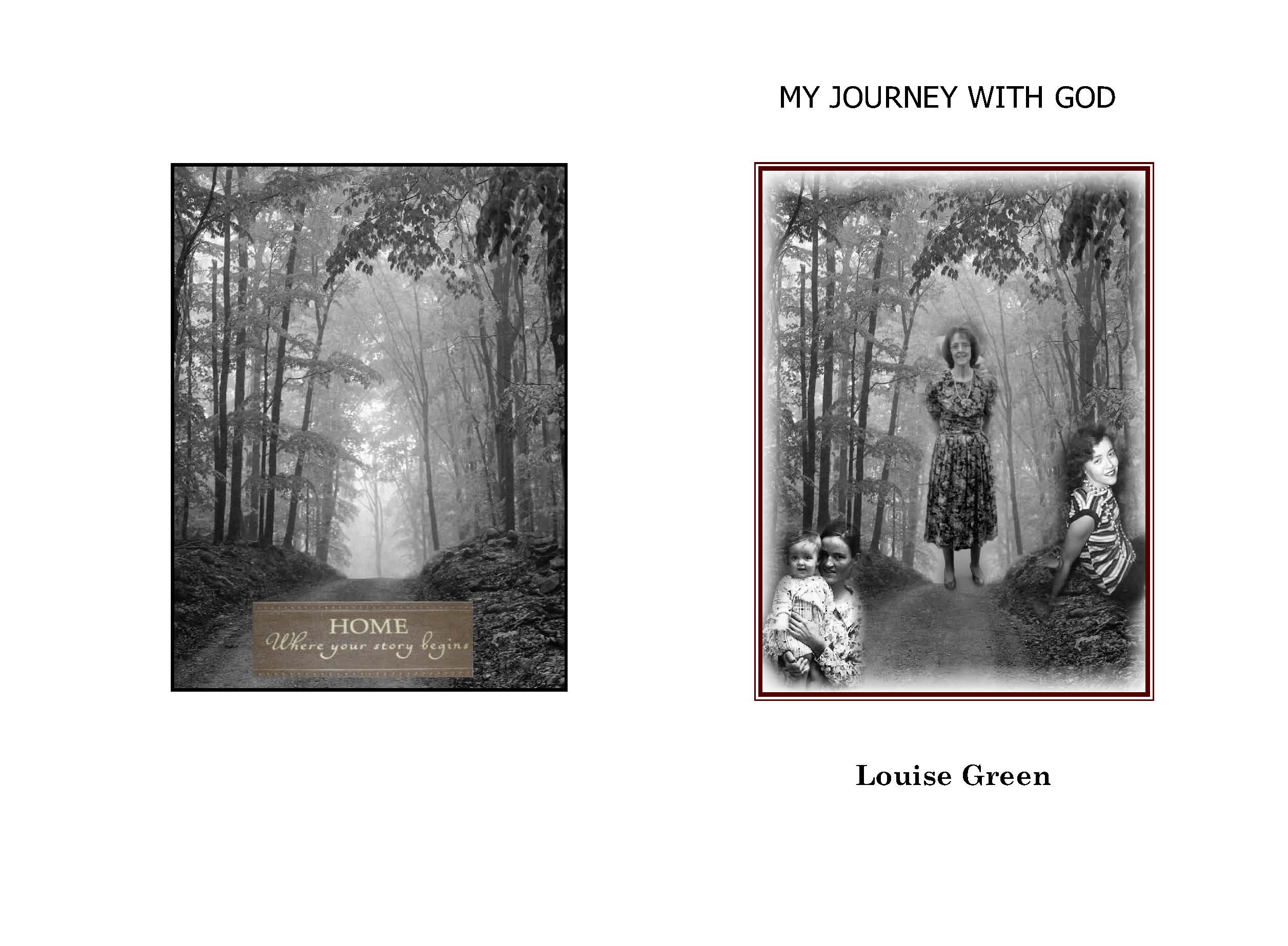
Front and back covers of "My Journey with God"

Religion and spirituality are big topics for self-reflection.

One of the first books I helped someone self-publish through Write My Memoirs falls into a category of a faith or spiritual memoir. Titled “My Journey With God,” it was more of an autobiography than a memoir, covering the author’s full, not terribly unusual, life. When I asked the author what motivated her to write the book, she said her way of publicly thanking God for a good life was to celebrate faith in memoir form. The book’s front and back cover appear above.

Gratitude in Memoir

This was a revelation for me. Of all the reasons to write a memoir, I had not considered that one. But I get it—it’s a type of gratitude journal. Some authors chronicle their faith journeys and perhaps lead readers along a similar path. There’s a whole Christian book publishing industry built around this concept, and those publishing companies can provide publishing opportunities for authors whose manuscripts may get rejected elsewhere.

In Faith Unraveled: How a Girl Who Knew All the Answers Learned to Ask Questions, author Rachel Held Evans writes about straying from her Christian fundamentalist roots before recommitting to God with an approach that she found more adaptable to her life. In the recently released Mostly What God Does: Reflections on Seeking and Finding His Love Everywhere, Samantha Guthrie of NBC’s “Today Show” uses personal essays of questioning and searching to open readers’ hearts and minds to a life exploring faith.

God as Redeemer

It makes sense that religion pops up often in memoirs, since it plays a role in many lives. Sometimes, it’s the memoir’s main topic or shares the limelight as the solution half of a problem/solution memoir. One of the earliest and best-known accounts, from 1948, is The Seven Storey Mountain: A Journey of Faith and Transformation, Exploring Vulnerability, Forgiveness, and the Quest for Spiritual Fulfillment in the Midst of a Turbulent World by Thomas Merton, who became a Trappist monk and guided readers toward spiritual reward. More recently, both Wired for God: Adventures of a Jewish Yogi by Dani Antman and Native: Identity, Belonging, and Rediscovering God by Kaitlin B. Curtice discuss the intersection between religious roots and the yearning for broader spirituality.

The author’s story of redemption is a popular theme in memoirs, and here, too, religion can enter the discussion when the author talks about overcoming illness, abuse or other adversity. Lacey Buchanan’s Through the Eyes of Hope: Love More, Worry Less, and See God in the Midst of Your Adversity, published in 2017, credits God for the strength to face her life’s challenges. Her son was born with a rare medical condition.

Religious Exposés

Religion in memoir is not always presented with gratitude. One trend in memoir is exposing abuse disguised as, or excused through, religious devotion. The best-selling memoir Educated presents author Tara Westover’s experiences with her family’s variety of Mormonism in quite an unflattering light. The truth behind the facade presented by television’s religious Duggar family is revealed in Counting the Cost by Jill Duggar, Derick Dillard and Craig Borlase.

The Inner Circle Book One: My Seventeen Years in the Cult of the American Sikhs, a 2021 memoir by Peter MacDonald Blachly, similarly traces the author’s experiences inside a cult-like religious group. In Devout: A Memoir of Doubt by Anna Gazmarian, published earlier this year, the author does not condemn her evangelical Christian upbringing, but she shows how she struggled to retain her spirituality while diagnosed with bipolar disorder and dealing with a medical community that did not easily fit within her religion’s parameters.

Part of Life

When not the memoir’s primary focus, religion still can bring a valuable dimension to the story. In her 2003 memoir, Leap of Faith: Memoirs of an Unexpected Life, Queen Noor of Jordan writes about her life as an American who married Jordan’s King Hussein. She addresses family life, her views of historical events, and her humanitarian efforts, and she drops a lot of famous names of people she’s met. But for readers to fully understand her life, she also discusses her Muslim faith and the way she blended her American upbringing with her life as a member of a prominent Middle Eastern monarchy.

Happy Holidays to You, Readers!

If you’re incorporating faith into your memoir, this time of year gives you a good opportunity to get in close touch with your feelings. And whether or not you have faith in your memoir or in your life, I wish you the happiest of holiday seasons.

Story Example for Memoir Writers

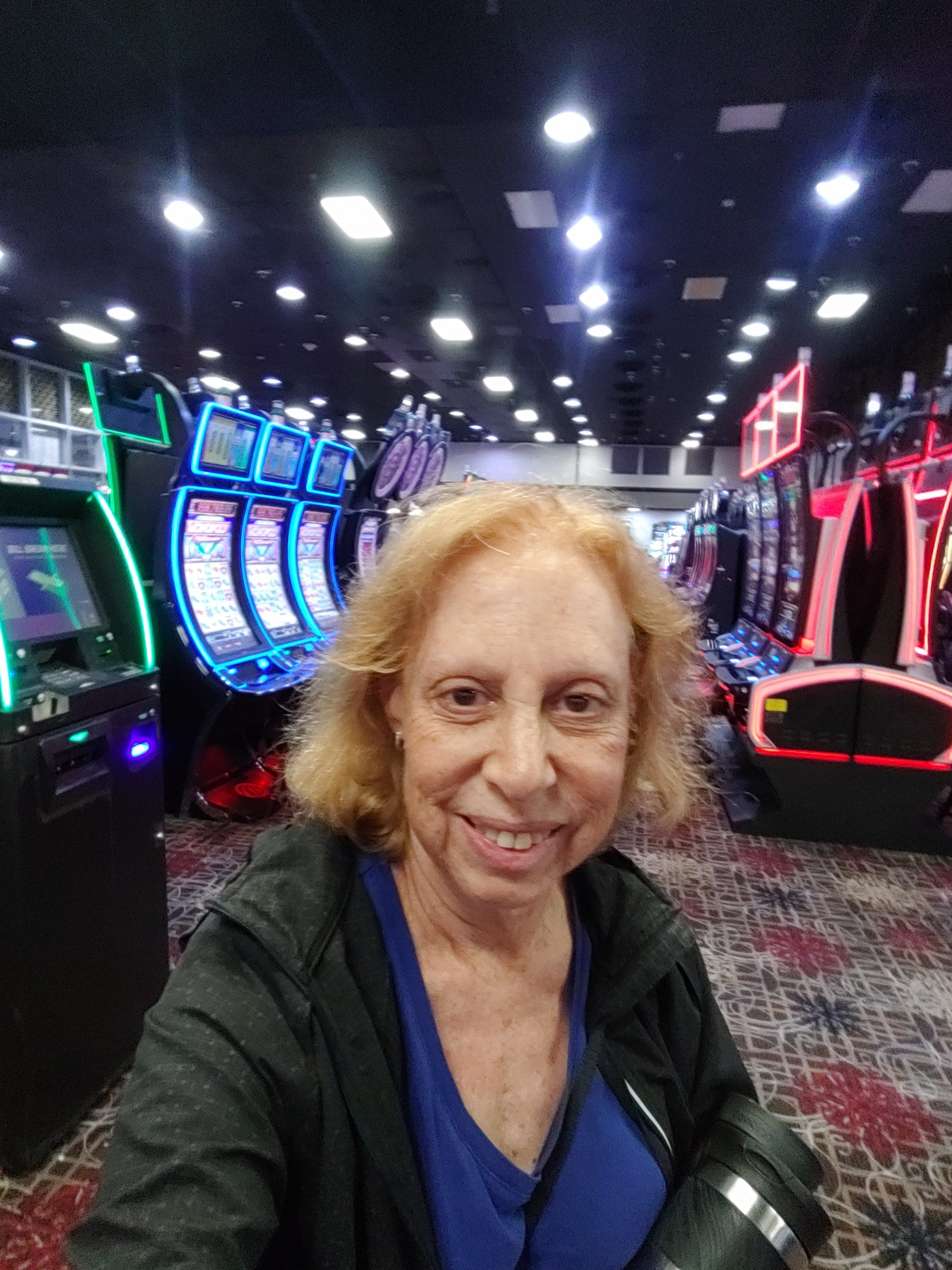
Rosanne at a casino

Trying to glean lessons from my own tale of Hurricane Milton.

Here on Florida’s Gulf Coast we’ve had two weather crises back to back. I’m sure you’ve heard about our battles with Helene and Milton.

During my evacuation two days before Hurricane Milton made landfall, I tried to distract myself by writing up my experiences in real time, in diary fashion. Afterward, I thought about this episode in terms of whether it would fit into a memoir. Would this be something I would include? It would depend upon the general theme of my memoir. Either way, I think it holds lessons as a story example for memoir writers.

I wrote the piece in present tense. As I’ve mentioned in past posts, I’m not a big fan of writing an entire memoir in present tense. In this case, I did what came naturally, and there it was: present tense right in my face. So I now am better acquainted with why many memoir authors want to write in present tense. People who’ve read this account tell me they feel as if they’re right there with me, fretting about where the hurricane will make landfall and nervous about how it will impact my life. Isn’t that every memoir author’s aim? So I get it.

I still think that for a full memoir it’s easier and ultimately more effective to write in past tense. The reader grows weary of present tense. For a short piece, though, present tense can work well. I like it for the introduction to a memoir or for any chapter that takes place at the current time.

This sample story demonstrates how a narrative in present tense can accommodate some past tense when appropriate. It also illustrates ways to interlace feelings with description, manage dialogue, provide background when necessary, use active voice and action verbs, and sneak in little facts you want the reader to know without dwelling on them. You also can see from this story how, if you have a diary filled with stories, you will have to do some editing. For example, I would probably replace the last four paragraphs with an update on any actual changes I made in the ensuing years or a transition to the next story in the memoir.

Seeing Eye to Eye with Hurricane Milton

Four days in Sarasota in October 2024

Hide from wind, run from water.

It’s a new phrase for me, and I memorize it. Like “feed a cold, starve a fever”: you must keep it straight, which is which.

But what if you have both a cold and a fever? “Feed” and “starve” are mutually exclusive, not the case with “hide” and “run.” So I do both, scared of wind, frightened of water.

It’s Monday, October 7, and as I run and hide from a natural disaster, obsessively focused on my own immediate trauma, the rest of the world is marking the date as one year since the Hamas attack on an Israeli music festival. On Facebook, I see that a friend is recalling the same date more than 20 years ago as the day she lost her 15-year-old son. Tragedy takes many forms here in the human experience, and what’s happening to me is not the worst that can happen.

We were cold in Chicago, so four years ago we moved south, out of the path of snowstorms and heartland tornadoes but into the belly of tropical weather. “I could never live in Florida,” some friends have said to me, with hurricane danger mentioned among the reasons. We chose an area that historically has not been in the eye of the tiger storms, but we understand there’s still risk, that past is not necessarily prologue with nature’s inherent volatility. In exchange for paradise winter, we accept humid summer and the wildcard of hurricane season.

October 8, another long and stressful day. With distance between my body and life-threatening peril, I obsessively click around from weather map to weather map, hoping that I can mentally will Milton to defy all science and just dissolve or turn tail and head back out to sea. The TV forecasters offer me no reassurance. When one of them chokes up during a report, that becomes the news. Another one wears a fitted blue dress revealing that she is pregnant, reminding me that life goes on in one way or another. I think back to yesterday, when my own pregnant daughter and her husband sent around pink balloons to let relatives know what kind of cousin/grandchild they can expect in March.

As October 9 dawns, my anxiety is high. We’re staying in a hotel casino west of Miami that was sparsely populated when we arrived on Monday but ran out of rooms by late Tuesday. We drove two cars to keep them from flooding at home. It was a little chancy to go south in case Milton taunted forecasters with a swerve to the right, but going north to Georgia or Alabama would mean three times the mileage, much heavier traffic and worries about gas availability. Along with me are Keevan and our friend Barbara, who evacuated with us from her home in Venice, just south of us. We are lucky to have options and resources; we understand that, and we meet people from all over the state’s southern half. Some live right on the water, others more inland but in mobile or manufactured homes. Every story is different. One couple splits time between balmy winters in Venice, Florida, and mountain summers near Asheville, North Carolina, devastated by Hurricane Helene just two weeks ago. Their house in Venice is in danger from storm surge not from the Gulf itself but from the Myakka River flowing at the end of, and perpendicular to, their street. They look sad, but here they’re at least safe.

Between watching the news and continuing to plead with Milton to be gentle, I do normal things. It’s drizzly in Miami, but I take advantage of a short period of sun to go for a run in the parking lot. Then Keevan, Barbara and I drive to Walmart and Publix and somewhere for lunch. We’re tired of expensive hotel food and bring groceries and boxed leftovers back to the hotel, where we have a mini-fridge and microwave. As the wind picks up in Miami, we calculate how much worse it must be at home, so much closer to the storm. I check the phone app connected to our home alarm, and there’s no signal. That means we’ve lost power at home. I wince.

After dinner in our room, Keevan and I go down to the casino to play the slots. It’s a sensory onslaught of blinking colored lights and sounds of ding ding ding as the machines hand over winnings, but the players look more defeated than victorious. We meet a couple from Punta Gorda. “Where are you from?” they ask us. “Sarasota,” I reply. “Oh….” Sarasota gets the biggest “oh….” as it sits right in the center of all the spaghetti storm-tracking models. I feign a weak smile as I take a selfie to remember this weird juxtaposition of home-to-here scenery.

Distraction and commiserating with people keep my spirit manageable as Milton inches closer to the Gulf coast. It’s a category 5 hurricane and then cat 4 and back to 5, then 4 again but getting down to cat 3, which is some good news. It jags and wobbles, sometimes north and sometimes south, and it’s not clear which direction will most spare us. It doesn’t matter, because it feels crummy to root for it to hit other communities instead of my own. My anxiety begins to morph into acceptance, which is good, because when landfall finally happens sometime around 9pm, Milton hits Sarasota’s beach on Siesta Key, eight miles from our house.
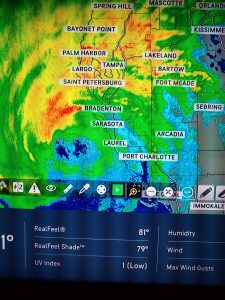
Map of Hurricane Milton's path

It seems not to take long before the hurricane’s eye settles over Sarasota and the TV storm reporters are talking about how eerily still and quiet it is. But soon after that, “dirty side” gusts and downpours start whipping the city. Before I go to bed, I check the alarm app again. It’s connected. I’m not sure whether that means we have power or, more likely, that the connection is picking up the backup battery, but the app indicates nothing out of the ordinary.

It’s October 10, and Milton is still a hurricane but no longer over land. We text our neighbors, who had planned on riding out the storm at home because they have hurricane shutters, whereas we are still trying to figure out that part of living here. A next-door neighbor responds that there’s no power in the neighborhood, but our house seems to be intact. It feels like a miracle. I picture all the possessions I left there as I hurriedly and arbitrarily packed some objects while abandoning others. From what we can tell, the roads going northwest are passable. We drive the three hours home.

The sun is shining, and as we glide along Routes 41 and 75 we see standing water and flattened trees, but nothing significant to indicate what took place during the previous 24 hours. At home, there’s no power but there is everything else just as we left it, except for a dozen palm fronds littering the lawn and two trees that toppled and damaged our fencing. But there’s not even water blanketing our street the way there was during Hurricane Ian and some of the other storms that made landfall much farther than eight miles from our house. So what is the deal here?

A few things worked in our favor. Milton did accede to my wishes in weakening to a cat 3 storm by landfall. Although it dumped a lot of rain in some areas, it was fast-moving and didn’t build up massive rain measurements in Sarasota. The half-hour it took for Sarasota to pass through the eye provided a little break when the wind and rain stopped. Every storm is quirky and spotty, and how it meanders into the particulars of Tampa Bay’s configuration will change the impact of water levels for cities up and down the Gulf Coast. All in all, worse-case scenarios did not happen. And the people heeded warnings, evacuating where mandatory and then some. We were not required to evacuate. We live just outside the last evacuation zone, Evacuation Zone E, and the mandate came in only as far as Zone C. Unfortunately, Milton set off lots of tornadoes that twisted their way all over the state, causing casualties across the state in southeast Florida, not far from our refuge.

What you see on TV is a version of what’s happening. News reporters stand at the most dramatic visual point, right at the coast. Inland the rain and wind may be just as harsh, but often sturdy fencing and rows of trees provide some barrier to houses. Of course, then there’s the danger of the trees falling and smashing things, but mostly it’s protection. The storm surge they talk so much about affects only the neighborhoods right along the shoreline and aside rivers and lakes. People living in houseboats always should leave, and those in mobile/manufactured homes are at risk anywhere within the hurricane cone. But other houses are constructed in adherence to strict building codes meant to withstand severe weather. Resorts, restaurants, hotels and various other businesses are situated along water, so storm surge is an important factor in the economy of the community but not in most of the residential areas of a city like Sarasota, although high rise condos offering enviable waterfront views often have to rehab their lobbies after a major storm surge.

I learned a lot from Hurricane Milton and feel more like a seasoned Floridian in the aftermath. I still probably will evacuate during future hurricanes, because I would have trouble getting through a night with no power or possibly even cell service while the trees are thrashing about outside. But I think I’ll be less frantic next time, and maybe we’ll have storm shutters by then.

Back to the Beginning: Your Memoir’s First Sentence, Part 3

Book with blank pages waiting for your memoir's opening sentence

Aim to grab the reader from the very start, but don’t sweat this too much.

In guiding you through writing your memoir’s first sentence, in the previous post I gave examples of openings from the celebrity memoirs I’ve read. That list contained memoirs of actors, and I left musicians and comedians for this post. So let’s jump in.

Patti Smith, Just Kids
“When I was very young, my mother took me for walks in Humboldt Park, along the edge of the Prairie River. I have vague memories, like impressions on glass plates, of an old boathouse, a circular band shell and an arched stone bridge.”

Smith begins her memoir in her childhood but, wisely, doesn’t waste her first sentence on something as mundane as pinpointing her childhood’s geographic identity. Yet, in her poetic prose she does just that. If you know Chicago, you will recognize the area of Humboldt Park or possibly the Prairie River.

The artistry of her phrasing is what’s important—memories are like impressions on glass plates, and items in the rest of the description roll out like a painting in front of your eyes. She lets you know that she had a mother who was engaged with her enough to take her on walks. She sets up the reader to expect skilled writing, and she follows through on that. Smith’s memoir won a National Book Award, and I think these are good first two sentences.

Leslie Jones, Leslie F*cking Jones
“I have this recurring nightmare. I want to quantum leap back to my younger self and tell that person all the stuff she needs to hear.”

Leslie previews for the reader that her memoir will look at all the mistakes she made and maybe reassure her younger self that everything will be okay. She uses “stuff,” indicating that she’s going to write the way she speaks. And, indeed, she does.

I liked this memoir a lot. As with most of these celebrity memoirs, I didn’t want it to end and missed Leslie when I finished the book and she stopped talking to me. But I’m not a fan of this type of opening sentence. It’s a tempting way to start—saying if I only knew then what I know now—but it’s not anything different from the rest of us. So, yes, it’s a sentence we can all relate to, but I want a memoir to begin with a nugget that belongs solely to the author.

Bruce Springsteen, Born to Run
“I am ten years old, and I know every crack, bone and crevice in a crumbling sidewalk running up and down Randolph Street, my street. Here on passing afternoons, I am Hannibal crossing the Alps, GIs locked in vicious mountain combat and countless cowboy heroes traversing the rocky trails of the Sierra Nevada.”

I really like the first sentence but not so much the second, which feels to me as if Springsteen is trying too hard, struggling to be a real Writer and, with that ambition, to create a visual simile from what he’s seen and prove to us that he knows about more things than music. But I do think the first sentence is relatable. As children, we all knew our streets like the back of our hand.

Ricky Lee Jones, Last Chance Texaco
“Oh, the skies were beautiful, pink and yellow and blue. Down along the end of the street was a well, a concrete circle about five feet in diameter. There you could find all manner of water-loving creatures, drawn from the desert to the shade.”

Jones had a chart-topping hit in 1979 called “Chuck E.’s in Love,” and the audio version of Jones’s memoir opens with a short song. I’m not sure how this is conveyed in print. Following the tune, the memoir’s opening line supplies an answer to the Chapter One title, “What Were the Skies Like When You Were Young?”

Jones reaches out to readers to get them to picture the skies of youth’s memory and imagination. She establishes her memoir as a detailed story, mentioning the desert right away because it influenced her art and life. Like Springsteen, she provides a description of her childhood street. So it’s not the most original beginning, but I think of the two of them, Jones wears it better.

Dave Grohl, The Storyteller
“‘Dad, I want to learn how to play the drums.’ I knew this was coming. There stood my eight-year-old daughter Harper, staring at me with her big brown eyes like Cindy Lou Who from How the Grinch Stole Christmas.”

Chapter One in Grohl’s memoir is titled, “DNA Doesn’t Lie,” which gives this sentence a little context. It shows Grohl as a drummer but also a father so involved with his children that he knows who Cindy Lou Who is. He’s introducing readers to his world, in which father and drummer are equally important, and he’s showing that he doesn’t take himself too seriously. I think it’s effective.

Molly Shannon, Hello, Molly
“I went to a nun psychiatrist who asked me to draw a picture of my family. I drew a picture where my dad had really long arms, and all the women had chopped-off arms.”

I like reading comedians’ memoirs because of all the humor in them. Molly Shannon was raised by her father after her mother was killed in a car accident. The preview of her limited, literally chopped-off, experience of having women as role models along with the funny image of trying to explain her childhood drawing to a mental health professional makes this a good opening sentence, kind of funny even in a chapter that deals with her mother’s death. Molly had me at “nun psychiatrist.”

Keith Richards, Life
“Why did we stop at the Fordice Restaurant in Fordice, Arkansas, for lunch on Independence Day weekend? On any day? Despite everything I knew from ten years of driving through the bible belt.”

In his very long but well-reviewed memoir, Keith Richards goes into detail about his childhood and pretty much everything else in his life. That’s why I’m happy with this opening that starts in his young adulthood, giving us the pleasure of meeting him right before the fame kicked into superstar gear, back when we formed our own opinions of all Rolling Stones. We can predict what goes wrong in this anecdote, but we want to know exactly how it goes wrong.

With this opening, Richards displays his naivete and arrogance all at once. And then the book goes on to fulfill our expectation to be candid and thorough.

One Non-celeb Example of a Memoir Opening

Let’s look at the example of probably the most successful recent memoir by a previously unknown author. Tara Westover’s opening two sentences to Educated are:

“My strongest memory is not a memory. It’s something I imagined, then came to remember as if it had happened.”

Brilliant? Not to me. I think Educated is an excellently written memoir, but it wasn’t the opening line that kept me reading. I find it almost a throwaway, nothing new to us or particular about the author. We all experience a blur between memory and imagination sometimes, especially as children. I think Westover, like Leslie Jones, could have launched her story without that introductory explanation of what she’s about to tell us.

Is the Opening Sentence the “Make or Break”?

From that example combined with those from the celeb memoirs I’ve shared with you in this post and the one before it, I think that maybe the trend today is that your opening sentence doesn’t have to be so much of a grabber. With online reviews readily available, people may start the book with an expectation already in mind and not depend on the first sentence to reel them in.

By the way, writing up these first-sentence posts made me realize that I’ve neglected one category of celebrity memoir—the sports memoir. So right now I’m listening to Andre Agassi’s Open, which is considered to be a well-written memoir about his tennis career. My beef is that Andre has someone else reading his memoir on Audible. But I do like his opening. He takes us right to a pivotal match very late in his career, and after that chapter we go back to his childhood. That’s my favorite structure.

Ultimately, the goal of your first sentence is to get the reader to want to read the second sentence. Then you want that to lead to the whole paragraph and little by little have your memoir become a book that readers can’t put down. So you do need to hook them immediately, but you also have to follow through with a lot of great sentences, some perhaps even better than sentence number one.

Back to the Beginning: Your Memoir’s First Sentence, Part 2

Blank screen with hand and stylus for writing a memoir's first sentence

Let’s look at some openings from published memoirs.

Last time, I threw out a few ideas to get you started on your memoir’s first sentence or couple of sentences. The beginning of your book will provide the hook to keep readers interested in finishing Chapter One and, you hope, beyond. But how critical is that first sentence? You probably want examples.

Into My Library of Celebrity Memoirs

As I often mention, my motivation to run is that it’s the only time I allow myself to listen to celebrity memoirs. By now, quite a few celebrities have talked me through my painful track training, so in a quick review I chose some of their memoir openings to share with you, along with my comments.

I have too many for one post, so I’m going to save half for a Part 3 on this topic. Today’s half offers only actors. I want to know about the author’s youth, but I admit to being partial to memoirs that start somewhere other than in childhood. Let’s see how these sentences introduce the reader to the memoirist’s world.

Jennette McCurdy, I’m Glad My Mom Died
“The present in front of me is wrapped in Christmas paper even though it’s the end of June. We have so much paper left over from the holidays because Grandpa got the dozen-roll set from Sam’s Club even though Mom told him a million times that it wasn’t even that good of a deal.”

You wouldn’t want a shocking beginning when you already have that irreverent title, so a somewhat banal first sentence provides balance. This bestseller lets you know you’re in for a story, not just a lengthy whine.

The sentence mentions her mom, so we stay on topic, but it doesn’t hint at why the author might be glad her mom died. If anything, she implies that she’s on the same page with her mother about the wisdom of her grandfather’s purchase. She gets you wondering what will happen with her mother. As my last post mentioned, it’s good to get readers to ask questions, because they’ll keep reading to find the answers.

This is a very young author, so starting in childhood isn’t going that far back. Still, note the choice.

Harvey Fierstein, I Was Better Last Night
“Philamina got the role of the evil witch, and I was cast as the king. The king? Who wants to be the king? Sure, he gets a crown and a cape, but the witch gets green skin, red lips and long, black fingernails. I wanted green skin, red lips and long, black fingernails. Second grade was not working out the way I’d hoped.”

The memoir of Harvey Fierstein, whom I hope no one confuses with Harvey Weinstein, focuses mostly on Fierstein’s professional life as an actor and personal life as a gay man. His opening sentences weave in both topics and then end with a surprise punchline that made me laugh out loud. Even if you read this memoir rather than listen to it, you can hear Fierstein’s distinctive, raspy voice in that last sentence.

I loved the book, and the first paragraph is probably my favorite of this group because it’s funny. But, again, here we are in childhood. And not every memoir can start with humor, so you may not be able to copy this style.

Viola Davis, Finding Me
“‘Cocksucker motherfucker’ was my favorite expression, and at eight years old I used it defiantly. I was a spunky, sassy mess, and when I spewed that expression, one hand would be on my hip, my middle finger in vast display, and maybe my tongue would be sticking out.”

Having Viola Davis read to you for hours is a treat, but I’m not sure about this opening sentence. Her description of her little self paints a clear mental picture, and the reader needs that because in her masterpiece of a memoir Davis spends a lot of time on her childhood.

I think my problem with this opening is that it feels like an early draft. I can see an author sitting and thinking about how to start her story and coming up with this, as if she’s looking at herself from an outside vantage point. It’s almost too cutesy or self-conscious or something. I’m a little torn on this one.

Rob Lowe, Stories I Only Tell My Friends
“I had always had an affinity for him, an admiration for his easy grace, his natural charisma, despite the fact that for the better part of a decade, my then-girlfriend kept a picture of him running shirtless through Central Park on her refrigerator door.”

The “him,” the target of Lowe’s affection as well as his girlfriend’s admiration, is John F. Kennedy, Jr. The two men were friends, and even though JFK Jr. doesn’t play a large role in Lowe’s memoir, he pops up later in the book in a pivotal way.

This opening, then, deftly previews for the reader that this friend will have something to do with Lowe’s life, but it’s so subtle that you might not see it coming when JFK Jr. shows up years down the road. The first sentence also gives you a feel for the way Rob Lowe saw people and hints at the role handsomeness will play in the book. I think it’s a good opening, and it’s nice to start somewhere other than childhood.

Minka Kelly, Tell Me Everything
“’Oh baby, I have something special in store for you,’ Mom gushed. She hugged her arms close to her chest as if she needed to keep the joy from bursting through her entire body, like it was a current of energy that pulsed through her, not always under the influence of her control.”

I feel as if I’m always going overboard in being transparent, and on this one my full disclosure is that I included Minka Kelly’s memoir because I really enjoyed it and hope to give it a little more exposure so more people read it. But then I’m a big fan of TV’s “Friday Night Lights,” in which Kelly had a lead acting role.

Like so many others, Kelly chose to begin her memoir in childhood and tell readers about her mother, the primary figure in her life. Bringing us into the heart of an anecdote, she leads with dialogue. I’m fine with using dialogue to open other chapters, but for Chapter One of the memoir I think it’s a bit of an easy way out. Don’t let that discourage you from reading the memoir. It’s good.

Henry Winkler, Being Henry
“It was the biggest audition of my life, and the sweat stains under my arms weren’t just clearly visible; they were a cry for help.”

I’m surprised this type of sentence doesn’t open more celebrity memoirs to immediately place us at the most pivotal point of the career. Maybe authors want to build anticipation so we keep reading until we get to the part of the celebrity’s life that most interests us.

We can make an educated guess about what the biggest audition of his life is—probably for the breakout role of Fonzie in “Happy Days”—but Winkler stops short of giving us the full story here. Readers don’t find out how that audition played out until much later in the book. I like the tease, and I also like the acknowledgment right away that the author knows why we bought his memoir.

Sally Field, In Pieces
“I wait for my mother to haunt me, as she promised she would, long to wake in the night with the familiar sight of her sitting at the end of my bed, to talk to her one more time, to feel that all the pieces have been put into place, the puzzle is solved, and I can rest.”

Field wants to quickly tell us what her title is about. I’m not sure that’s necessary; it’s not hard for readers figure out on their own. But the opening sentence is effective in letting us know that an Oscar winner now in her 70s is, if not still fixated on her relationship with her mother, at least writing her book in part to explore that relationship. I don’t think it’s the most original beginning, the most personal or even the strongest she could have come up with, but I think it’s not bad.

Is “Not Bad” Good Enough?

You can see that I’m not falling all over myself about how great these openings are. Some are very good; others are just adequate. But not one is a failure. I’ll let you know in Part 3 whether “not bad” is good enough.

Back to the Beginning: Your Memoir’s First Sentence, Part 1

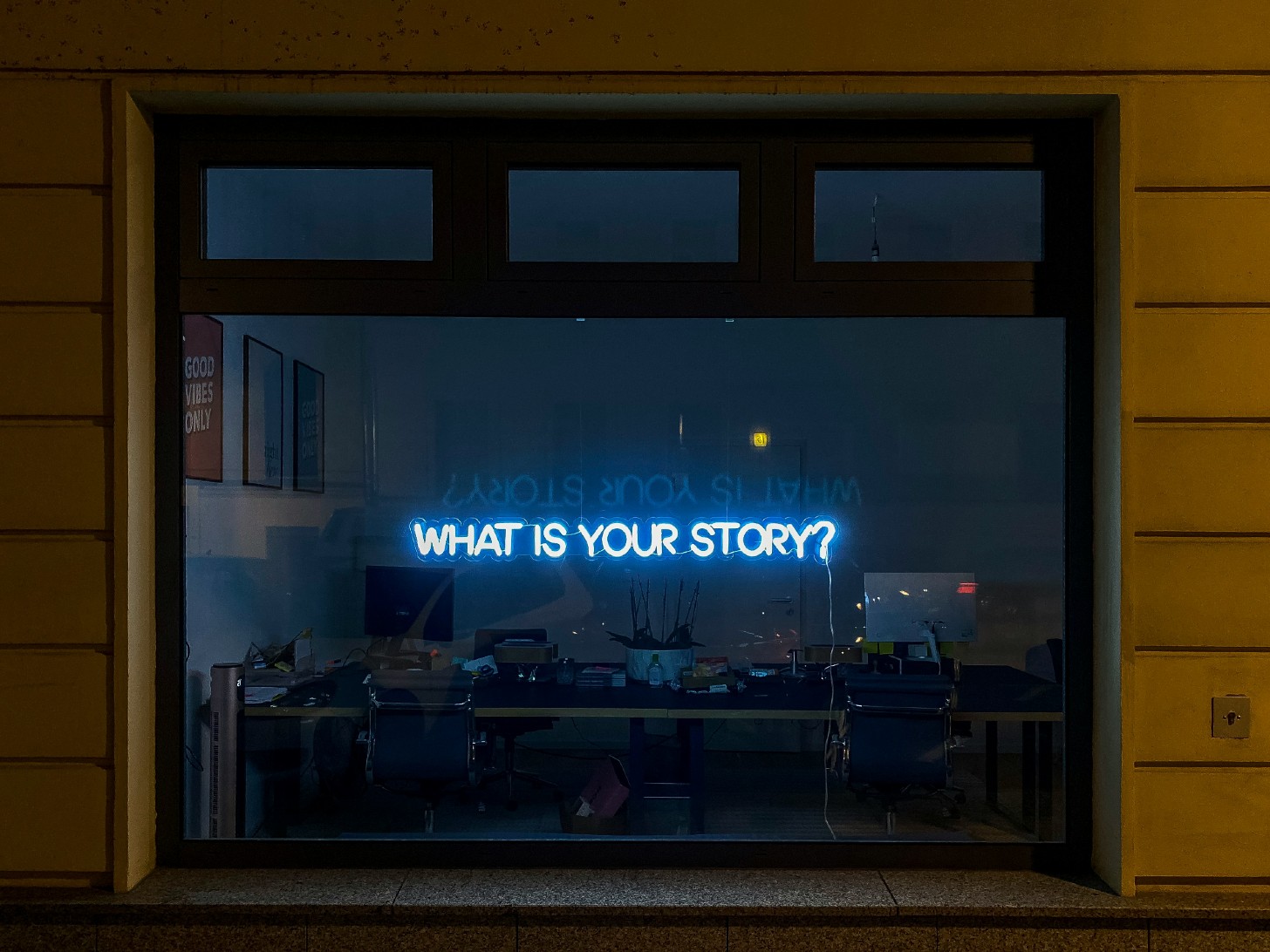
Neon lighting with text: "What is your story?"

Your opening introduces your readers to your world.

You’re in good company if you’re stuck on how to craft your memoir’s first sentence. Understandably, the opening line and paragraph of a memoir are important to every memoir author who wants to capture the reader’s interest right away.

You Don’t Have to Write the First Sentence First

Start writing your memoir anywhere you like, with any story from your life you think you’re going to want to tell. You may not end up including that story, but it will get you writing.

Then think it through a little. What happened in your life that will get readers to want to read the rest? Many memoirs today start at a pivotal moment or with the part of the author’s life most central to the memoir’s theme. Still, a lot simply begin in childhood, because there we find the seeds of who we are. Once you decide which moment of your life will launch your memoir, you’re ready to think about the words that will best express it.

So write something. The best sentence you’ve ever read may come to you immediately, or you may change your first sentence multiple times. When you have it, I think you’ll know.

What’s Trending in First Sentences of Memoir?

Good writing will always be good writing, but like everything else, memoir trends change. Readers are more sophisticated than ever, wise to a contrived opening line that’s trying too hard or designed to be clever above all else.

Writers rely on collective memory, a sort of modern-day lore that we know everyone knows. The thing is, though, that today you can’t count on all of us knowing the same things. We’re long past the days of three networks broadcasting nightly news and showing a regular weekly television schedule that everyone watches. Today, we seek information and entertainment from all over the place, from apps and social media, obscure cable TV shows, podcasts and blogs.

With our collective memory shattered, the opening sentence to Woody Allen’s memoir, Apropos of Nothing, wouldn’t ring a bell to a lot of people:

“Like Holden, I don’t feel like going into all that David Copperfield kind of crap, although in my case, a little about my parents you may find more interesting than reading about me.”

Holden? Holden Caulfield is the protagonist of Catcher in the Rye, which has an opening line referencing David Copperfield. I think most of us do get the reference to David Copperfield at least.

With society’s evolving norms, I think you’ll be wise not to assume that we all agree on anything. It will probably put off some readers if you call a thought “a truth universally acknowledged,” even if you don’t mean it to be one-hundred percent accurate. This opening sentence is not from a memoir but from the iconic novel Pride and Prejudice by Jane Austen, written in the very late 1700s:

“It is a truth universally acknowledged, that a single man in possession of a good fortune, must be in want of a wife.”

I mean, where do we start with that? Even the commas aren’t necessary, much less the thought.

What Should Readers Get From an Opening Line?

Experts in memoir suggest that your initial sentence should open the door to your world. It should intrigue readers about whatever you’ll be tackling in your memoir. You can achieve this in a number of ways:

  • Introduce a character—possibly the character of you—in a notable way. Make the introduction funny, self-deprecating, mysterious, surprising or truly shocking.
  • Start out with something very relatable to get readers to feel as if they are in your shoes, because they recognize your experience.
  • Plop the reader into the middle of the action of the most dramatic story in your memoir. Get the reader’s heart racing.
  • Provide a tidbit of information that gets the reader asking questions. Readers who need their questions answered will keep reading.
  • Craft a beautifully worded sentence to inspire confidence that your book will be full of wonderful descriptions at a high literary level.

“I didn’t realize I was black until third grade.” This is often cited as a great opening sentence. It belongs to Becoming Kareem: Growing Up On and Off the Court by Kareem Abdul-Jabbar and Raymond Obstfeld. This takes you into Abdul-Jabbar’s world by both introducing you to the character of little Kareem and getting you to ask the question, “Why? Do you not have a mirror?” And it’s just plain disarming. A-plus to the big man.

GreatOpeningLines.com, which bills itself as “history’s first website devoted exclusively to the celebration of great opening lines in world literature,” mentions that line along with this other one I noticed. As I write this, the news is breaking about Joe Biden’s decision to leave the 2024 presidential race. So it’s serendipitous that I find this opening line to Biden’s 2007 memoir, Promises to Keep: On Life and Politics:

“Joe Impedimenta, my classmates hung that nickname on me our first semester of high school when we were doing two periods of Latin a day. It was one of the first big words we learned. Impedimenta—the baggage that impedes one’s progress.”

Here, Biden divulges what was probably the most humiliating aspect of his life, either to get it over with, to garner some sympathy from the reader, or perhaps to offer something to which the reader can relate.

In Part 2 of this post, I’ll share a lot of first lines from celebrity memoirs and get to the bottom line of how important your first sentence is—or isn’t.

Including Travel in Your Memoir

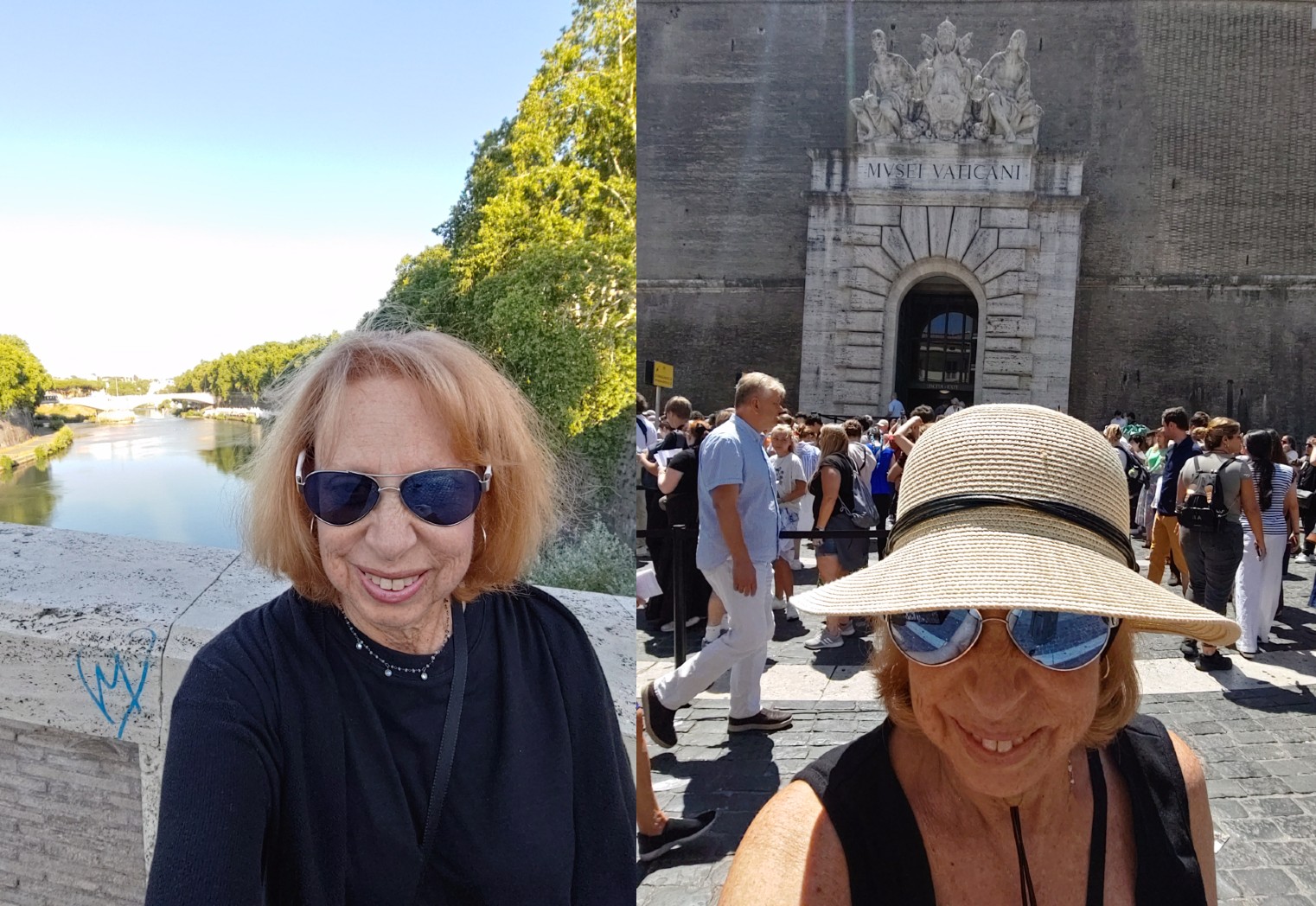
Two pictures of travel in Rome

Without making it a “travel memoir.”

To be fully transparent, I’ll mention that I selected today’s topic of including travel in your memoir as a way to relive my own recent visit to Italy—I even rapped about it. Perhaps you feel the same about trips you’ve taken—that as long as you’re writing about yourself, you might as well cover your travels. But unless you’re planning a memoir along the lines of Eat, Pray, Love, try to be careful not to satisfy your wanderlust by overwriting about your trips.

How Travel Can Be a Natural Part of Your Storytelling

Your memoir is a collection of stories, and traveling certainly can be one of those stories. Think of your experience in one of two ways:

  1. Plot driver. Does your travel story drive the plot of your life? This is easy to identify. Did you meet someone during your trip who turned out to be pivotal in your life? Or did something else happen that influenced your direction in life?
  2. Character developer. Maybe nothing unusual happened during your trip, but the experience still changed you. Leaving your comfort zone, facing your fears, having the “lightbulb moment” of realizing that the world is a big place with lots of opportunities, connecting with art, gaining confidence through navigating on your own—it could be any number of things that you carried with you long after you returned home. All of that is valid to write about.

Ways to Contrive the Importance of Your Travel

You can indulge yourself only so much. Like every other story in your memoir, your travel tales must have a point and move the narrative to the next rung. To some extent, you can contrive that point. Maybe you were out of town when something important happened back at home. So it’s not the trip that was important in your life; it’s your absence.

Instead of saying you were out of town when this or that went on, you can emphasize the significance of your absence by going into some detail about where you were and what you were doing. The contrast of what was happening at home while you were on vacation, relaxing on a beach or touring a foreign city, can be effective.

The summer before my senior year in college, I traveled with my college’s French department on a six-week summer-study program in Nice, France. In the big picture, this trip didn’t have a monumental effect on my life. But pretty much everything you do at age 21 can be considered significant enough to include in a memoir.

Many of you probably assume I have penned a memoir, but even though I have written various autobiographical accounts, I haven’t devoted an entire book to myself. I may someday. And if I do, I think I’d find a reason to include that trip to France, which extended to spending some time in northern Italy as well. It was my first time abroad, which is enough right there to include in a memoir. My college arranged for us to meet with the late author James Baldwin in his garden in the south of France, and I can’t imagine writing a memoir without mentioning that magical hour or two, even though I don’t remember anything that took place.

Here’s an idea. To contrive a reason to include your travel, you could introduce it as “the last time I remember…” and go from there to describe your travel experiences. I’m thinking of something such as:

  • The last time I remember having any discretionary income, I spent it on an African safari.
  • The last time I remember having a candid discussion with my mother, I had just arrived home from a trip to Japan, and she wanted to know all about it.
  • The last time I remember being as frightened as I was then, I was in an alley in Rio de Janeiro, walking alone, when a man slid out of the shadows and approached me.

How to Know Where the Line Is

After all of the contriving, you may find that it just doesn’t work. It may veer too far off your central theme, and you’ll be better off to keep what you’ve written as the basis for your next fictional short story. The editing you’ll do after your first draft will force you to make a lot of hard decisions. Editing is usually painful!

If the story holds up as pertinent enough, you still may have to delete some of the details. When you reread what you’ve written, pay attention to the “travelogue” voice. If your description sounds even a little bit like advice on where to go and what to see, you’ve probably crossed the line between memoir and travel memoir. And even if that lasts only one chapter, it’s likely to feel out of place.

As I always tell you, this is your memoir, and you’re the best judge about what’s important in your own life story. But we authors also want to keep the reader engaged, and that requires sometimes making sure we don’t indulge in sharing our favorite memories just in order to relive them ourselves.

Bias vs. Objectivity in Memoir

Man holding big glasses a foot in front of his eyes to gain objectivity in his memoir

This is your truth, so does it have to also be THE truth?

One motivating factor for writing your memoir is that you finally get to tell your story from your perspective—the way you want people to hear it. You’re not thinking about objectivity in memoir, and why should you be? By definition, this is your biased account. Achieving a balance of bias vs. objectivity may seem out of place in the memoir conversation. Well, it’s not!

You as the Hero in Your Life Story

Many memoir authors hope that their story will inspire readers. They’ve overcome a hardship, and perhaps readers who are facing a similar challenge will be encouraged that if they fight hard enough, they, too, can make it to a happier place and move on with life.

As you describe all the hurdles you’ve had to jump and the negativity you’ve had to push out of your way, you can build yourself up to be a bit of a hero. Look at all you’ve overcome. That’s impressive.

But is it? Have you recounted all the mistakes you made along the way? Have you given credit to people who helped you succeed? Have you considered the simple factor of luck?

There’s a saying, “Don’t let perfect be the enemy of good.” To adapt that, I’d advise against letting any need to look perfect be the enemy of coming across real. Look at yourself objectively. You’re not perfect. Admitting where you messed up is the way you relate to readers and get them to root for you.

View Your Story from Outside Yourself

If you have any trouble admitting your shortcomings, try looking at your life from other people’s points of view. Maybe you talk about a job you held, and your boss was excessively tough on you. You can reveal that person’s shortcomings as a supervisor, but do you also share in any accountability? Was the boss’s criticism of you at all justifiable even if the communication method may have been too harsh? It’s usually more effective to talk about your struggles and the errors you made, and then how unhelpful it was to absorb criticism that was hurtful.

Picture yourself with the people you write about during the time you were together. Now imagine them reading your book in present day. What are they thinking? Are you being truly honest with the reader about your own contributions to negative outcomes in your life?

Fact-check Pesky Little Details

Memory is so tricky; sometimes it incorporates our biases and we’re not even aware of that. Let’s say you recall a traumatic incident with a teacher that happened when you were 14 years old, something that was hard for someone that young to handle. Don’t rely on your memory. Think it through, and fact-check wherever you can. You may pick up your yearbook to discover that you had to be at least 16 when the incident happened, because the teacher didn’t join your school’s faculty until you were a junior.

That kind of thing doesn’t make your story less powerful. If the incident traumatized you, it still traumatized you. But the truth was that you were 16. If a reader does the fact-checking and finds a discrepancy, that reader might regard your entire book as fictionalized. Getting the smallest details wrong—dates, places, people’s names—can undermine the core of truth you’re telling.

Does the Truth Mean the Whole Truth?

Some memoir writers get bogged down in too much truth! You have to explain enough for the reader to understand the point of each story in your memoir, but don’t be afraid to omit irrelevant details about the incident. Setting is important, and description of what you saw, heard and smelled puts the reader in the midst of the action. But sometimes we overexplain the background of what’s happening.

I think discerning how much to reveal is one of the hardest parts of storytelling. Think of someone you know with whom you’re always silently thinking, “Get to the point!” You don’t want your readers shouting that at your book.

Suppose in the chapter about your adolescent years you refer to Alice as your best friend. In the next chapter, you’re in high school and you say, “I felt relieved to see that my two best friends, Miguel and Samantha, had saved me a seat.” Will the reader notice the switch? Yes. So don’t leave the reader hanging. Say something like:

“I felt relieved to see that Miguel and Samantha, who at that point had replaced Alice in my best-friend hierarchy, had saved me a seat.” Or: “I was relieved to see that my two best friends, Miguel and Samantha, had saved me a seat. I still was in touch with Alice, but she had moved and was going to a nearby high school, so we weren’t as close.”

What you don’t have to supply is an entire backstory:

“I felt relieved to see that Miguel and Samantha had saved me a seat. I’d known the two of them since middle school, but Alice had never wanted to include other friends in any of our activities. When her family moved and she started going to a different high school, I got to be friendlier with first Miguel, and then Samantha, since those two already were good friends. Alice and I called each other less and less frequently, and later on I heard that her family moved out of state altogether.”

Objectivity Begets Catharsis and even Forgiveness

The process of writing about your life may remove a huge weight you’ve been carrying around. You finally are able to openly share with readers a long-held secret or a painful time in your life. It feels great to let go of the burden. The rub is that, once you’re healed, you don’t always like what you’ve written.

In an essay some years back, memoir author Amye Archer told about the way her view of her ex-husband changed as she wrote each new draft of her story about her marriage. The anger she felt at the beginning gradually dissipated. She sat down to write her memoir with a lot of indignation—look what this terrible man did to me! The more she rewrote her drafts, the more she saw her own role in the failure of the marriage. As more time passed, her current life brought her happiness, and she didn’t have the need for readers to be mad at her ex when even she wasn’t as mad at him anymore.

If you’re harboring anger like that, I think your memoir will be more authentic if you can get to the point that Amye Archer reached. You don’t want to publish it and then get there afterward. You don’t want to cringe when you read your own memoir.

There is such a big “but” to this. Even if you’re very much past the trauma, when writing the memoir you do want to get your head back to the way you felt at the time. You want to return to the pain so that the writing makes the feeling real for your reader. But then you can add perspective that has come with time.

This isn’t a textbook, a journalistic report or a historical account. It’s not even a biography of someone else. You’re writing your story about you. But it will ring truer with the reader and carry more authenticity if you layer your perspective with a little objectivity.

Editing Your Memoir for Word Choice: Part III

Word choice in memoir writing

Originality and a twist on clichés will help make your memoir memorable.

For the third post in this three-part series about editing your memoir for word choice, I want to discuss originality and ways to use clichés to your advantage. I remind you that this is your memoir. It’s not a famous writer’s story, and it’s not a term paper, either. Be authentic but creative; offer something the reader doesn’t ordinarily see.

Dip Into Your Speaking Voice

When you insert yourself fully into this personal storytelling, your speaking voice will blend naturally with your writing voice. Let’s say you’ve always called your mother “Ma.” Most of the memoirs you read refer to “my mother” or “Mom,” but if you’ve never called your mother “Mom,” your memoir is no time to start. Toggle back and forth between “my mother” and “Ma.” That is the best, most authentic word choice for your memoir. The reader will hear you, not some generic, watered-down version of you.

Now let’s say that you swear a lot when you talk. Confine that aspect of your speaking voice to the dialogue you enclose in quotation marks. The rest of the text will be too distracting if every sentence contains profanity.

Include a few Unusual Words or Ways to Describe Something

In a previous post, I gave an example from movie and television director Ed Zwick’s new memoir, and since that book remains fresh in my mind, forgive me if I use it for an example here as well. Zwick mentions that someone in his life luckily had “reservoirs of patience.” While “reservoirs” is a pretty common word, using it to describe someone’s patient nature strikes me as clever writing. She didn’t have “lots” of patience or “endless” patience; she wasn’t “super-patient” or “tremendously patient.” With “reservoirs of patience,” the author not only delivers a word that isn’t typically associated with having patience; he also creates a visual, stopping you just for a slight pause to consider how much he appreciates the person’s patience. And notice that he does not need an adjective such as “deep reservoirs of patience.” The unmodified noun says it precisely.

Now I’ll make up an example. Let’s say you like the word “serendipity.” Instead of calling something a “pleasant coincidence,” in your everyday speech you just tend to use the word “serendipity.” Then give the reader a taste of your unique flavor of language by using that word. However, using it once, or twice at most, will be enough.

What about including words that you never use? Maybe you’ve already described various people as “smart,” “intelligent,” “wise” and “brainy,” and you don’t want to repeat any of those words, but you have a smart friend you still want to write about. So you Google for synonyms of “smart” and come up with “sagacious.” You’ve seen the word and know what it means, but you’ve never used it. Should you write “sagacious” to describe that friend in your memoir? My vote is probably not. If you feel it fits comfortably into the rest of your memoir, then okay, but if you’re using mostly everyday words, I think a word like “sagacious” sounds as if you’re trying too hard to be, well, sagacious.

Remember that synonyms are not the only solution. You can always rework the sentence. Instead of describing your friend with a synonym for “smart,” you can say that your friend seemed to know everything about everything, or your school friend was always tops in your class, or your work friend sat around doing tough crossword puzzles during his coffee break. Again, get creative.

Not All Clichés Are Bad, and Most Clichés Can Be Made Good

You may have been told to avoid clichés, and that’s generally good advice. But lately I’ve felt more kindly toward the much maligned cliché. I think these common phrases can give your memoir a relatable quality.

Let’s consider the reasons you’ve been told to steer clear of clichés as well as overused similes and metaphors. This is a bad sentence: “She was running around putting out fires, busy as a bee, but when I walked in she looked as if she’d seen a ghost.” Not only are three clichés too many for one sentence, but those particular clichés are not the best choices.

But it can be charming to let a few familiar sayings creep in here and there. And you can control your clichés by altering them for effect. I’ll contrive a paragraph for this purpose:

I believed that every cloud had a silver lining, but I couldn’t find even one in the series of storms that rained on all of my parades that June. I’d hoped my graduation would bring my parents together in some sort of peaceful reunion, but Dad never even showed up. I thought moving out of Mom’s house would certify my entry into adulthood, but by August I’d moved back in, unable to juggle enough jobs to have anything left over after paying rent. Most of all, in Alex I thought I’d found my soul mate, my companion for riding into the sunset and leaving all of my anger and disappointment in the dust. Alex took me for a ride, all right, and the sunset did get darker and darker.

It’s not Shakespeare, but I think the clichés prove useful: “every cloud has a silver lining,” “rain on my parade,” “find my soul mate,” “ride into the sunset,” leave something “in the dust,” and take someone “for a ride.” I could see an editor saying, “Ugh!” But I think it all puts the reader at ease. I find that compelling memoirs tend to have a bit of folksiness in them, and common phrases work toward that end.

I’m just saying that when you edit your first draft, don’t automatically delete your clichés. Give a little thought to whether they might be adding something to your narrative.

Word Choice Is Your Choice

When you write a memoir, it’s motivating and inspiring to read other memoirs. But you don’t want to copy another author’s style. Your memoir is about your life, written in your voice. Every word you choose has a piece of you in it. If a sentence sounds as if someone else said it, replace it with words that are either yours alone or yours as representative of ordinary language.

Editing Your Memoir for Word Choice: Part 1

Editing your memoir for word choice requires you to choose your words wisely

Now that you’ve written your story, make sure you’ve worded it for impact.

If you’re like me, you go over your manuscript countless times—literally so often you lost count long ago—and one thing this process covers is editing your memoir for word choice. For your first draft, you likely followed the advice to just write and not worry about the quality of the writing. Get your story down, and you can fuss with it later.

Guess what—it’s later! And you’re probably fussing. I think it’s a good idea to do one read-through with just the storytelling in mind. Does it tell the story you want to tell in the order that works best for the reader? Are there holes, is there repetition, or is there extraneous information that distracts the reader from the main theme of your memoir?

To discern all of that, you’ll want to read your book as if you were your target reader. But it’s a topic for another day. The edit I’m referring to now is the one you do to check out everything else—punctuation, grammar and that devilish word choice issue. Let’s tackle two aspects of word choice—accuracy and precision—and in my next installment I’ll finish off the rest.

Correcting Outright Word Choice Errors

Between homophones, closely related words and word mixups unique to you, it’s easy to make errors as you focus on telling your story. Closely examine every word to ensure it’s the best word for its spot in all of English!

Sometimes we say something automatically that is flat-out incorrect, and we write it the same way because no one has ever corrected us. You may think conflate means the same as confuse, but take the time to make sure. When you look it up, you’ll discover that conflate means to mash together two or more ideas into one. So it relates to confuse, because conflating two things can create confusion, but the two words still are not synonyms.

Other times, since homophones sound the same, we write down the wrong one if they have different spellings. You can know the difference between your and you’re perfectly well but still absentmindedly write the error, “You know your heading for trouble when you start out that way.” It happens. During one of our phone chats, the author of a memoir I’m ghostwriting used the word gait, which I wrote as gate. It’s not that I don’t know the difference, but I’m not sure I’ve ever used the word gait myself, and the correct spelling just didn’t hit my brain as I was writing.

Choosing the Most Precise Word

Editing for precision is a task that might not come until you’ve read your manuscript multiple times. At that point, you have your story as you want it to read, but is every word chosen wisely?

English is such a rich language; don’t settle for a general word when a specific word is available. The replacement word doesn’t have to be esoteric; it’s often an ordinary word but still provides your reader with a clearer picture of the scene. This is not the easier route, since when you replace a word you may have to change other parts of the sentence so that it all works grammatically. Let’s try an example.

Maybe you start out with, “Dad put me on his shoulders so that I could see the parade better as it passed by.” Meh, right? So you change it to, “Dad put me on his shoulders so that I could view the parade better as it passed by.” View is a bit more specialized than see.

On your next read, you decide to try, “Dad put me on his shoulders to give me a better vantage point from which to view the parade.” You like that, but on reviewing later you get stopped by all of the from which wordiness, so you make another edit to combine the best of both: “Dad put me on his shoulders to give me a better vantage point as the parade passed by.” With vantage point, you eliminate the need to tell the reader that being on his shoulders helped you view the parade, so you have to let go of the word view you worked so hard to find.

On yet another read, the word put glares at you. It’s such a general word, so you change it to, “Dad lifted me on his shoulders to give me a better vantage point as the parade passed by.” Well, you lift people, but then you still put, not lift, them on your shoulders.

Now you have a decision to make. You decide to elaborate. “Dad lifted me by my waist and quickly raised me high, plopping me on his shoulders to give me a better vantage point as the parade passed by while he kept his safety hold on my waist.” Now you have the more colorful, distinct verb plopping to replace putting. But you’ve added a lot. Is it necessary? Is it better than the original? I think it helps readers create a visual in their mind’s eye.

Rely on the Simple Search for Synonyms

Often, I look at some general word I’ve written and I think, “I know there’s a word that means exactly what I’m getting at.” I google for synonyms all the time, and eventually I usually find the word I was trying to think of—or an even more suitable word.

Let’s say you’ve written, “Mother was good at making people feel bad.” Here, good works as wordplay with bad. But good is a general adjective, and in other cases your narrative can usually benefit from replacing it.

Let’s say your mother was good at something else. You might say, “Mother was adept at making every person in the family feel valued.” Or, “Mother was effective in using her icy stare to let me know I’d crossed the line.” Or, “Mother was skilled at all outdoor jobs, from mowing and planting to washing windows and patching the roof.” Or, “Mother was useful to have around when Dad would drink too much.” You could have used good in each of those cases, but in no case would good have been as good, er, successful, as the replacement.

On my first draft of two paragraphs up, I wrote that good was a general word. When I read it over, I replaced word with adjective. That’s exactly what I mean—find the most precise word available.

Next time, I’ll help you spot more areas for improvement in word choice to make your copy compelling for the reader. As always, if you need help editing, our editors at Write My Memoirs would be honored to help polish your memoir.

How to Include Life Lessons in Your Memoir

Without turning your memoir into a self-help book


Like many memoir authors, you may be aiming to include life lessons in your memoir. You’ve overcome addiction, escaped domestic violence, triumphed over an illness or condition, healed from an injury or grown in some other way, and one major goal in writing your memoir is to help readers replicate your success. It’s partly a self-help book.

Still, you don’t want to cross genres. Even though you want to be pretty explicit in stating the lessons, you envision your book listed in the memoir category, not as another self-help manual. Can you incorporate a bit of how-to in your memoir? Sure. As I always say, it’s your memoir, so write the book you want to write. I have some ideas for ways you can offer suggestions while staying in the memoir space.

Make Lessons Part of Your Writer’s Voice

Your book’s theme—or maybe just one chapter’s theme—is succeeding despite a setback or life circumstance. By definition, you’ll be writing about the initiatives that changed your life. The reader will pick up on this, but you still can give it an extra boost.

If you wanted to revolve life lessons on a knee replacement, for example—which I realize is unlikely but it will demonstrate my points—it might look something like this:

It wasn’t that I didn’t know what to do. I knew all too well. The doctor had laid it all out, I was googling “knee replacement” night and day and, of course, Robbie was constantly giving me the blow-by-blow on his own surgery and recovery. I’d already stocked my kitchen with inflammation-fighting foods, popping blueberries like gumdrops and vowing to find recipes that made kale taste less like a rubber glove. I made sure my freezer’s icemaker was churning out cubes.

There was more. I completely dropped out of my golf group so that I wouldn’t be tempted to tee up before my knee was ready to accommodate my distinctively twisty swing. I borrowed a footstool from my neighbor Debra, who also insisted on lending me four perfectly sized pillows to pile on the stool in order to create the required elevation when I sat on my couch. I lipsticked the word “REST” on mirrors in both my bedroom and my bathroom. One day I even let myself into a church, quickly whispered, “Dear God, please don’t let me die on the table,” and slipped out before any official saw me.

Here’s another idea for introducing these lessons using your voice within the text of the memoir. This would come later in the story:

I got to thinking about how I’d gotten this far while other people were struggling even though they’d had surgery at about the same time that I had and, for the most part, were quite a bit younger than I was. I decided that, along with some luck plus proximity to an excellent hospital and medical staff, my simple determination played a big role. Since I’d always been a good student, it was natural for me to be a good patient. I dutifully followed doctors’ orders while also doing some of my own online research. I stocked my kitchen….. And then go into the steps but in first person and past tense.

Use a Device Such as Dialogue or Written/Watched Instructions

Sticking with your knee replacement memoir—again, an unlikely topic I’m using only for its applicability to neutral examples—you can put the advice into the mouth of your mom, friend, doctor, clergy or whomever. In that case, it changes to something like this:

It wasn’t that I didn’t know what to do. I knew all too well. The doctor had laid it all out, I was googling “knee replacement” night and day and, of course, Robbie was constantly giving me the blow-by-blow on his own surgery and recovery. Other than the repetition, “Robbie’s Rules” as I came to call them were actually pretty helpful:

  • Stock your kitchen with inflammation-fighting foods like berries and greens. Robbie assured me that I’d get used to the taste of kale, but I figured I’d find recipes to disguise it instead.
  • Keep plenty of ice on hand.
  • Drop out of leagues. Golf, tennis, running clubs—officially drop out, even if only temporarily, so you won’t be tempted to tee up, serve a ball or lace up your running shoes before your knee is ready to accommodate the sport.
  • Place a footstool in front of your couch, and pile three to four pillows on it to create the required elevation.
  • Make signs with the word “REST” that you can tack up everywhere. Then you have no excuse that you forgot to be patient.
  • Don’t be afraid to use whatever shred of spirituality you have left. Praying might just work.

Memoir authors tend to be concerned about the truth. If no one gave you advice, you don’t have to invent the story. Instead, you can have a lead-in as vague as “I remember reading somewhere that…,” or something like this:

It wasn’t that I didn’t know what to do. I knew all too well. The doctor had laid it all out, I was googling “knee replacement” night and day, and when I mentioned my upcoming surgery in passing conversation, absolutely everyone had a piece of advice to share. I don’t remember where or from whom I learned what, but I decided to be patient and follow some common-sense guidelines.

Set Aside a Chapter for Your Acquired Wisdom

You can devote a chapter or two to come off as a more obviously specific advice column. This can be your epilogue or last chapter, or it can be somewhere in the middle if it feels more suitable at that point. This can serve as a handy guide for the reader, especially if the suggestions you’re passing along are very different from those found elsewhere or if they concern a very unusual condition.

In this chapter, you can write as if you’re speaking with someone who has asked you to share what you’ve learned from your experience. It’s okay if it sounds a little drier than the rest of the book, but don’t abandon your writer’s voice completely. Keep in mind it’s still part of your memoir, part of your story, and not an op-ed or essay.

Break Up Your Advice to Create a Pattern

In his 2024 memoir, Hits, Flops and Other Illusions: My Fortysomething Years in Hollywood, director Ed Zwick tacks a “postscript” addendum, in the form of a list, onto the end of every chapter. They’re rosters of filmmaking tips, Hollywood secrets or observations—literally life lessons in some cases.

While I’d say this works well enough for Zwick in a memoir about a long career, I’ll also say that I can picture Zwick teaching a college course in filmmaking. If you can picture yourself teaching a course in the topic of your memoir, then this approach could be for you, with lists that could just as easily go up on a blackboard during a class session. Otherwise, I think it’s a stretch on an ordinary memoir.

Save It for Another Book or Other Project

After you include your life lessons, when you edit your book you may admit to yourself that they’re out of place and just don’t fit. In that case, keep what you’ve written and consider writing a second book that truly would fall into the self-help category. Or it can be the starting point for a workbook, a podcast or a chapter in a later book with life lessons from all aspects of your life. Maybe you have advice on marriage, parenthood, politics, living long, travel—the piece you’ve already written would be one of those chapters.

If you never use that portion at all, you still took the opportunity to write it all out. The process of memoir writing is part of the magic. Never feel that you wasted time on paragraphs just because they end up on the cutting room floor.

Login

Then just set up a chapter and start writing your memoir. Don’t worry about rules. There are no rules to writing your memoir; there are only trends. These trends are based on techniques and features identified in current top-selling memoirs. At best, they’re the flavor of the month. If you’re capturing your life in print for your family, for your own gratification or to inspire readers, rather than aiming to set off Hollywood screenplay bidding wars, these trends don’t even apply to you. You’ll write the memoir that suits you best, and it will be timeless, not trend-driven.There are no rules, but there are four steps:

1. Theme/framework
2. Writing
3. Editing/polishing
4. Self-publishing

You’ve researched this, too, and you’ve been shocked at the price for getting help with any one of those steps, much less all four. That’s because most memoir sites promise to commercialize your work. They’ll follow a formula based on current memoir trends, because they want to convince you that they can turn your memoir into a best-seller. These sites overwhelm you with unnecessary information not to help you, the memoir author, but to address Search Engine Optimization (SEO) algorithms so they can sell more.

That’s not what we do at Write My Memoirs. Our small community of coaches, writers and editors are every bit as skilled as any you’ll find, and we charge appropriately for their expertise and the time they’ll spend helping you craft a compelling, enjoyable read. But you won’t pay an upcharge for other websites’ commercialization, the marketing that follows, and the pages of intimidating “advice.” You can sell your book if you like—we have ISBNs available for you—but our organic process of capturing your story takes a noncommercial path.

If you want help with any or all of the four steps above, choose from our services or save money by selecting one of our packages. If you’d like to talk about what’s right for you, schedule a call. One year from now, you can be holding your published memoir in your hand. And at that point, it will be a big deal!