We are experiencing issues with our Contact form.
Please Email Us Directly at: Su*****@************rs.com.

Every ordinary life story is extraordinary!

PLEASE NOTE:

oUR CONTACT US Form HAD A MALFUNCTION.
IF YOU HAVEN’T RECEIVED A REPLY, PLEASE FILL IT OUT AGAIN OR WRITE US DIRECTLY.

Every ordinary life story is extraordinary!

How Much to Explain in Your Memoir

Woman writing in a book with a pen

It’s not easy to figure out where readers need background info.

Knowing how much to explain in your memoir is one of the trickiest aspects of writing it. You may be humming along in a chapter about working at your first job when you hit a roadblock simply because you don’t know whether readers will need background information to fully set the scene.

The level of detail involves three areas: specifics about you personally; information that enriches the reader’s knowledge about a broad topic such as a period in history, a location or a famous person; and a quick reference to a phrase or pop culture tidbit that someone might google if you don’t supply it—or the opposite and get kind of insulted if you do.

Let’s take them one by one, using that example of the chapter about your first job, teaching high school history. It’s important to your story because you moved to the city to take that job, and the school is where you met your spouse, who also was teaching there. You want to talk about the courtship, but the job wasn’t very significant because after two years you moved on to a different line of work.

Personal Details

If your whole point is to include this job because it’s where you met your spouse and the city is where you decided to live, you may feel that you’re going down a rabbit hole to explain why you took the job to begin with. And is there any use in comparing your own high school with this one? Talking about the memories it brought back? Should you bother saying that the principal reminded you of your uncle because of some quirk they had in common? And if you wouldn’t otherwise mention your uncle, do you have to explain a little about him?

These decisions are a good example of the difference between a first draft and a final manuscript. Throw it all in there at the beginning. Then in subsequent drafts, surrounded by all the other chapters in your book, this first job will feel either substantial and worthy or distracting and off-topic—content a reader might just skim.

This also is an example of what “they” mean when they tell you to kill your darlings. You may get a lot of satisfaction from reminiscing about this time in your life, but if it doesn’t serve the plot or delight the reader, cut it out. You may find your memories of your uncle to be amusing, even to a stranger, but does it have anything to do with your theme? There’s no right or wrong here, but don’t waste readers’ time or risk boring them.

Encyclopedia-level Information

Then there’s the information that isn’t really about you or your life. With the high school as the setting for dating your future spouse, what should you say about the school itself? You might describe walking through the halls just as you remember. Readers have been to high school and will be able to picture it without any description, so I wouldn’t go overboard. But when you walked into your future spouse’s classroom, what was on the wall? Or in your own classroom, was there a map? A screen of any sort? It’s helpful to supply some of that detail

You spent only two years in teaching. Should you educate the reader on the history of the teaching profession and what it means to people? No. What if your whole career was in teaching? Still no, not unless your book’s theme is you as a teacher.

But you moved to the city in which the school was located, and that became your permanent home. Talking about the city, from its geography and history to the climate, business community and people, could be germane to your topic.

Common Knowledge—or Not

There was a time when we all read newspapers and watched the same three television channels. Common knowledge was universally common knowledge. With that no longer true, it’s hard to know what references in history or pop culture will go over readers’ heads. How much explanation do you owe your readers? When does it become condescending?

I was reading a book review in The New York Times that mentioned Andy Warhol and then said the book’s prose style was “unlikely to be anyone’s cup of soup.” To smile at that, you have to be familiar with Andy Warhol’s painting, “Campbell’s Soup Cans,” you have to know the phrase, “Not my cup of tea,” and you have to pick up on the way the writer conflated the two. You can’t get away with explaining a joke, so the reviewer here did not offer the reader any help. You either got it or you didn’t. Readers of NYT’s Sunday book review section probably need no backup on this one, but it’s still an assumption on the reviewer’s part to include the reference at all. For readers who get it, though, it’s fun.

Conversely, I just finished the audiobook memoir All About Me! by Mel Brooks, and when he talks about being served Limoncello in a restaurant, he explains what Limoncello is—a lemony liqueur—because when he drank it someone had to identify it for him. He doesn’t mention that Limoncello is generally served between courses to clear the palate, which is the only important thing about Limoncello. So I’m not sure his explanation served any purpose at all. Since Brooks was 95 when he wrote his memoir, I’m not going to pick on him for this.

Customize for YOUR Books

From these examples, you can see that you must have a reader in mind to take an educated guess about how much explanation readers will need about the common knowledge part and somewhat about the encyclopedia-type of information.

But also think about how your narrative is flowing. Does the reader need a little break from the drama? That might be a good time to describe the city in detail. Are you writing your memoir partially in the hope that you’ll educate readers? Then you need background on that illness or country, the science or history, a building or method. But if you’re writing to show off how great you are at descriptions, it’s better not to indulge in that sort of thing.

A Look at Stephen King’s 20 Tips for Writers: The First 10

Photo of Stephen King

Even though you’re probably kidding when you refer to the “horror story” that is your memoir, it’s worth checking out this advice.

When I came across Stephen King’s 20 tips for writers, I thought they’d probably be apt for memoir authors, not just writers of horror and other fiction. Many do apply, although some are just obvious suggestions you’ve heard over and over, which kind of surprised me. Let’s look at them one by one, ten this time and ten the next time. My comments follow each tip.

  1. First write for yourself, and then worry about the audience.
    There’s really no other way to write. Only when you have something tangible can you try to view it as a reader who’s coming to your story for the first time. On a first draft, if you’re not pleasing yourself, or if you don’t feel accomplished after writing it, you’ll never finish this book. Stephen King is right: please yourself first.
  2. Don’t use passive voice.
    Never? That’s an extreme position. There’s plenty of room in your book for a bit of passive voice. Think of ’Twas the night before Christmas….The stockings were hung by the chimney with care. Could you improve the poem by saying The children hung their stockings by the chimney with care? No. Sometimes passive voice is the better voice, even if not all that often.
  3. Avoid adverbs. “The adverb is not your friend.”
    Well, right, more or less. It’s not that you can’t describe the how or when, but using an adverb is kind of lazy and, worse, the adverb reflects your own impression of the action rather than leaving that to the reader to decide. Here’s an example: She graciously offered me some tea. That’s easy! You tell the reader how the gesture was made—graciously—so you’re finished with that image. That’s what I mean when I say it’s lazy. Instead, let the reader get the feel of that gracious gesture: As she offered me some tea, she touched me lightly on my arm. I knew it was long past tea time and appreciated that she would go to the trouble of making me a cup so late in the day. All of that says “gracious.” And I know what you’re thinking—while eliminating “graciously” I added “lightly,” just another unwanted adverb. This is the problem with taking an extreme position and then refusing to break the “rule.” Still, be careful when you do.
  4. Avoid adverbs, especially after “he said” and “she said.”
    Nothing sounds more like high school writing than: “I wish you still lived here,” he said wistfully. Again, instead of giving into the urge to describe how he said it, supply the reader with more information—more show, less tell. “I wish you still lived here,” he said, looking out toward the setting sun. The reader understands the “wistful” aspect.
  5. Don’t obsess over perfect grammar.
    Um, you don’t have to obsess over perfect grammar as long as, eventually, some editor does. We don’t speak with perfect grammar, so it’s not easy to develop your authentic writer’s voice that has, I’ll call it, close-to-perfect grammar. But it will make a better book if the narration—not the dialogue, where anything goes—is grammatically correct. So while I agree that you shouldn’t pay grammar so much attention that it distracts you from writing fluidly, at some point you still have to address the grammar.
  6. The magic is in you.
    About this point, Stephen King says, “I’m convinced that fear is at the root of most bad writing.” I’ve edited a lot of work by nonprofessional writers, and if the content is interesting, the writing comes from the heart, and the writer’s voice is consistent, the magic is there. Sometimes it needs digging through some weeds to find it, and it always needs editing, but it’s usually there. So yes, feel confident that the magic is in you.
  7. Read, read, read.
    This is essential. You have to get into a writing rhythm and specifically a memoir writing rhythm. So go read some memoirs! And read fiction, read narrative history, read classic literature. Other authors will influence you. You’ll learn options in structure, patterns of dialogue, and methods in describing scenes and scenery. There’s really no way around it no matter how much talent you have.
  8. Don’t worry about making other people happy.
    No rule applies to memoir authors more than this one. You have to write your truth. You can’t worry about hurting the feelings of people you name or obscurely refer to in your book. As for the general readership, you want readers to recommend your book, but that doesn’t mean you want your book to make them happy. You just want them to enjoy the experience of reading about your life even if “happy” is nowhere in the process.
  9. Turn off the TV.
    I guess so? Who tries to write a memoir while watching TV? If you’re following a football game while writing chapter five, you are not disciplined enough to write a serious book. I think we all know this.
  10. You have three months.
    This is astonishing! We are not all Stephen-King-level writers. Just about no one is. Maybe three months for a rough first draft of fiction is possible for a full-time, professional writer spending at least 40 hours a week on it. But for you? There’s no time limit, really. You may not be watching football while you’re writing, but you probably have a job and maybe a family and other obligations. This is your memoir. Take the time you need to get it right.

Check back in two weeks for the next ten Stephen King tips!

How Technology Can Help—Or Hurt—Your Memoir Writing Process

Hands on phones and tablets

A look at today’s apps, aids and methods.

I’m currently coaching a memoir author who is writing her story with talk-to-text software. Editing her work has me thinking about how many options writers have today compared with not that long ago when the only choices were to type your words on a typewriter or sit with a pen and legal pad and write out your stories longhand. Even though I don’t use a lot of the latest bells and whistles, I find it useful to explore how technology can help—or hurt—your memoir writing process.

At one extreme: AI

Although you’ll still have to supply your stories, AI can do all the writing for you. At this point no one knows whether AI will take over writing from humans, but right now publishers do not want your AI-written memoir. So let’s take that off the table.

Still, AI can do some of the lighter lifting. To learn what all AI can do, I went to the source and just asked AI. To quote ChatGPT, “When starting out, it can be difficult to know where to begin or how to structure your life story. AI tools can prompt questions, suggest themes, and help you map out key events and timelines. This guidance can make the initial stages of writing feel less overwhelming and provide a clear framework for your narrative.” I couldn’t have said it better myself, so I’m not going to bother.

Also according to ChatGPT, some AI programs can identify holes in your narrative, redundancies and inconsistencies. These slip-ups are really common when you’re writing a long, themed narrative, so this area of help is useful, too, for memoir authors—even though I rely on myself instead.

My advice is not to feel above consulting AI to see what it can offer you. There’s no shame in partnering with AI to help you with structural elements or even some rewording. Maybe you’ve written a very long sentence and want to see how it can be summarized. That’s okay. On the other hand, if you have confidence in your writing, don’t feel pressured to use AI just because it’s available.

Grammar checkers

I’ll say the same thing here: there’s nothing to be embarrassed about in using something like Grammerly or a more comprehensive writing program like Scrivener in checking your grammar, organization and more. I haven’t experimented much, but people have told me that they often don’t understand the edits and suggestions. If you don’t know how critical the “corrections” are, you can’t judge whether to accept them. Maybe you feel that the edit harms the flow, but at the same time you don’t want an actual grammar error in your book.

At this point, I’ll always recommend a human editor who can make those judgments and explain things to you. For example, in my own text, Word will always underline where I’ve eliminated the “and” at the end of a series. Here’s what I mean:

“I was hot, angry, exhausted, embarrassed. I couldn’t focus on the problem at hand.”

A grammar checker will want to change it to: “I was hot, angry, exhausted, and embarrassed.” You can omit that serial comma, but the “and” is essential in grammar. I know this. But there’s an acceptable style that in some cases omits the “and.” I like the cadence and frequently choose that grammar-fracturing style for effect.

Is a grammar checker better than nothing? You bet. There are lots of grammar rules people aren’t certain about, from “that/which” to the more difficult homophones like “complimentary/complementary.” If you feel that grammar is a weak spot for you, this technology can be very helpful.

Voice-to-Text

Even though it still can make many errors in understanding a dialect or fast speech, voice-to-text software is a godsend to people with arthritis in their hands or other disabilities that hamper keyboarding. If you’re driving and need to text someone, speak your message out loud rather than trying to text while driving. It may save your life.

However, as a fast typist who’s been at some keyboard or other since I was 11 years old, I could not begin to dictate a coherent story. It’s not natural to speak in full, perfect sentences. If I had to, I’d learn, and I’m sure some people are really good at it. But if you’re not, I think voice-to-text will give you more of an outline than a first draft.

Even if you’re an articulate speaker, that’s a skill distinct from writing. With speaking, you will consider inflection and timing. With writing, you’ll think about how the reader will see it. So you may choose different words depending on whether you want them to grab the attention of ears or jump off the page.

The greatest value of voice-to-text may be in freeing you up to think out loud and just tell your story without being focused on the screen and maybe seeing errors or having other distractions. So if voice-to-text has worked for you in dictating, say, emails, and you can commit to serious editing of the text later on, I’m certainly not going to discourage you from using this technology.

Human Skill + Tech

You’re out to dinner and suddenly a scene comes to mind from winter of fourth grade. You’d completely forgotten that bullying incident on the playground, but there it is, clearly in your head and available to fill a big hole in your memoir’s second chapter. Grab your phone! Text yourself, leave yourself a voicemail, write it out in your notes app—just make sure you have it somewhere. Don’t trust yourself to remember that scene as clearly the next time you sit down at your computer. This is what technology is for—to help you.

But taking over for you? No, at least not yet. It’s pretty easy to understand why you as a human are no longer necessary for writing straightforward, informational copy with perfect spelling and grammar. But in a memoir, not only do you need your original stories, which AI cannot find online, but you need your writer’s voice that AI or a grammar program cannot create for you. It can be subtle, the distinctiveness in the way your writer’s voice rolls out your narrative, but it’s the key to compelling copy. You’re the only you. And you’re a human, just like the readers you hope to attract.

How to Get Started on Your Memoir

Four people trying to get started writing their memoir

There are so many ways to begin that you can find one you like.

Burning desire is often what drives an author to write a memoir. Let’s say you have that. What comes next? As much as you want to get your life down on paper, you may be at a loss about how to get started on your memoir. Of course, there’s no one way or right way to begin. Different people are successful with different approaches. Let’s look at four of them.

Approach 1
Set Yourself Up

People like plans. They like marking up their calendars and arranging their desks. I’ll sit in this room on this chair, and I’ll write for two hours three mornings a week. I’ll stay off social media and keep my phone on silent.

If that sort of structure and anticipation of consistency will help you to commit to working toward a goal, spend a little time getting it exactly right. Make sure you’ll be comfortable, undisturbed and focused.

And what if you prefer to skip this step? That’s fine, too. It means that you’re one of plenty of people who write—or talk to text—during their work commute or lunch hour. You can concentrate in a dark, noisy hotel room as easily as in a sunny, isolated writer’s cabin. You can get your hungry kids dinner and go right back to wherever you left off in that chapter.

Approach 2
Write an Outline

In my writing career, I have never worked from an outline. Whether I’m writing a book or an article, I don’t know exactly where I’m going when I start. And when I do have a rough idea, I don’t need to get it into outline form in order to keep it in mind.

However, what an outline does, particularly when it’s a detailed outline, is give you tangible assignments. Like this: Roman numeral III is my teenage years. Under that, letter D is the story of the night I ran away. I will write that story this week, and I know where to insert it in the book because I have my outline.

An outline lets you build a book in that sort of piecemeal fashion. You can write according to your mood—some days you might feel ready to tackle the memory of trauma, and other days you just want to write about an inspiring teacher at school or the first time you fell in love. Eventually, the outline gets filled in.

Even if you write it in the order the outline dictates, and even if your book rolls out in generally chronological order, an outline can save you some anxiety. You won’t have to think, “What should come next?” And an outline can serve as a valuable guide in letting you know whether you’re pacing yourself accurately in terms of how many pages you want in the total manuscript.

Approach 3
Write One Story

This is the most common advice for new memoir writers. Just write out that one story that is crystal clear in your memory, and you’ll be on your way. Story by story, your theme will begin to take shape and you’ll be in the habit of writing.

I find that whatever I write first is what I edit the most. Typically, that’s an article’s lede or a book’s introduction or first chapter. I go over it and over it. So the first story you write may not immediately set you out on the big adventure of writing your memoir. But even if you’re like me and rewrite that first story many times, you’re nailing down your voice while perfecting a singular piece of your puzzle. That counts as working—still good use of your time.

Approach 4
Start with Research

Who would do the most tedious part first? Who would put off writing, which is the cathartic part of crafting a memoir, just to dig up some facts? Well, that nutty writer would be me.

I’m not sure whether I’ve ever mentioned that I have not written my own memoir. I’ve ghostwritten or heavily edited other people’s memoirs, and I’ve written about episodes in my life, but I haven’t written my own entire memoir. So maybe on a memoir I would write at least an introduction before diving into the research.

But I’m mostly a reporter, so the facts are what speak to me. Let’s say you want first to tackle the chapter on your ancestry. You want to tell readers about your people, about where you come from. It may not be the first chapter in your book, but it’s your chronological beginning, the seeds that planted your life. In that case, I would interview people who knew my parents before I was born. I’d look through photo albums and read any old letters I had. I’d learn about whatever it was I wanted to share with readers—the areas where my parents grew up or their military service or their own hardships. When I had all of the information, that’s when I’d start writing the chapter on my early life. For me, that’s so much easier than having to pause a lot while I gather the facts, or having to go back and rewrite sections after I find one more person to interview. I like to have it all together and then start.

Always Remember: Your Book, Your Process

I hope this shows you that there’s no one way to kick off the task of writing a memoir. You know yourself. Choose the right way for you. Or try them one at a time and see what sticks. As always, I wish you good luck on this journey.

Before You Start Your Memoir

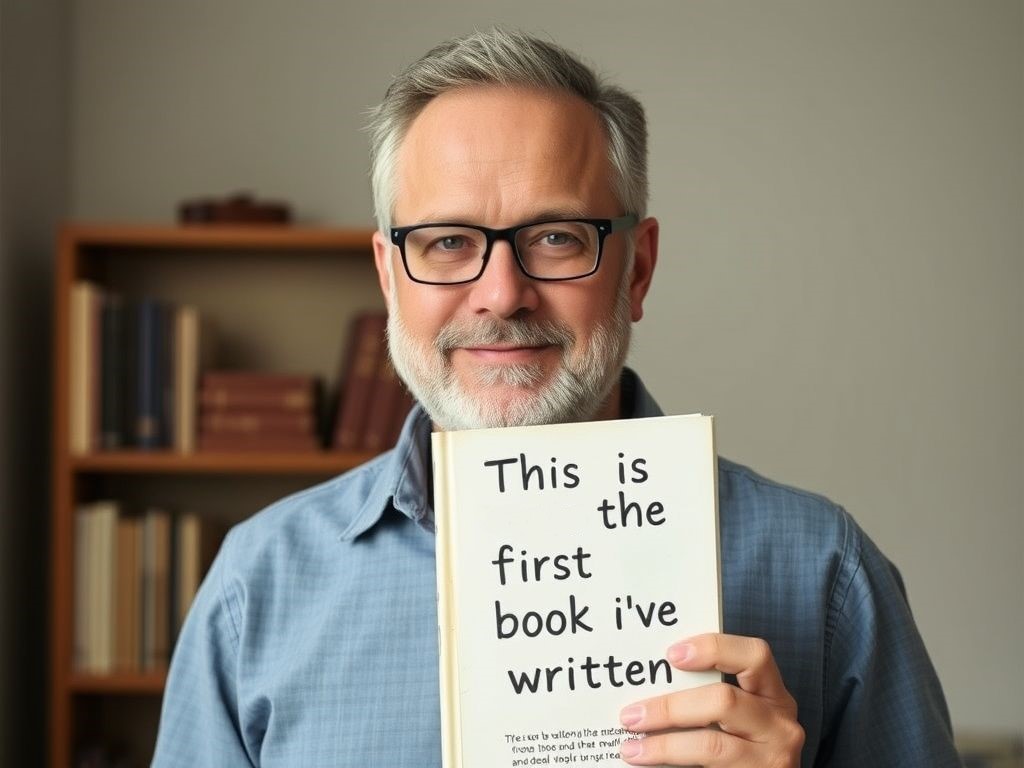
Man holding a book with the title "This is the first book I've written

This is the one thing you should do.

Authors of memoirs tend to be people who have had something interesting happen in their lives, and many are not writers by profession. If you’ve decided to write a memoir, this may be the first book you’ve written. So before you start your memoir, maybe you should do one little thing—write something else!

Even a gifted singer sounds better with practice and guidance, and writing is the same kind of art. You start out with whatever level of talent you bring to your keyboard, and from there you can improve.

I think the hardest aspects of writing a memoir are, first, just making the commitment and getting started, and then establishing a routine and consistently moving forward. I don’t want to put up a hurdle for you between the stages of commitment and consistent progress. If you feel that you’re “on a roll,” go ahead.

But if you have doubts about your writing and want your memoir to be not just informational but actually also well-written, it makes sense that your memoir should not be your first major piece of writing or the only writing you’ve done outside of school. Block out some weeks or months on your calendar for sharpening your skills.

Taking a class is a great idea, because you’ll have the teacher’s guidance, you’ll have an end date, and you’ll write enough to start feeling comfortable with the process. But you also can do some of this on your own. As you write, hand your work over to someone who could be your target memoir reader. Ask whether the writing flows and feels compelling.

Writing Practice Ideas

What should you write in these practice sessions to prepare you for writing your memoir?

  1. Dialogue. Not every good memoir contains dialogue, but most do because life is full of conversation. When you write dialogue, you bring the reader right into the action and involve the senses of, at minimum, hearing and sight. Dialogue writing is both a skill and an art, so learn the mechanics. Don’t make the rookie mistake of writing more than one sentence before supplying the attribution. Some authors will write an entire paragraph and finish the last sentence with “he said,” as in: “Don’t force my hand. I will tell Mom your big secret if you leave me no other choice,” he said as he looked up to watch a plane flying overhead.” That is not the conventional format. This is: “Don’t force my hand,” he said as he looked up to watch a plane flying overhead. “I will tell Mom your big secret if you leave me no other choice.”
  2. Research. You may think you’ll write your entire book from your own memory. Sure, the stories you relate will rely heavily on what you remember, but you’ll still have to do research. In some cases the research will be general fact-checking and finding out whether it was Sycamore Lane or Sycamore Road. But you may have to dig deeper. Let’s say you want to tell readers about your first job. You were hired in 1980 to sell T-shirts on the Atlantic City boardwalk. Every day, you got off a bus and walked to the shop. What did you pass? You might try to find photos of that era so you can name and describe the jewelry stores, the breakfast spots, the salt water taffy stands. You might relate a scene that takes place on the beach at 5pm. Was the tide coming in or going out? What time did the sun set on the day you’re describing? What was the weather—the temperature, humidity, wind and other conditions? All of those pieces will add color to your narrative but require you to do some research. Today, data and details are relatively easy to access. Imagine yourself working on this project before the Internet. I won’t give you a “when I was young” lecture on how we would use the library, telephone and public records to chase facts, but what took us weeks now can take minutes. So consider yourself born at the right time for that.
  3. A throwaway story. Write about what you know—you! Choose an episode in your life that you do not plan on including in your memoir. Look, if it turns out great and you love it, maybe you can wedge it in there somehow. But the idea is to practice the craft of memoir by writing a simple and unremarkable narrative from your own experience. Choose a scene you remember vividly, but it doesn’t have to contain a lesson or represent a pivotal point in your life. It’s just a story. Can you make it come alive?

After you complete those three exercises, I think you’ll find that you’ll be better prepared as well as more confident to write a chapter of your memoir. If you want one more assignment before you start, though, my advice is to read some memoirs that have received good reviews. Every good memoir has the author’s voice, but what they all have in common is that they keep the reader interested. By reading those memoirs, you’ll pick up tips on how that happens. Good luck!

Tips from A Selection of Memoir-Writing Blogs

Top Memoir Blog badge for Write My Memoirs

With the Write My Memoirs blog ranked #4 among memoir-writing blogs, let’s look at what the rest are advising memoir authors.

When FeedSpot notified me that it had ranked the Write My Memoirs blog fourth among all online memoir-writing blogs, of course I went to FeedSpot to take a look. And there it was. I didn’t pay these people or do anything out of the ordinary, so fourth sounds pretty nice to me. Then I became curious: what are the other blogs like? If you’re equally curious about the advice other bloggers are giving memoir authors, to save you time I’ve curated tips from a selection of memoir-writing blogs on FeedSpot’s list.

Some of the memoir-writing blogs I went through mostly provide the blogger’s review of books and even movies. I’m not interested—I’ll go to Goodreads if I want reviews. But some do give advice the way I do, anticipating what memoir authors need to help them produce their books. I chose four to share some of their tips with you.

Marion Roach Smith

Seasoned writer and memoir coach Marion Roach Smith has roughly 2,500 social media followers, so I understand why Feedspot awarded her blog the top spot. Her strategy is to interview published writers to get their answers to questions such as how to keep faith in your own ideas. I think these are more or less transcripts from her podcast. But a recent blog post, “In Praise of Humility in Memoir,” departs from that pattern as Smith shares her own views.

From that blog post: “My father, a fine sportswriter, used to say that you should try to write everything like a letter home, a suggestion that’s both graceful and correct. In a letter home you rarely tell those people who raised you how very great you are, or right you are, or unique. You tend to write about the ideas you are trying on, or the things you’ve tried and failed; how scared you are, or how lonely.”

I think that’s pretty good advice, although that last sentence uses the semicolon incorrectly. In a sense, a memoir is a very long letter. Even if you view your book as part memoir and part self-help book, readers don’t want a pompous author crowing about success. As you may remember, I listen to a lot of celebrity memoirs. So the authors are, by definition, famous and usually incredibly talented and good at what they do. But the enjoyable memoirs are the ones that focus more on their insecurities, flaws and failed attempts.

Memoir Writers Network

Occupying the #2 spot is a blog that is updated only every six months or so. I have nothing against book author Jerry Waxler, owner of Memory Writers Network, but I’m not sure why a blog with such infrequent posts qualifies for that rank. Also, I noted some punctuation errors that are probably not simple typos. Still, I found some things of value.

Titled “Siblings Disagree: Family Feuds in Memoirs,” one post focuses on Waxler’s experience reading a particular memoir about a dispute within a family. He explains that as a reader, he doesn’t take sides but instead uses memoirs to inspire a thinking exercise:

“To get the most value from my memoir reading experiences, I ask myself questions. Who are these people? What makes them tick? What would I have done? How deeply did I feel, not just the emotions of the situation, but perhaps even more importantly, how did the author’s presentation lead me through moral, ethical, and emotional dilemmas toward resolution?”

This is valuable for memoir authors to hear. Wouldn’t you be happy to have readers be so affected by your book that they would want to ask themselves these questions?

Louisa Deasey

Down the list a bit is a blog written by Louisa Deasey, an Australian writer who coaches authors and helps them publish—a lot like what I do. She has a big pile of blog posts to choose form, and I looked at one called, “When You’re Feeling ‘Stuck.’” Her answer to breaking that barrier is to come back to your “why” of writing the memoir. I think that’s a great tip.

In the post, Deasey metaphorically compares writing a memoir to growing a plant, writing that “seeds need darkness and quiet time in order to grow. They require faith, vision and trust. We can’t be pulling them up every few days, demanding to see ‘evidence’ of their growth. We can’t be talking to everybody about what it looks like… because we can’t see. The most miraculous creations (in the plant kingdom and in our human lives) don’t look like anything for awhile, until suddenly…They exist!”

I like that comparison.

Write Your Memoir in Six Months

Linda Joy Myers, one of two founders of Write You Memoir in Six Months, wrote a blog post that even I could use to read: “Pushing the Fear of Being Sued to Where It Belongs—on the Backburner.” In Facebook memoir groups, this is a perennially hot topic. A lot of authors fear that the people they write negatively about will sue them, and fighting a lawsuit takes money even if you have confidence that you’ll win in court.

Myers reminds authors that there’s no point in worrying about offending people until you at least have a manuscript. She writes, “The first draft is for you—and it’s for you to sort out your story, what you need to say, and how you’ll say it. The job of the first draft is to give you space to write! You need to claim that space and time and put publication fantasies and worries aside.”

She cautions writers from trying too early in the process to get permission from the people mentioned in the book. As you continue writing, you’ll change and delete a lot of references, so wait. Also, you may not get the answer you’re hoping for, and that could set you back in your motivation.

Myers acknowledges that once your book feels complete, you should consult a lawyer to identify which parts or language will be defamatory enough to possibly generate a lawsuit. You may want to change names and all identifying characteristics of some of the people. But all of that is for later. If you want to write your memoir, just go and write your memoir.

I agree with this advice, too. So I think FeedSpot chose some good memoir-writing blogs for authors to explore. I hope you always come back here to number four as well.


Words Writers Mix Up

Speech bubbles indicate young woman mixing up words while speaking with judgmental older man

Confusion grows over word usage.

I used to think the growing list of words writers mix up meant they were having a homophone issue—there/their/they’re, affect/effect, complimentary/complementary and that sort of thing. When terms sound alike, it’s easy to forget which meaning is spelled which way. Just remember that something may pique your interest, but you’re not much fazed by it.

These confused words are called malaprops or malapropisms and there was a time when we could use them as puns, but today I’m afraid that too few people would get it. Check out this joke with a pun in written form. How many people would get it?
The bride walked down the isle. Must have been a destination wedding.

More Malapropisms

As confusion grew, I began to see mixups with words that are pronounced only slightly differently from each other—lose/loose and precede/proceed, for example. Another commonly confused category comprises words with similar meanings, such as allude/refer.

But in recent years, the malaprops have expanded into full phrases made of up words that, in meaning if not sound, have nothing to do with each other. If you find yourself saying, “For all intensive purposes,” today’s column is for you. This column is for you as well if you laugh when people say that.

I’m not going to go through the sound-alikes, look-alikes or close-meanings. It’s a very long list available on various websites; I found a comprehensive account published by Touro University. Instead of repeating all of that, I’ll interrupt your memoir writing by giving you a few laughs and review some malapropisms that have created a whole new category of language-nerd comedy.

Let’s Laugh at Least

About as common as “for all intensive purposes,” which by the way should be for all intents and purposes, is “doggy dog world.” We know that can’t be correct, because that would be a cute world instead of the competitive world, or dog-eat-dog world, that is our reality.

You flesh out an idea when you want to explore it. I suppose you can “flush out an idea,” but that would indicate the idea’s quick destruction. I probably don’t have to tell you writers that you can take me for granted, but you cannot “take me for granite.” These are called eggcorns, a specific term for the phenomenon of mishearing a word or phrase and repeating the nonsensical replacement, launching a comical new meaning that spreads like a virus.

I give a little leeway to “deep-seated” as the eggcorn of deep-seeded. For one thing, they sound identical in the way most people would pronounce them. And for another, I can understand rationalizing that a deep-seated bias is a bias that goes a long way down, which is close enough to the intended meaning. Plus we don’t used the word “seeded” very often in ordinary conversation.

A similar pair is “chomping at the bit” vs. champing at the bit to indicate being eager to get going on something. Not only do they sound nearly alike, but we no longer use that meaning of the verb “champ” at all. So the original meaning of “champing”—that a horse is biting at the bit—is no more appropriate than saying the horse is chewing, or “chomping” at the bit. Still, when you’re writing, use the one that is generally considered correct, which is champing.

On the other hand, while it’s easy to understand how nip it in the bud became “nip it in the butt,” that doesn’t mean the second phrase makes any sense. You might nip something in the butt—ew—but that would have nothing to do with the nip-it-in-the-bud intended meaning of stopping something before it has a chance to cause much damage.

I’ve had this does-it-make-sense discussion with my grown children, who tried to convince me that a diamond in the rough is more or less synonymous with a needle in a haystack. No. When you perceive a bit of shining genius in an inexperienced person, the person is a diamond in the rough and just needs mentoring or an opportunity. When you find a shining genius in a group of ordinary people, you’ve found a needle in a haystack. You know this is correct because the phrases don’t make sense when you use one to mean the other.

So when you write what you consider a common saying, think about the meaning. Why make even a small error—“tongue and cheek”—when you can avoid it by realizing that makes no sense? Then you’ll look it up and find tongue in cheek, put your own tongue in your cheek, look in the mirror and see that it gives you a look of kidding someone, which is what you’re doing when you say something in a tongue-in-cheek manner.

You curl up in a fetal position, not a “feeble position.” You’re telling a “bald-faced lie”? Think about that. What exactly is a bald face? It’s a bold-faced lie. If you believe someone has an “alterior” motive, that is not a word at all. You mean an ulterior motive. If you believe that’s a “mute point,” think again, because it’s a moot point. And if you call it a “moo point,” you’ve been talking to Joey Tribbiani in a funny segment on Friends.

Misheard Song Lyrics

A subgroup of eggcorn is mondegreen, referring to a misheard song lyric. This term was coined in the 1950s by writer Sylvia Wright, who confessed that as a child she’d repeated a folksong lyric, They had slain the Earl of Moray and laid him on the green, as “They had slain the Earl of Moray and Lady Mondegreen.”

My husband and I were married a year or two when I realized that he sang along with Neil Diamond’s Forever in Blue Jeans as “Reverend Blue Jeans.” Luckily I had a sense of humor back then! And when the internet came along with all of its available trivia, I discovered that my husband wasn’t alone—this was among the most commonly misheard lyrics. But my favorite mondegreen is a misheard lyric from Purple Haze. Jimi Hendrix wrote the line as Excuse me while I kiss the sky, so I’ll use the eggcorn as my sign-off today: “Excuse me while I kiss this guy.”

(AI created the generation-gap image. I apologize to young people.)

Why Memoir Authors Procrastinate

Books with text "Turn the page"

It has nothing to do with being lazy or busy or distracted.

It’s common to put off your goal of writing a memoir either before or after you’ve started writing it. We beat ourselves up for this, annoyed that we can’t just sit down and write. But it’s not that we’re lazy. And, yes, we’re all busy and get distracted by everything, but we also prioritize and can find time. I hope looking at why memoir authors procrastinate will either motivate you to stay on task or help you at least to forgive yourself for periodically abandoning the project.

Writing a Memoir is Like Everything Else You Do

It’s not just writing; we procrastinate all tasks. And writing can really be a challenge. The thing with procrastination is that it quickly becomes an “out of sight, out of mind” condition. First you tell yourself that you’ll start on Monday or the first of the month or after the holidays. But once you’ve delayed it, you give yourself permission to put it off again, when Monday or whatever targeted date arrives.

Or if you’ve started your memoir and you pause, you get out of your writing habit. Like any habit, then it takes effort to get back into the swing.

Writing a Memoir is Like Nothing Else You do

Writing is hard, but you’ve written before, at least in school. The new aspect is your subject matter. Maybe you’ve put yourself into previous work—perhaps you’ve written an opinion piece or based an essay on a personal experience—but this book reveals so much about your life that you may not have even thought through, much less written about for others to read.

With a memoir, you’re running head first into obstacles thrown by two bullies—general writer’s block and naked exposure. When one’s not bombarding you, the other one is.

A Writer’s Procrastination

All writing projects carry inherent roadblocks:

  • How to begin your story? You may get so obsessed over grabbing the reader with a catchy lede that you can’t move on until you’re satisfied with your opening paragraph. This can be true whether you’re writing an article, essay or book. It’s a trap, and all you have to do is step around it. Start somewhere in the middle, with a story you remember well. Keep adding stories, and eventually you’re likely to intuitively know how to begin.
  • Structure. How to begin an article, story or book is just one of the decisions in the bigger picture of how to structure the piece. If you’re telling a story, do you go chronologically, jump back and forth, or start with a pivotal event and then go back and trace the roots before picking up where the event left off? Considering your structure also opens the doors to form. Should you craft your writing as a diary? Even a poem? Should you write in present tense or past tense?
  • Research. Nothing stops creativity in its tracks like finding yourself at a loss for facts. You may tell yourself that you’ll continue that chapter as soon as you have time to interview a key person, get access to some public records, read a history book, find an old map/telephone book/Yellow Pages, or get hold of whatever source you need to consult to provide detail or accuracy. You have two choices: put that chapter aside but keep writing from a different point in time, or start on the research right away. It’s harder to go back to it after you’ve lost momentum and still haven’t done the necessary research.
  • Edits. Being unhappy with some part of what you’ve already written is another hurdle writers easily trip over. Until you fix this or that, what you want to write next won’t have enough background to make sense, or the opposite—it will be somewhat repetitive. Or you’re just feeling that the writing isn’t that good and you should improve it before starting the next chapter. But writing a flawed first draft is absolutely permissible. I confess that this issue often slows me down. I want to be satisfied with the part that’s done, and sometimes I edit it over and over before I continue. That’s okay, too, as long as, at some point, you get yourself to accept that it’s in good enough shape to move past it.
  • Insecurity/imposter syndrome. Before you start writing, and periodically as you write, your insecure side may be needling you about not being a good enough writer. You’re either writing this or you’re not. Make up your mind, and stick with it! Worry about how good it is after you finish. At least then you’ll have fulfilled your promise to yourself to write it.
  • How to end? If you get to the ending, know that finishing a piece of writing is easier than starting it. But in any dynamic writing, you can be unsure of whether you should wait and see what happens next. Or you may not know how much to include. So you put the writing aside again, hoping to come to terms with an ending. That’s when insecurity can creep back in to sabotage your project and keep you from going back to it at all.

A Memoir Author’s Additional Procrastination

With all of the circumstances that can derail any kind of writing, it’s not a surprise that a memoir carries even more threats to completion. Memoir authors specifically also have to deal with:

  • PTSD. Many memoirs focus on a traumatic event. The only way to write about trauma, at least when you’re writing it out for the first time, is to more or less relive it. You have to gear up for that, and it’s understandable when you let days or months pass before getting yourself to go through that. Or you start, and then the next time you try to pick it up again you just can’t. This is hard, and you have to really commit to getting it done, but then it’s often cathartic and the event stops haunting you.
  • Simple sadness. Maybe you’re humming along fine until you reach the part about your mother’s death, and you are just never in the mood to write about that. Again, it’s having to relive something that was difficult the first time.
  • Second thoughts. A lot of memoir authors struggle with whether to publish their life story. Even after starting the project, they may hit a point of delaying because they worry that their life isn’t interesting enough for anyone to want to read about it, or that what they’re writing about will hurt the feelings of some of the people in their life, or that some of those people may even take legal action against them. They don’t know the first thing about getting a book published and worry about that process. People who write about a happy life may start to worry that they’re jinxing their own chance for joy in the future—as soon as you proclaim you’ve had a great life, something bad happens—and that can stop them from finishing the work.

So you may be insecure or worried or traumatized, but you’re not lazy! Give yourself a break, identify what’s keeping you from finishing your memoir, and dive back in.


Memoir Is More Forgiving Than Biography

Old photo in a memoir of woman paddling a canoe

Fuzzy facts provide one more reason to write your story from the first-person perspective.

I was reading a recent book review of a biography—not a memoir—of Dr. Mary Putnam, a pioneering doctor in women’s medicine, when a single criticism struck me. Writing in The New York Times Book Review section, the reviewer noted that the author “indulges in sentimental moments of seeming speculation.” This is why memoir is more forgiving than biography—in memoir, speculation is accepted as accurate enough, and if anyone has the right to be sentimental, it’s a memoir author.

Biography is History

The sentence the reviewer quoted was: “Sometimes while they worked, their hands touched, causing Mary to feel electrified.” The author created this visual in order to bring to life a courtship, explaining how Mary Putnam came to marry a fellow scientist at a time when women in a serious profession like medicine were commonly considered too masculine for a man to marry. Is it a stretch to think that a brush of their hands might have occurred as they were in close proximity in the lab together, working toward a common goal and appreciating each other’s scientific mind? Not at all.

But did it actually happen? Probably not, but who knows? In a biography, though, I agree with the reviewer that the description feels contrived. There’s no footnote to credit a source for this “fact.” There’s no descendant or witness to interview. The author can’t know what happened between the two people, and the reader understands this.

Memoir is True-ish Story

Memoir carries different rules. You may conjure up out of your imagination the very same scene about a relationship you had, with no memory of hands touching or not touching. But when you write that your hands touched and sent electricity flowing through you, the reader accepts it—even appreciates that you’ve included such intimate detail.

This is the beauty of memoir. It must be accurate in dates and in the facts of the events, and the author must present the information in a sincere way. But your descriptions of little backstory events can include a blurriness of accuracy. You’re not expected to remember every aspect of a setting or encounter.

Maybe the lady at the counter didn’t say the exact words you quote in chapter two, but your account of the exchange still captures the intent of her words. Perhaps you’re not sure whether it was your brown jacket or your blue one that you had on the day your dad walked out, but you know you were wearing one or the other so you just choose one because the narrative becomes more vibrant when you include the jacket’s color. And your hands probably touched as you flirted with your lab partner senior year of high school, but you can’t be sure. You just like the image so you throw it in there.

In memoir, that’s all okay. In a biography, it’s cheesy, “indulgent” as the book reviewer calls it, and insulting to the reader. Isn’t that funny? As a memoir author you can get away with a lot more, and you should try. Your memoir should read more like fiction than like history, whereas a biography, even with elements from fiction such as a lot of dialogue, still is meant to be taken as a historical account.

Stick to As Much Truth as Possible

That doesn’t mean everything is loosey-goosey in your memoir. It’s still easy to alienate readers when your story develops a feeling of falseness. So follow a few principles:

  • Don’t exaggerate! If you say that your mom hit the city street at a speed of 100 miles per hour, it doesn’t ring true. Either refer vaguely to a “high speed,” or you can say it felt to you as if you were moving at 100 miles per hour. Better yet, find a creative way to describe a child’s impression while riding in a fast-moving car.
  • Keep any fact-fudging believable. Beyond just exaggeration, everything you contrive must sound at least plausible. Going back to the example of the lady at the counter, the conversation has to be close enough to the truth to sound as if it could have taken place. Let’s say I want to write a chapter about my mother. The photo above is of my mom attending a summer resort before she was married. I have little idea what she did there, but owning a picture of her paddling a canoe gives me a point of accuracy to cite.
  • Stay consistent. One of the biggest pitfalls in writing a memoir is letting your information clash—not keeping your facts straight. If chapter three takes place in 1967 and mentions that you spent your summer with your eight-year-old cousin, chapter six can’t have the same cousin coming home from the army in 1973.
  • Fact-check what you can. Dates, names, spellings, street names—was it a road or an avenue? Anything the reader might know or can google is something you should check before you get to the final manuscript. If you visited western Pennsylvania, the city is Pittsburgh with an “h”; if you were in Kansas, it’s Pittsburg, no “h.”

But when you tell your own story, you are the number-one source for facts. You’re not only the author but also the main character. The reader trusts you to tell the truth about your life—or a version that captures the truth in spirit.

Memoir Writing Sample

Rosanne in front of a fire at a restaurant

The year 2024 in my life

To start off 2025, I thought I’d give you a memoir writing sample of my own work. This doesn’t really work as a chapter, because I tweaked and adapted it from my annual holiday letter. But it might give you some ideas about infusing humor and weaving a theme throughout a story arc. I changed the family names.

Chapter Sample
The Year 2024

I fractured my right foot’s fifth metatarsal the day after Thanksgiving 2024 to end the year on a low note. As always, life was presenting a learning curve, and I vowed never again to break my own rule about switching on a light when walking at night through a rented house with a sunken living room.

We were in Chicago at the time, once again gathering the immediate and some extended family to enjoy late autumn until it devolved into 14-degree weather. The cold of the north can look good next to—counting backwards for Sarasota alone—Hurricane Milton, Hurricane Helene and Tropical Storm Debbie. Early one October day had me watching, from the safety of a hotel room west of Miami, Milton slamming straight into Sarasota. Our house weathered the weather, while a couple of our tall trees and some fencing were not as fortunate.

As Hurricane Milton raged, Rita was at her D.C. office, breathlessly monitoring the storm tracker. “Wait, that’s my street!” she exclaimed as the map showed the eye of the hurricane looming directly above our neighborhood. When the skies calmed, Rita returned her attention to matters in her government job in food security, where her learning curve had to do with crops and soils in various climates. This did not help her figure out why I couldn’t find a decent locally grown orange in the Orange State.

In my continual learning about hurricanes, I was informed that flooding on our street was unlikely, since it stretched between a manmade reservoir and a main road’s drain and was engineered to send the standing water to one or the other, plus we were situated too far from the coast to be affected by a storm surge. Wind, though, was always a worry.

And well before hurricane season, there was always humidity. I would try to get away, so in August when Judith and Chris sold their sweet Boston home of 12 years and moved not far away to a newer house with space for me to stay with them, I immediately flew up there for a few days. They appreciated my help during parents’ dreaded black hole—the weeks between camp and school, where eventually Sophie entered third grade and Cody started fifth. They didn’t have to change schools; in fact, their school was just steps from their new house.

Our relationship grew closer in 2024, when the kids took to video chatting on their own with me. Sophie liked sending memes of herself as a cat, while Cody mostly grunted “I don’t know” in response to my questions, just as he would do in person. It came with the 11-year-old territory. In the fall, Sophie got into the habit of ringing me up early as she prepared for her day. One morning, when Judith reminded her daughter that it was time to go to school, Sophie said she needed a minute. “I’m on a call,” she explained. When I supported her mom’s direction that she’d better leave soon, Sophie held her iPad up to the window so I could see the outside. “Grandma,” she countered, “the school is right there.”

We knew that Paul was popular with the kids, but we hadn’t pinned down a reason until Judith related the deliberation Cody and Sophie had when their parents were serving them ice cream. “Should we have two regular scoops or two ‘granddads’?” Cody asked his sister, referring to the term they apparently used when they wanted the supersized portions Paul doles out during their Florida visits.

Anna and Dylan were stretching the honeymoon phase of married bliss. After a decade of working alongside her dad, Anna floated her résumé for in-house counsel jobs and in January began working remotely as senior counsel at a California-based fintech firm. I had to google “fintech,” even though Judith coded in that sector for years. Blame my neverending learning curve in tech. And in fin. Paul was so impressed when Anna was offered the job—impressed with himself, of course. “Being my associate attorney can really take you places!” he concluded.

Paul missed his former associate and had to do all the work himself, but he took breaks by continuing to play on two old-man softball teams, each with a weekly double-header. There also was our Senior Games training. With my bum foot I was glad we didn’t wait for Florida’s December games to qualify for the following summer’s Nationals but, instead, earned our qualifying medals in South Carolina and Georgia. At the South Carolina games’ javelin event, one competitor in my age group had never thrown before. Paul coached her a little, offering tips and correcting her movements. And then she beat me. I gave my husband the silent treatment, while he contended that it was my own fault, because despite my steep learning curve in javelin, I never listened to his advice.

In late June, while the others opted out, Paul, Rita, Anna and I spent time in the ancient ruins of Rome and Pompeii. Paul loved every minute of watching all he’d read about come to life. The Vatican, the Colosseum, the Pantheon—everything was fascinating. Having studied there one college semester, Anna made all the plans—from the nightly restaurants to designing our walking route so we’d pass the Trevi Fountain precisely at dusk to driving us to Pompeii in a rental car she’d prebooked from a company owned by “some guy online.” Sounded reliable.

Then Anna returned home while the three of us continued on to Bologna, one of few Italian spots Rita had never visited. She wanted to learn something new, so we hopped a train and then took a walking tour of what turned out to be an interesting city. From there we went to Modena to see the Ferrari Museum with a lot of cool cars and the home of Pavarotti, where his opera costumes were displayed along with the Emmy awards he’d received for some PBS specials. It was fun to see Emmys up close.

It was on this trip that our learning curve really climbed. Not only did we pick up information about Italy and of course wine, but we discovered we needed to get better in touch with our bodies. I thought I was sensitive to the extreme heat because it was drier there than on the Gulf Coast, and I couldn’t get enough water in me even when surrounded by an aqueduct. But when we arrived home, a little test told Rita and me that we’d been walking around with Covid, which Rita had brought with her from Washington. Paul stayed Covid-free, and Anna felt fine as well. But a completely different type of test revealed that in Italy Anna was, as they say, just a little bit pregnant. She and Dylan ended the year looking forward to a baby due the following March.

Login

Then just set up a chapter and start writing your memoir. Don’t worry about rules. There are no rules to writing your memoir; there are only trends. These trends are based on techniques and features identified in current top-selling memoirs. At best, they’re the flavor of the month. If you’re capturing your life in print for your family, for your own gratification or to inspire readers, rather than aiming to set off Hollywood screenplay bidding wars, these trends don’t even apply to you. You’ll write the memoir that suits you best, and it will be timeless, not trend-driven.There are no rules, but there are four steps:

1. Theme/framework
2. Writing
3. Editing/polishing
4. Self-publishing

You’ve researched this, too, and you’ve been shocked at the price for getting help with any one of those steps, much less all four. That’s because most memoir sites promise to commercialize your work. They’ll follow a formula based on current memoir trends, because they want to convince you that they can turn your memoir into a best-seller. These sites overwhelm you with unnecessary information not to help you, the memoir author, but to address Search Engine Optimization (SEO) algorithms so they can sell more.

That’s not what we do at Write My Memoirs. Our small community of coaches, writers and editors are every bit as skilled as any you’ll find, and we charge appropriately for their expertise and the time they’ll spend helping you craft a compelling, enjoyable read. But you won’t pay an upcharge for other websites’ commercialization, the marketing that follows, and the pages of intimidating “advice.” You can sell your book if you like—we have ISBNs available for you—but our organic process of capturing your story takes a noncommercial path.

If you want help with any or all of the four steps above, choose from our services or save money by selecting one of our packages. If you’d like to talk about what’s right for you, schedule a call. One year from now, you can be holding your published memoir in your hand. And at that point, it will be a big deal!