We are experiencing issues with our Contact form.
Please Email Us Directly at: Su*****@************rs.com.

Every ordinary life story is extraordinary!

PLEASE NOTE:

oUR CONTACT US Form HAD A MALFUNCTION.
IF YOU HAVEN’T RECEIVED A REPLY, PLEASE FILL IT OUT AGAIN OR WRITE US DIRECTLY.

Every ordinary life story is extraordinary!

Back to the Beginning: Your Memoir’s First Sentence, Part 2

Blank screen with hand and stylus for writing a memoir's first sentence

Let’s look at some openings from published memoirs.

Last time, I threw out a few ideas to get you started on your memoir’s first sentence or couple of sentences. The beginning of your book will provide the hook to keep readers interested in finishing Chapter One and, you hope, beyond. But how critical is that first sentence? You probably want examples.

Into My Library of Celebrity Memoirs

As I often mention, my motivation to run is that it’s the only time I allow myself to listen to celebrity memoirs. By now, quite a few celebrities have talked me through my painful track training, so in a quick review I chose some of their memoir openings to share with you, along with my comments.

I have too many for one post, so I’m going to save half for a Part 3 on this topic. Today’s half offers only actors. I want to know about the author’s youth, but I admit to being partial to memoirs that start somewhere other than in childhood. Let’s see how these sentences introduce the reader to the memoirist’s world.

Jennette McCurdy, I’m Glad My Mom Died
“The present in front of me is wrapped in Christmas paper even though it’s the end of June. We have so much paper left over from the holidays because Grandpa got the dozen-roll set from Sam’s Club even though Mom told him a million times that it wasn’t even that good of a deal.”

You wouldn’t want a shocking beginning when you already have that irreverent title, so a somewhat banal first sentence provides balance. This bestseller lets you know you’re in for a story, not just a lengthy whine.

The sentence mentions her mom, so we stay on topic, but it doesn’t hint at why the author might be glad her mom died. If anything, she implies that she’s on the same page with her mother about the wisdom of her grandfather’s purchase. She gets you wondering what will happen with her mother. As my last post mentioned, it’s good to get readers to ask questions, because they’ll keep reading to find the answers.

This is a very young author, so starting in childhood isn’t going that far back. Still, note the choice.

Harvey Fierstein, I Was Better Last Night
“Philamina got the role of the evil witch, and I was cast as the king. The king? Who wants to be the king? Sure, he gets a crown and a cape, but the witch gets green skin, red lips and long, black fingernails. I wanted green skin, red lips and long, black fingernails. Second grade was not working out the way I’d hoped.”

The memoir of Harvey Fierstein, whom I hope no one confuses with Harvey Weinstein, focuses mostly on Fierstein’s professional life as an actor and personal life as a gay man. His opening sentences weave in both topics and then end with a surprise punchline that made me laugh out loud. Even if you read this memoir rather than listen to it, you can hear Fierstein’s distinctive, raspy voice in that last sentence.

I loved the book, and the first paragraph is probably my favorite of this group because it’s funny. But, again, here we are in childhood. And not every memoir can start with humor, so you may not be able to copy this style.

Viola Davis, Finding Me
“‘Cocksucker motherfucker’ was my favorite expression, and at eight years old I used it defiantly. I was a spunky, sassy mess, and when I spewed that expression, one hand would be on my hip, my middle finger in vast display, and maybe my tongue would be sticking out.”

Having Viola Davis read to you for hours is a treat, but I’m not sure about this opening sentence. Her description of her little self paints a clear mental picture, and the reader needs that because in her masterpiece of a memoir Davis spends a lot of time on her childhood.

I think my problem with this opening is that it feels like an early draft. I can see an author sitting and thinking about how to start her story and coming up with this, as if she’s looking at herself from an outside vantage point. It’s almost too cutesy or self-conscious or something. I’m a little torn on this one.

Rob Lowe, Stories I Only Tell My Friends
“I had always had an affinity for him, an admiration for his easy grace, his natural charisma, despite the fact that for the better part of a decade, my then-girlfriend kept a picture of him running shirtless through Central Park on her refrigerator door.”

The “him,” the target of Lowe’s affection as well as his girlfriend’s admiration, is John F. Kennedy, Jr. The two men were friends, and even though JFK Jr. doesn’t play a large role in Lowe’s memoir, he pops up later in the book in a pivotal way.

This opening, then, deftly previews for the reader that this friend will have something to do with Lowe’s life, but it’s so subtle that you might not see it coming when JFK Jr. shows up years down the road. The first sentence also gives you a feel for the way Rob Lowe saw people and hints at the role handsomeness will play in the book. I think it’s a good opening, and it’s nice to start somewhere other than childhood.

Minka Kelly, Tell Me Everything
“’Oh baby, I have something special in store for you,’ Mom gushed. She hugged her arms close to her chest as if she needed to keep the joy from bursting through her entire body, like it was a current of energy that pulsed through her, not always under the influence of her control.”

I feel as if I’m always going overboard in being transparent, and on this one my full disclosure is that I included Minka Kelly’s memoir because I really enjoyed it and hope to give it a little more exposure so more people read it. But then I’m a big fan of TV’s “Friday Night Lights,” in which Kelly had a lead acting role.

Like so many others, Kelly chose to begin her memoir in childhood and tell readers about her mother, the primary figure in her life. Bringing us into the heart of an anecdote, she leads with dialogue. I’m fine with using dialogue to open other chapters, but for Chapter One of the memoir I think it’s a bit of an easy way out. Don’t let that discourage you from reading the memoir. It’s good.

Henry Winkler, Being Henry
“It was the biggest audition of my life, and the sweat stains under my arms weren’t just clearly visible; they were a cry for help.”

I’m surprised this type of sentence doesn’t open more celebrity memoirs to immediately place us at the most pivotal point of the career. Maybe authors want to build anticipation so we keep reading until we get to the part of the celebrity’s life that most interests us.

We can make an educated guess about what the biggest audition of his life is—probably for the breakout role of Fonzie in “Happy Days”—but Winkler stops short of giving us the full story here. Readers don’t find out how that audition played out until much later in the book. I like the tease, and I also like the acknowledgment right away that the author knows why we bought his memoir.

Sally Field, In Pieces
“I wait for my mother to haunt me, as she promised she would, long to wake in the night with the familiar sight of her sitting at the end of my bed, to talk to her one more time, to feel that all the pieces have been put into place, the puzzle is solved, and I can rest.”

Field wants to quickly tell us what her title is about. I’m not sure that’s necessary; it’s not hard for readers figure out on their own. But the opening sentence is effective in letting us know that an Oscar winner now in her 70s is, if not still fixated on her relationship with her mother, at least writing her book in part to explore that relationship. I don’t think it’s the most original beginning, the most personal or even the strongest she could have come up with, but I think it’s not bad.

Is “Not Bad” Good Enough?

You can see that I’m not falling all over myself about how great these openings are. Some are very good; others are just adequate. But not one is a failure. I’ll let you know in Part 3 whether “not bad” is good enough.
New Memoirs for 2024 to Help You Write Yours

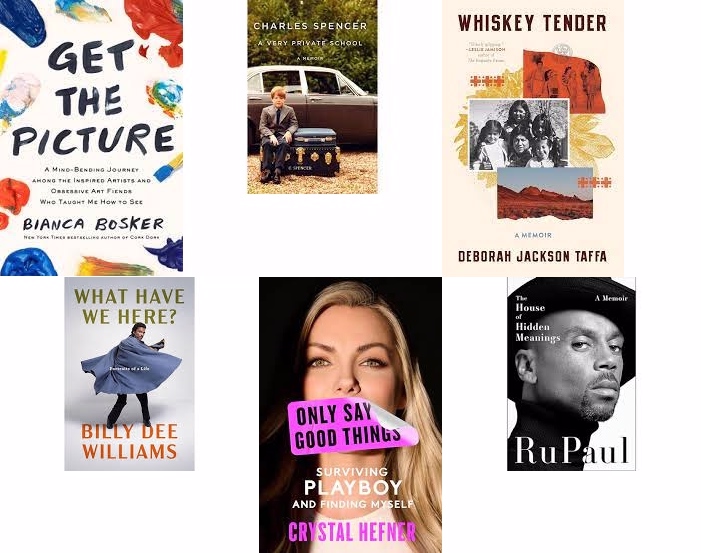
Six 2024 memoirs you can read to help you write yours

Memoir continues to be a popular genre as 2024 moves along. Reading memoirs for 2024 can give you a lot of clues to help you write yours.

It’s hard to find time to read books when you’re writing one of your own. But it’s both motivating and instructive to read well-crafted memoirs published about the same time you’re hoping to publish yours. What is selling these days? What type of work do publishers accept?

My tip if you have no time to read is to combine exercise with audiobooks. I listen as I run, which gets me out running and also takes no extra time, since I’m “reading” memoirs during the time slot I’d already set aside for working out. It’s a lot of bang for the buck.

I’ve divided a selected group among this year’s most anticipated memoirs, some just-published and others not yet in print, into categories reflecting types of memoirs and memoir authors I see in my work as a memoir editor and coach. Of course, you can read memoirs that are not in your group, too.

If Your Memoir Recounts a Triumph Over Adversity

Everyone but Myself by Julie Chavez
Was published January 9
An intense panic attack rocks Julie Chavez and motivates her to take better care of her mental health.

Outofshapeworthlessloser: A Memoir of Figure Skating, F*cking Up, and Figuring It Out by Gracie Gold
Was published February 6
Bulimia and suicidal ideation are just two of the challenges 2014 Olympic bronze medalist Gracie Gold discusses in her story of discovering her worth.

A Very Private School by Charles Spencer
Coming March 12
Growing up rich isn’t the same as growing up happy. Princess Diana’s younger brother Charles Spencer may have had a privileged childhood, but he recalls feeling abandoned and encountering nothing but cruelty at the boarding school that educated him when he was a little boy. He had to establish his own sense of self even through the fame that came with his sister’s marriage to British royalty.

If Your Memoir Focuses on Your Minority Group Experiences

What Have We Here? by Billy Dee Williams
Was published February 13
Old-timers know Billy Dee Williams from various TV and movie roles, including his breakout role in 1971’s “Brian’s Song,” while “Star Wars” fans recognize him as the first Black actor in the franchise. There’s a lot before and in-between for Williams to share with readers about being a Black actor back when.

Whiskey Tender: A Memoir by Deborah Taffa
Coming February 27
Deborah Taffa reflects on her 1970s-1980s childhood on a Navajo reservation in New Mexico and incorporates the history of Natives’ relationships with other Americans.

Beautiful People by Melissa Blake
Coming March 5
Here, a viral tweet inspires a book. In 2019, disability activist Melissa Blake tweeted to advocate for the rights of people with disabilities, and this memoir goes deeper into her experiences and disability.

The House of Hidden Meanings by RuPaul
Coming March 5
Highly anticipated, RuPaul’s memoir takes readers into the life of a drag queen who grew up poor, Black and queer. Word is that RuPaul is no less articulate a writer than he is a TV host and personality.

Cactus Country: A Boyhood Memoir by Zoë Bossiere
Coming April 17
Remembering the time spent in an Arizona trailer park, author Zoë Brossier tells how it was to navigate gender lines with both binary and nonbinary experiences.

Make It Count: My Fight to Become the First Transgender Olympic Runner by CeCé Telfer
Coming June 18
Born in Jamaica, CeCé Telfer became the first openly trans woman to win an NCAA championship, and here she chronicles the path.

If Your Memoir Shares Lessons and Inspiration

Only Say Good Things: Surviving Playboy and Finding Myself by Crystal Hefner
Was published January 23
This tell-all memoir by the third wife of the late Hugh Hefner is getting a lot of buzz. She was just 21 when she married the Playboy magnate and was the widow left when he died in 2017. With a few more years and a broader perspective, Hefner describes the underbelly of life in the mansion.

I Did a New Thing by Tabitha Brown
Was published January 30
Known for her multiple books on her vegan lifestyle, Tabitha Brown links her success to fearlessly trying new things. She traces the way little steps can lead to big changes.

All You’ll See is Sky by Janet A. Wilson
Coming April 16
Wilson explores her relationship with her husband as they embarked upon a 25,000-mile African adventure. She helps the reader learn how a marriage can survive even when unpleasant events and memories surface.

If Your Memoir Incorporates Your Work or Hobby

Get the Picture by Bianca Bosker
Was published February 6
Bianca Bosker worked as a security guard in a museum, only one of the adventures she shares as an appreciative observer of art and artists.

The French Ingredient by Jane Bertch
Coming April 9
In 2009, American Jane Bertch launched La Cuisine Paris, a French cooking school for the non-French. Her memoir tells the challenges of an American trying to open and operate a business in France and describes the delicious dishes she taught.

If You Think You’re Too Young to Write a Memoir

One in a Millennial by Kate Kennedy
Was published January 24
Podcast host Kate Kennedy grew up in the 1990s and 2000s and offers up her first memoir reviewing all that was cool and hip in those decades.

Here After by Amy Lin
Coming March 5
Canadian author Amy Lin not only lost her 32-year-old husband suddenly while the pair were still newlyweds but shortly after faced her own health crisis. Even young people face tragedy and challenges worthy of a memoir.

If Your Memoir Has an Unorthodox Format

Alphabetical Diaries by Sheila Heti
Was published February 6
Sheila Heti’s first book was the novel Pure Colour, while this memoir tackles the creative structure of presenting sentences from Heti’s journal in alphabetical order.

Joyce Carol Oates: Letters to a Biographer by Joyce Carol Oates, edited by Greg Johnson
Coming March 5
This memoir gathers correspondence between the late novelist Joyce Carol Oates and editor Greg Johnson to fashion a narrative providing insight into Oates’s life and thoughts.

What Rappers Fat Joe and Kid Cudi Tell Us About Memoir

Fat Joe and Kid Cudi

Yesterday, Kid Cudi announced that he’s several chapters into writing his memoir and hopes to publish it next year. The musician, actor and producer, who started as a popular rapper, promises to reveal stories that are not known to his fans or the public in general. Certainly a celebrity memoir should do that. But there’s more to his message than a bit of sensationalism or gossip.

Similarly, rapper Fat Joe released The Book of José last fall to chronicle the path he took from a tough childhood to money and fame. What can these new memoir authors teach us?

1. People Write Memoirs to Inspire

Like many of you non-famous memoir writers, Kid Cudi wants his memoir to inspire people. He tweeted:

“Anybody that has a dream or wants to do anything, especially those kids in those small towns somewhere in the United States or anywhere outside the world, in another country, that just wants to do something great with their lives. This book is gonna give you that push. This book is definitely gonna continue the same formula I started with the music and hopefully it’ll be something you can keep with you and something that can guide you and give you some inspiration and some hope.”

Fat Joe, too, includes inside info on his celebrity friends, but the book is more significant in speaking directly to the next generation to say that anything is possible when you have talent and dream big.

2. There’s No Wrong Time to Write Your Memoir

Fat Joe is 52, and Kid Cudi is 39. You might call their books their life so far. They are not finished with life or career, but the tale of how they became successful won’t change, so why not write it now?

When you have a story arch in your life, that’s fodder for a memoir. One person with only one life can write multiple memoirs, each focused on a different era of that life.

3. Other Creativity Can Accompany, But Not Replace, Memoir

Kid Cudi and Fat Joe have been rappers for a long time. Haven’t they said in song all they want to say? Kid Cudi has acted in scores of TV shows and movies, and Fat Joe created a new standup comedy routine to supplement his book. But memoir stands alone, apart from the other creative projects, because memoir is unique. It’s a book about the author by the author in the author’s voice.

You can read it on screen or hold the book in your hand. You can give it as a gift. There’s nothing like seeing your own truth on the page in black and white, available for all time.

4. The Memoir Genre Is as Hot as Ever

With all that these guys have going on, you wouldn’t think they would bother putting out a traditional vehicle like a memoir. As you authors know, it takes a lot of time and trouble to write a memoir. Even if they have a co-writer, they have to give it their attention.

But memoir—celebrity or otherwise—continues to be a popular nonfiction genre. While memoir has given Fat Joe and Kid Cudi a respected way to express themselves, they’ve given back to the memoir genre their personal stamp of approval. Their fans get to experience memoir by learning more about someone they admire. They get to have hope, because these authors give them that hope.

No wonder even in this time of texting, tweeting, TikTok and general quick fixes, a memoir—an actual book—still connects with both writers and readers.

A Love Story as a Memoir

Roses around a piece of paper that someone is writing on.

When you remember that a memoir is not your entire life story but just an episode or time segment in your life, you can see why sometimes a memoir is little more than a love story. It’s that place and time, recalled through sights and sounds, food and conversation. It’s that one who got away or the romance that blossomed into a long marriage. It’s the ultimate joy of your life, or it’s loss and grief. The memoir tells one or more aspects of what that love was about.

Why Write a Love Memoir

You might write your love story memoir because you want to document:

  • Your happy marriage. This type of memoir honors your spouse, who’s likely the most important person in your life. It will trace your life from the time you fell in love up to the present day or, perhaps, to when your spouse died.
  • Your troubled marriage/relationship. Love doesn’t always bring together the most compatible people, and in some cases the relationship is explosive. Maybe you want to document that. Sometimes it’s not about compatibility but about abuse. At Write My Memoirs, we hear from people who want to explain how and why they left an abusive relationship that, at least at one time, involved being in love.
  • The loss of your partner. Whether the relationship was brief or long, losing someone you love is tough. One way to process the loss is to write about it, as many people do. This memoir can express your admiration for the partner, but it also can contribute to the general discussion of how we move on alone.
  • More than one love. You can devote a memoir to your romances without limiting it to just one. Maybe you’ve noticed a pattern in the people you’ve loved, or you just want to walk down memory lane and relive the experience of each romance.

Other Love

Your love memoir may not be a romantic story at all. Love comes in many forms, and a love memoir can reflect any of them. Let’s do this in rhyme:

The love for a child,
The love for a pet,
The love for an icon
You have never met.

People write tributes to their siblings or parents in the form of a memoir. There are memoirs about the love for a friend. Truth & Beauty: A Friendship, by Ann Patchett, recounts the friendship the author had with writer Lucy Grealy. Among the tributes to Fred “Mr.” Rogers is I’m proud of you : My Friendship with Fred Rogers, a memoir by his friend Tim Madigan. And there’s Just Kids, a memoir we love here on Write My Memoirs, about singer Patti Smith’s love for her late friend, artist Robert Mapplethorpe.

Start Today!

But today is Valentine’s Day, and romantic love is always fascinating, always a unique story. So if you want to reminisce about a romance you experienced that may or may not still be in bloom, today is a great day to write that first word. You can practically smell the flowers.

Why People Start Writing Their Memoir at Age 70

Older man writing on a computer.

There’s no correct time to write your memoir. You can be young and still have lived through enough trauma or unusual circumstances to write a compelling tale. Both Tara Westover and Jennette McCurdy were still in their 20s when their respective memoirs, Educated and I’m Glad My Mom Died, hit the best-seller charts.

But for most of us, it takes years before we sit down and write about our lives even if the episode we write about happened decades earlier. A genealogist friend of mine told me that a lot of people who contact her for help in tracing their ancestral line are right around that magic 70-year mark. Similarly, age 70 seems to be a common point for non-celebrities to look back and write down the significant events of their lives.

Multiple Reasons for 70-year-olds

From what we hear at Write My Memoirs, this seems to have multiple reasons. If you’re 70 and thinking about writing your memoir it might be because:

  • You finally have time. By age 70, you’re most likely either retired or working part-time. Even if you’re not exactly desperate for something to do, you probably can budget in writing hours.
  • You have grandchildren. Not every 70-year-old is a grandparent, of course, but those who are frequently want to write down the facts of their lives so that the next generations have the information.
  • You feel mortal. This is when we all start thinking about how much time is left to accomplish our goals. If you don’t write your memoir now, when will you do it? Unfortunately, time is running out for you to be able to count on good mental and physical health.
  • You’ve had a lot of experiences. Maybe at 40 you thought that your life was ordinary and not worth chronicling. You may not have ever kept a diary. Now that you’re older, though, you’ve lived more and can see that everyone’s life is unique. You did have some unusual experiences after all—maybe recently.
  • You’re feeling nostalgic. Studies show that older people like walking back through their lives. You may enjoy recalling your childhood, thinking about your teen years, reliving your romances and feeling proud of your professional achievements. You’re nostalgic for your own life. Writing about it becomes pleasurable.
  • You want to share your opinions. Perhaps your memoir is less about your life and more about how your experiences inform your politics, child-rearing advice or other opinions.
  • You’ve always wanted to author a book. If you never came up with a plot for a novel or did the research for a nonfiction, informational book, you still can write your memoir. It’s the one topic you know very well with little research, and you don’t need imagination to invent a plot, because it all happened to you.

You certainly don’t have to wait until you’re 70 to begin writing your memoir. But if you’re approaching that age or beyond it, now is a great time to get that book into motion.

Writing About Love: A Valentine’s Day Memoir

Rose on book pages

While many memoirs focus on a traumatic time in the author’s life, there’s no rule saying a memoir must be dark. If you have a great love in your life—romantic or otherwise—you may want to document that in your memoir or even use it as the main focus.

Just Kids comes to mind. Musician Patti Smith’s memoir about her relationship with photographer Robert Mapplethorpe ranges from the initial romance to an enduring, passionate friendship after Mapplethorpe confronts his true sexuality. And it certainly has its dark edges with Mapplethorpe’s death from AIDS. But it’s the love between two people, especially creative people whose emotions stay right on the surface—the rawness of love with no boundaries, no limits, no qualifications—that captures the reader.

Include This, Don’t Include That

Focusing on the relationship doesn’t mean you can’t chronicle other parts of your life. You can provide the setting by telling the reader a bit about yourself before meeting the person, and you can wrap up loose ends by providing a bit of an epilogue to the relationship. You can flesh out other aspects of your life taking place as the relationship progresses, plateaus and either wanes or proves permanent.

As with any memoir theme, though, you have to rein in any impulse to go completely off-topic. Writing a memoir is a constant exercise in editing yourself. Resist the urge to include that important incident in your life that has absolutely nothing to do with the main theme. You can try to contrive a connection between this romance you’re writing about and your harrowing experience the time your car broke down in a strange country—but, if it doesn’t work, just let it go. You can always write a second memoir with a theme that accommodates all of the other episodes you’d like to share.

The opposite is true as well. There may be minor incidents in your life that you’d omit in a comprehensive autobiography but, since they relate in some direct way to the love relationship you’re describing, you should include them in this type of memoir. Perhaps a forgettable previous relationship teaches you something about yourself that makes the focused relationship richer than it might have been. Or maybe you’re particularly open to someone new because of a temporary loneliness you wouldn’t have bothered mentioning. You might need to educate the reader on the geography or history of the city in which the two of you met, something you certainly wouldn’t devote pages to if the relationship weren’t the focus of the book.

Paint the Picture

Always remember the “show, don’t tell” rule. In a memoir of romance, you’ll be tempted to share with the reader every feeling—every heartbeat, butterfly in the stomach, lightness of step. Instead, take your writer’s eye way above you and look down at yourself. Are tears rolling down your face? Beads of sweat dotting your forehead? Are you skipping down the street or laughing nervously or rubbing cheeks that are sore from smiling? When you truly let the reader see you inside and outside, you don’t have to articulate how you’re feeling. Readers w

ill already know, because they’ll be feeling the same way right along with you.

Can the love in a memoir be your love for a pet, a culture/city/country, a hobby or sport, a profession, a son/daughter/sibling/parent? Sure. We love lots of things. Just make it compelling and stick to the focus.

Whom do we love here at Write My Memoirs? We love our authors! Happy Valentine’s Day from Write My Memoirs. Keep writing!


Examples of “Show, Don’t Tell” in Memoir

Open book to show, don't tell

In our last blog post, we talked about why that old saw, “Show, don’t tell,” still applies in memoir and in good writing in general. Now let’s look at some examples.

Clarity: Chekhov + do tell

  1. First, let’s clear up two misconceptions.
    The origin of the “show, don’t tell” concept is credited to writer Anton Chekhov, and that is correct. However, the quote attributed to Chekhov is: “Don’t tell me the moon is shining; show me the glint of light on broken glass.” That’s someone’s pithier interpretation of what Chekhov factually wrote to his brother, but it represents Chekhov’s meaning well enough.
  2. We don’t really mean not to tell. Of course your memoir is telling all sorts of things. “Show, don’t tell” just means that when you convey the feelings of the character—in a memoir that’s often your own feelings—the most effective method is to show with a vivid description rather than to tell with subjective words, typically adjectives, like sad, happy, angry and all the rest.

“Show, don’t tell” examples

In The Yellow House, author Sarah M. Brown skillfully uses her location for changing buses as a way to let the reader know how she felt about her place in society. She trusts readers to picture this location and her demeanor even though they may not be familiar with the businesses she identifies in the passage:

I was deposited at the corner of Downman and Chef Menteur where I waited to transfer to another bus. The stop, an uncovered bench the size of a love seat, was just in front of Banner Chevrolet car dealership’s lot full of buffed to shining cars, prices on yellow bubble numbers plastered to windshields, deals none of us could afford. We who were waiting for the always-late bus stood still in our places while others flew by—off the Danziger Bridge, off the interstate onto Chef Menteur, heightening the reality of our immobility.

When you show, you get to write detail the way you would if you were writing fiction. Do it well, and the reader will see exactly what you’re seeing—details the reader probably wouldn’t even notice in real life. William Finnegan is a master in his memoir, Barbarian Days: A Surfing Life:

I passed a graveyard. In the cemeteries in Tonga, late in the day, there always seemed to be old women tending the graves of their parents—combing the coral-sand mounds into the proper coffin-top shape, sweeping away leaves, hand washing faded wreaths of plastic flowers, rearranging the haunting patterns of tropical peppercorns, orange and green on bleached white sand.

It’s okay to blend show and tell

Don’t feel that you have to “fix” every sentence that veers out of show and into tell. Judge your writing on the merits of the whole. The better you learn the rule, the more you’re permitted to break it. From Patti Smith’s memoir, Just Kids:

When I went back upstairs I felt an inexplicable sense of kinship with these people, though I had no way to interpret my feeling of prescience. I could never have predicted that I would one day walk in their path. At that moment I was still a gangly twenty-two-year-old book clerk, struggling simultaneously with several unfinished poems.

There’s a lot of telling in that paragraph. Smith tells you that she felt a sense of kinship; she doesn’t describe a scene that illustrates that sense. She candidly says that she couldn’t explain that feeling and never could have predicted it; she doesn’t show you any of that bafflement through dialogue or action. But look at that last sentence—it’s all show. She describes who she was at that moment. As the reader, you put yourself in her place. You understand the distance Patti Smith feels from the established rock stars she just encountered, and simultaneously you sense the meeting of the minds because she’s a poet, perhaps a lyricist. You also have the advantage of knowing the level of success Smith eventually attains. This is a good example of effectively blending telling and showing.

Giving yourself permission to blend show and tell instead of limiting yourself to showing will help you to keep your writing momentum going. You don’t want to get so attentive to the writing process that it interrupts the flow.

Good Reaction to Our Grammar Course!

Thumbnail images of Grammar Course lessons

If you’ve been a member of Write My Memoirs for a while, you know that we don’t do any hard-selling. The site is free to use, and we’re not constantly emailing you to push our writing, editing and self-publishing services. But our new Grammar and Writing Course can really help you, at such an affordable price, so we’re tooting our own horn here!

People who have taken the course, consisting of eight video lessons plus a free intro lesson, say it has helped them identify their weaknesses in sentence structure, punctuation and word usage. The practice materials are yours to review any time you forget a point, and you also can rewatch the videos.

Who benefits most from our course? The course is designed for native speakers of American English, so residents of the U.S. will probably get the most out of it. The content aims at people of all ages who have a middle to advanced level of English knowledge but still aren’t writing in a polished, professional manner. Can non-native speakers learn something? How about native speakers whose grasp of English is closer to the beginning stage? The short answer is yes! If you want to improve your writing, no matter where you’re starting, the course is worth taking. It’s just $39!

Take a look at the free Introductory Lesson. You’ll see me, the instructor, and I’m a little goofy and nervous in that first lesson, which covers parts of speech and parts of a sentence. As you proceed through the other eight lessons, the topics get a lot less dry. You’ll have a chance to practice everything and access the answers to the quizzes. When you finish, you can email us a few paragraphs of your writing, and we’ll send you back our edits and suggestions. What a deal! Sign up for the course today!

Should You Hide Identities in a Memoir by Changing the Names?

Person hiding behind hand

Today’s blog is written by a guest blogger, memoir author Lani Cox. We asked Lani the question in the title. Lani writes:

What’s the purpose in telling your story? If it’s to connect to your readers, then I don’t believe using real names is as important as you might think. Even if you’re writing something journalistic, names can be switched out. Interestingly, the more you try to write objectively (as much as you can when telling your life story), the more your readers will respect your attempt to protect the not-so-innocent.

I’ve written two memoirs. In the first, I wrote about my experiences as a Waldorf teacher. In the second, I’m writing about my family. For the former, I changed the school’s name but left the city accurate, as there were several schools I could have been referring to. I also chose to change all of the names of the faculty and students.

For the second memoir, I haven’t changed anyone’s name, although I do not reveal the identity of my mother’s former boyfriend. I’ve simply referred to him as my stepfather, since he raised us. All of this could change, but there’s no reason that I can see to change anyone’s name, because I’m not saying anything damaging.

You could make the argument that you can’t predict how people will react to being written about, no matter what you say, and you would be right. I think, for this reason, it’s best to err on the side of caution, because you will more likely regret using a real name than not.

So I’ve made a judgment call. If I’m sharing what could be construed as negative behavior, I feel it’s best not to specify who it is. When I wrote a short piece about a classmate from grade school who teased me for my drawing, I was shocked when she told me she read it. This made me feel embarrassed and realize that you never know who’s reading your writing!

For my family memoir, it’s very easy to figure out who is who, so I don’t see the point in fibbing. Also, a couple of the folks I’m writing about have passed away. Of course, it’s not foolproof, but I feel that more and more readers are becoming educated that a memoir is your point of view, not the final truth on the matter.

What’s the purpose in telling your story?


Image by Nadine Shaabana for Unsplash

Is Your Story Worthy of a Memoir?

Memoir cover

So many people are not sure whether the story of their life or one episode of their life is special enough to be “memoir-worthy.” If you’d like to document your life so that your family and friends will have all the facts straight, every story is memoir-worthy. But what if you’re hoping that your book will land on the best-seller list or provide the foundation for a hit movie?

This is the first of two guest blog posts by memoir author Lani Cox, who supplies guidelines for knowing whether your story has the potential to sell.

How can you tell if what you want to share is worth telling? In a word: feedback.

I’ve written two memoirs. I self-published the first one, and for the second one, I’m trying to learn from the mistakes I made the first time around, so I’m taking my time. But with both, I’ve gleaned valuable insight from various sources.

Share it with a writers’ group

When I first started writing for public consumption, I joined a writers’ group. Most people were supportive, and if you have a negative experience, please don’t let that put you off. These days there are many avenues.

When I lived in the expat community of Chiang Mai, Thailand, I started my own group. My ad went unanswered for a long time—so long that I forgot about it until the day that a fellow writer contacted me. The group grew from there, and it was a wonderful experience. I’m still friends with the ladies I met through the group.

If there aren’t any writers’ groups in your town (as it is currently for me), try online groups and websites like Wattpad.

Share it on a blog

Something else I did was start a blog, uploading a chapter at a time. I started getting comments,  emails and shares as I was writing about the alternative world of Waldorf education, maybe because there wasn’t a lot of other information about it at the time.

A second blog about my expat experiences has led me to explore even more topics. Being part of a writing community is a great way to learn about other people and see what resonates with them. You also can learn a lot about putting yourself out there. These days, that is so important.

Share it with your friends

Before the internet took over our lives, I listened to the stories my mom and grandma would tell. I retold them to friends and to anyone who would listen. This was a more organic approach and planted the seeds of my storytelling future as a writer. You most likely already do this but, if you don’t, I’d encourage you to open up to others. Making connections is one of the most rewarding aspects of writing memoir.


Login

Then just set up a chapter and start writing your memoir. Don’t worry about rules. There are no rules to writing your memoir; there are only trends. These trends are based on techniques and features identified in current top-selling memoirs. At best, they’re the flavor of the month. If you’re capturing your life in print for your family, for your own gratification or to inspire readers, rather than aiming to set off Hollywood screenplay bidding wars, these trends don’t even apply to you. You’ll write the memoir that suits you best, and it will be timeless, not trend-driven.There are no rules, but there are four steps:

1. Theme/framework
2. Writing
3. Editing/polishing
4. Self-publishing

You’ve researched this, too, and you’ve been shocked at the price for getting help with any one of those steps, much less all four. That’s because most memoir sites promise to commercialize your work. They’ll follow a formula based on current memoir trends, because they want to convince you that they can turn your memoir into a best-seller. These sites overwhelm you with unnecessary information not to help you, the memoir author, but to address Search Engine Optimization (SEO) algorithms so they can sell more.

That’s not what we do at Write My Memoirs. Our small community of coaches, writers and editors are every bit as skilled as any you’ll find, and we charge appropriately for their expertise and the time they’ll spend helping you craft a compelling, enjoyable read. But you won’t pay an upcharge for other websites’ commercialization, the marketing that follows, and the pages of intimidating “advice.” You can sell your book if you like—we have ISBNs available for you—but our organic process of capturing your story takes a noncommercial path.

If you want help with any or all of the four steps above, choose from our services or save money by selecting one of our packages. If you’d like to talk about what’s right for you, schedule a call. One year from now, you can be holding your published memoir in your hand. And at that point, it will be a big deal!