
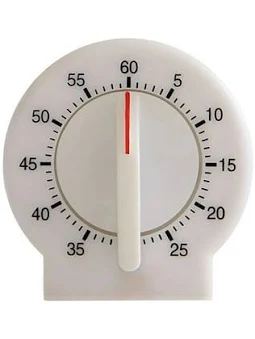
This technique guarantees that you will finish your memoir. In theory.
I always learn a lot from every memoir I read/listen to, but Lauren Graham’s I’m Talking as Fast as I Can supplied a little bonus information that has nothing to do with her life or memoir style. She wanted to pass along a 10-step writing motivation technique called the Kitchen Timer Method. After learning it from director/screenwriter Don Roos, Graham adopted it herself and says she never had another problem with procrastination, writer’s block or anything else that can keep writers from making progress.
This is how it goes, but of course below each step I have to add my two cents. The all-caps sections are original, not mine ever!
- Buy a kitchen timer, one that goes to 60 minutes.
Me: Translation for 2026: know how to set your watch or phone alarm for one hour. - We decide on Monday how many hours of writing we will do Tuesday. When in doubt or under pressure or self-attack, we choose fewer hours rather than more. A good, strong beginning is one hour a day.
Me: I think this is a great idea. Rather than commit to a long-term calendar or plan even a week ahead day by day, wait until the day before. You’ll know your schedule and can somewhat anticipate any surprises that come up. This also lets you plan the rest of your life without much regard to your writing goal, because even if you schedule other things that day you know that you won’t set your writing time until all of those other plans are made. - The Kitchen Timer Hour:
No phones. No listening to the machine to see who it is. We turn ringers off if possible. It is our life; we are entitled to one hour without interruption, particularly from loved ones. We ask for their support. “I was on an hour” is something they learn to understand. But they will not respect it unless we do first.
No music with words, unless it’s a language we don’t understand.
No internet, absolutely.
No reading.
No “desk re-design/landscaping,” no pencil-sharpening.
Me: Don Roos developed this before so much of a book’s research could be done online. The “listening to the machine” and “no pencil-sharpening” are the giveaways. So the problem I have with this rule is that then we must define what an hour devoted to “writing” looks like. When you’re writing a memoir, other nonfiction or even a novel, the hour you devote to writing can turn out to be 60 valuable minutes of online research. There are chapters you can’t write without determining a sequence of events or other information that is in the public record. I would say turn off your phone’s ringer but leave the buzz on for emergencies, and definitely no social media or responding to email/texts. But I would replace “no internet, absolutely” with “internet for research purposes only.” And it counts as research when you spend your time emailing requests to friends and relatives for stories, documents or facts they may remember. - Immediately upon beginning the hour, we open two documents: our journal, and the project we are working on. If we don’t have a project we’re actively working on, we just open our journal.
Me: Roos’s idea here is that you write, and if that means nothing but writing in your journal, well, good enough. But as a memoir author you always have a project: your memoir. And writing a memoir doesn’t automatically mean you also even have a journal. So on this one, just open your memoir document. - An hour consists of TIME SPENT keeping our writing appointment. We don’t have to write at all, if we are happy to stare at the screen. Nor do we have to write a single word on our current project; we may spend the entire hour writing in our journal. Anything we write in our journal is fine; ideas for future projects, complaints about loved ones, even “I hate writing” typed four hundred times.
When we wish or if we wish, we pop over to the current project document and write for as long as we like. When we get tired or want a break, we pop back to the journal.
The point is, when disgust or fatigue with the current project arises, we don’t take a break by getting up from our desk. We take a break by returning to the comforting arms of our journal, until that in turn bores us. Then we are ready to write on our project again, and so on. We use our boredom in this way.
IT IS ALWAYS OKAY TO WRITE EXCLUSIVELY IN OUR JOURNAL. In practice it will rarely occur that we spend the full hour in our journal, but it’s fine, good, and right that we do when we feel like it. It is just as good a writing day as one spent entirely in our current project.
Me: If you can get yourself to write in your journal, you can put the same thoughts into your memoir. You may delete them later, and I think that’s the key to this #5 point—don’t give in to writer’s block. Write anything, and edit later. It’s all part of your life. For me, the problem is that I’m a writer. So devoting an hour to writing is no problem since I write all day long. For someone like me, that hour has to be devoted to the memoir or whatever project I’m avoiding. And the part about staring at the screen? I think the idea is that if you sit there for an hour, you’ll write something. - It is infinitely better to write fewer hours every day than many hours one day and none the next. If we have a crowded weekend, we choose a half-hour as our time, put in that time, and go on with our day. We are always trying to minimize our resistance, and beginning an hour on Monday after two days off is a challenge.
Me: I respect this point of view when it functions for you, but it is actually opposite of my experience. I used to work at least a little bit seven days a week. I made all my professional deadlines, but sometimes the rest of my life would get away from me. For many years now, I’ve taken Saturdays off from working. Saturday is a great day to spend on the phone or in person chatting with friends, getting some shopping done, cooking something special, cleaning a closet, assembling some apparatus that’s been sitting in a box, packing for an upcoming trip, and so forth. I think that when you set such a high bar of never skipping a day, when you do inevitably skip a day it’s like cheating on your diet—you think everything is ruined now. But I do agree that two days in a row make this writing goal feel less like a habit and more like a hobby. So try to write on day two, but busy life today doesn’t always cooperate. Maybe you’re traveling or dealing with a sick child or hosting out-of-town friends. A day off here and there, even weekly if that is what becomes you habit, is just fine. - When the hour is up, we stop, even if we’re in the middle of a sentence. If we have scheduled another hour, we give ourselves a break before beginning again—to read, eat, go on errands. We are not trying to create a cocoon we must stay in between hours—the “I’m sorry I can’t see anyone or leave my house, I’m on a deadline” method. Rather, inside the hour is the inviolate time.
Me: I don’t agree with this except that you should get up and stretch after, maximum, an hour. Touch your toes, walk up a flight of stairs, certainly eat if you’re hungry. But if you’ve scheduled two hours to write, there’s no need to split them in half to the point that you’re running errands in between the two hours. It’s fine if you want to do it that way, but I don’t see why it’s imperative. - If we fail to make our hours for the day, we have probably scheduled too many. Four hours a day is an enormous amount of time spent in this manner, for example. If on Wednesday we planned to write three hours and didn’t make it, we subtract the time we didn’t write from our schedule for the next day. If we fail to make a one-hour commitment, we make a one-hour or a half-hour appointment for the next day. WE REALIZE WE CANNOT MAKE UP HOURS, and that continuing to fail to meet our commitment will result in the extinguishing of our voice.
Me: I fully agree with this one. If you scheduled two hours but made it only through the first hour, the natural response might be to try to make it up the next day and schedule three hours. As he notes, doing that is probably setting yourself up for failure. Let it go. If you made it through only one hour, then set one hour as the nest day’s goal. You know you can keep that promise to yourself. - When we have fulfilled our commitment, we make sure we credit ourselves for doing so. We have satisfied our obligation to ourselves, and the rest of the day is ours to do with as we wish.
Me: Sure. Get it done, and go about your day. Or do everything you need to do all day, and then write at night. Let your memoir be part of your life rather than having it consume your life. That’s good advice, but I can’t say I follow it. I recently ghostwrote a memoir, and I lived and breathed it a lot of each day. When I saw one of the people in the book boarding the same plane as I was, I thought that perhaps I was just imagining it was that person because the players in the book were always in my thoughts. Don’t be like me! - A word about content: This may seem to be all about form, but the knowledge that we have satisfied our commitment to ourselves, the freedom from anxiety and resistance, and the stilling of that hectoring voice inside of us which used to yell at us that we weren’t writing enough — all this opens us up creatively. When we stop whipping ourselves, our voices rise up inside.
Me: Absolutely. Under the pressure of our own burdensome self-chastising, we lose the freedom of mind and soul that it takes to create. I remember this from college. I felt frozen facing papers and tests for three or four different classes. A friend urged me to let go of all but one and just get started on that one. It was amazing how much better I felt—instantly—once I made progress on the first one, and then I went to the next and the next.
Well, that’s the Kitchen Timer Method. Follow it to the letter, try my tweaks, or come up with your own version. Good luck!

