We are experiencing issues with our Contact form.
Please Email Us Directly at: Su*****@************rs.com.

Every ordinary life story is extraordinary!

PLEASE NOTE:

oUR CONTACT US Form HAD A MALFUNCTION.
IF YOU HAVEN’T RECEIVED A REPLY, PLEASE FILL IT OUT AGAIN OR WRITE US DIRECTLY.

Every ordinary life story is extraordinary!

Possessive with the Gerund

Hang in there to learn this last grammar point

No one knows this structure.

You may not remember learning this rule about using the possessive with a gerund, but I assure you it was in an English grammar book you had at some point. It goes like this: some words ending in “ing” should be introduced with a possessive rather than an object pronoun. That’s the case when the “ing” word is a gerund, which is a noun.

To make this easy for you to understand, here are sentences that naturally seem to follow this construction correctly:

Their whispering disturbed everyone who was trying to watch the movie.
You probably don’t say, “Them whispering disturbed…..”

They took my arriving early as a sign of eager participation, which was not the case.
Again, it doesn’t sound right to say, “They took me arriving early….”

My constant apologizing only made them angrier.
Would you say, “Me constant apologizing….?” Unlikely.

His dancing was fun to watch.
Was “him dancing” fun to watch? We tend to say/write this correctly.

I think these examples sound correct because a word like “dancing” or “singing” is recognizable as a noun. But in many cases, using the possessive is not as intuitive, even though it is still correct:

He didn’t appreciate my commenting on his new facial hair.
vs. the error of:
He didn’t appreciate me commenting on his new facial hair.

I hope you don’t mind my interrupting you.
vs. the error of:
I hope you don’t mind me interrupting you.

To prevent my mom’s having to drive home late, I insisted she stay overnight.
vs. the error of:
To prevent my mom having to drive home late, I insisted she stay overnight.

You may have chosen the second choice in each example, but technically that would be incorrect. All three should take the possessive. So your ear is often an unreliable ally in this decision.

Sometimes It’s Not a Gerund

However, sometimes an “ing” word is not a gerund; it can be a participle. When it’s a participle, which is a verb form rather than a noun, you shouldn’t use the possessive:

I saw them still waiting for the bus after I’d circled the block twice.

I get annoyed at people claiming to be someone they’re not.

On the first example, your ear won’t let you write, “I saw their still waiting for the bus….” In that case, you can trust yourself to recognize that “waiting” is a participle.

On that second example, you could make an argument either way. Could “claiming” be a gerund and then it would be “people’s claiming”? I suppose so. But even highly educated readers may stop and have to look at that sentence if it has the possessive, and when you write a book, you don’t want to stop the reading fluidity.

Then there are sentences that require the possessive to be correct, but I’ll opt for making an error instead. Examples:

My basketball team’s winning the competition gave us all confidence as we prepared for the next challenge.
vs.
My basketball team winning the competition gave us all confidence as we prepared for the next challenge.

In some sentences, it’s important to figure out whether the “ing” word is a gerund or a participle, because using the possessive will change the meaning:

I wanted more info on the man juggling three jobs.
vs.
I wanted more info on the man’s juggling three jobs.

Did I want more info on the man, as the first sentence implies, or did I want more info on how to juggle three jobs?

Get It Write has a good explanation of this. In general, though, I am not judgy about it. If you want to drop that possessive, in most cases I’m okay with that decision. But as with so many grammar rules, I usually reword a questionable sentence. I would never write a sentence like the above “basketball” example. I’d say: Winning the competition gave everyone on my basketball team confidence as we prepared for the next challenge.

There are so many ways to convey the same thought that I try not to get trapped into these gritty choices.

One More Controversial Grammar Point Explained

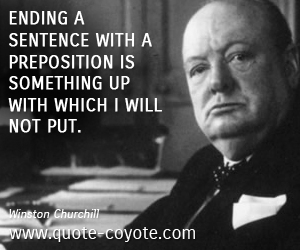
Winston Churchill quote meme

Can you end a sentence with a preposition?

Continuing from my last post, here’s another controversial grammar point.

Ending with a Preposition

Grammar-type people love to haggle over this one, and the meme above shows one of the several versions of a quote widely, but probably erroneously, attributed to Winston Churchill. No matter who really said it, the quote is perfect for making the point that in some cases you tie yourself in knots trying to avoid ending a phrase or sentence with a preposition.

The easy-to-understand sentence, “That’s something I will not put up with,” ends with the preposition “with,” and according to the rule, must be addressed in some other way. That leads you to, “That’s something with which I will not put up,” which still ends with a preposition. So you have to take one more step to reach the unwieldy, “That’s something up with which I will not put.”

As with everything in English, you can reword a thought to avoid the problem. For example, you can say, “I won’t put up with that.” Problem solved. But do you have to do that every time?

I think in some cases you should and in some it’s not necessary. In a memoir, you probably will include a lot of dialogue. Make your dialogue sound natural. A lot of grammar rules go out the window when you’re quoting people in the way they truly talk.

Apart from dialogue, let’s look at sentences that you might end with a preposition but don’t really have to. Before we start, consider that sentence you just read. It ends in “to.” Rewording that is a bit of a nightmare. No matter how many “which” devices you use, you can’t just stick the “to” somewhere else; it doesn’t work to say, “Let’s look at sentences that you might end with a preposition but to which you really don’t have” or “….a preposition but have to which you really don’t.” To avoid ending with a preposition, you would have to totally rework it. I’d say, “Let’s look at sentences that you might end with a preposition, but you can choose not to do that.”

Here are examples of sentences that you might end with a preposition but, instead, you can reposition the preposition:

  • I didn’t know which category I should place that into.
    vs.
    I didn’t know into which category I should place that.
  • I didn’t know which half I should take my slice from.
    vs.
    I didn’t know from which half I should take my slice.
  • He was head of the committee I eventually took charge of.
    vs.
    He was head of the committee of which I eventually took charge.

In all of those sentences, I would use the “which” device and avoid ending with a preposition.

I’d choose differently for the next sentences. Even though it’s not difficult to avoid ending with a preposition, I don’t think that improves the sentence. Sometimes you improve the grammar at too high a price to the language or the communication:

  • Her own situation was what she wanted to talk about.
    vs.
    Her own situation was about what she wanted to talk.
  • I know I wasn’t exactly the kind of person they were hoping for.
    vs.
    I know I wasn’t exactly the kind of person for whom they were hoping.

I would just use the first option in those sentences. In some cases, you’re dealing with an idiom of some sort. Take this:

  • I didn’t know where that comment came from.
    vs.
    I didn’t know from where that comment came.

In that sentence, too, the first option sounds more natural.

Let’s try “with” as in the meme quote:

  • They told me to bring a “plus one,” but I don’t have anyone to go with.

Sure, you could say, “…but I don’t have anyone to bring.” That’s what I would do, at least in writing. But if you’re writing a memoir from the heart, and you want to write in a natural way that ends some phrases and sentences with a preposition, I certainly will not stop you.

This whole line of thought applies when you’re talking about a clause rather than a full sentence. If you say, “I didn’t know which half I should take my slice from, so I let the other person go first,” you still have to decide where “from” goes. It’s exactly the same as if it ended the sentence.

Note to anyone who stuck with me through this long lesson: I have one more coming, and then we’ll be done with grammar for a while.

Two Controversial Grammar Points Explained

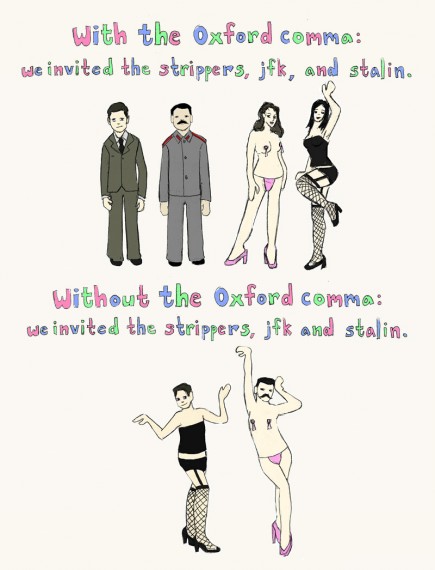
Meme demonstrating use of the Oxford comma

Breaking Some Rules You Learned in School Can Enhance Your Writing.

You might think of grammar as black and white—correct grammar and incorrect grammar and nothing in between. But some grammatical structures fall into a gray area. Maybe the thinking on them has changed over time, or there might be examples of great writing taking opposite choices. So let’s explore some tricky grammar. Here are the first two controversial grammar points, and I’ll follow up with more in the coming weeks.

Serial Comma

People keep wanting to die on this hill, typically in favor of the serial, also called the “Oxford,” comma, but some stalwarts against the damn thing stake their claim to higher ground as well. The serial comma is the comma before and when you’re naming three or more items.

Outside of the United States, the serial comma has generally been accepted as proper. But Americans, especially American journalists, have been more likely to contend that the serial comma is, at the very least, unnecessary. In “my day,” standard stylebooks advised dropping the comma, and journalism schools taught that you’re always trying to save space, even the space of a tiny punctuation mark.

But then the Internet came along, with its eclectic and global mix, and Americans saw that they were in the minority not only in the world but also among academics, who tended to go with the comma. The meme above depicting JFK, Stalin and strippers became the rallying image against the serial comma. The idea is that without the comma, JFK and Stalin become identified as the two strippers. With the comma, you’ve invited two people and an indefinite number of strippers:

We invited the strippers, JFK and Stalin.
vs.
We invited the strippers, JFK, and Stalin.

What never went viral is a meme showing how inserting the comma can create an ambiguous meaning. In the following example, JFK could be your uncle, whereas without the comma it’s clear that you’ve invited three people:

We invited my uncle, JFK, and Stalin.
vs.
We invited my uncle, JFK and Stalin.

For many years after getting my master’s degree in journalism in the U.S., I held fast to omitting the serial comma as I was taught. But when times change, I change. Today, even here in my country the serial comma has become relatively standard, and the AP Stylebook no longer bans the comma and, in fact, recommends using it in a long, complicated series. I still drop it in a short and simple series:

On my birthday, I received three cards, some makeup and a necklace.

But in anything longer or more complex, I usually throw in a comma before the and.

Sentence Fragments and Run-ons

A proper sentence requires a subject and a verb. Sometimes it’s an implied subject, as in a command. “Go away!” is a sentence with you as the implied subject.

But skilled writers do not always have to be proper in their writing. Run-on sentences and sentence fragments used to indicate a lack of sophistication. Today, they can signal just the opposite. When you break rules with knowledge and purpose, you’re molding the language to fit your writer’s voice. That’s a good strategy for developing your style. With that approach, you can justify inserting a period after a phrase that has no subject and, therefore, is not really a sentence. Or you can use the once reviled comma splice instead of a period or semicolon to create what technically is a run-on sentence.

Look at these examples of sentence fragments (in bold). I think they’re just fine within the context of their paragraphs:

My sister stared at me but said nothing. Nothing at all. She didn’t even blink.

I looked away and thought of all the things I could do. Accept the ring. Give him reasons for not accepting the ring. Tell him I still loved him. Tell him why I hated him. At least give him a hand so he could get up off his knee. Instead I walked away, slowly at first and then more quickly, not once looking back.

Let’s twist that second example and turn it into a run-on, comma-spliced sentence:

I looked away and thought of all the things I could do. I could accept the ring, tell him I still loved him, head into some imagined and unlikely sunset with him. Or I could decline his proposal, tell him why I hated him, push him to watch him fall completely to the ground. I could at least extend a hand, help him get up off his knee. But all I did was walk away, slowly at first and then more quickly, not once looking back.

I routinely use both devices—the fragment and the run-on. Fragments are the way we speak; they’re useful for connecting with the reader. With run-ons, I like the cadence of omitting the and or the or. I like the way you say it in your head when it’s a complete thought without being a proper sentence.

Come Back for More Torture

Next time, I’ll tackle ending a sentence with a preposition and using the possessive with gerunds. You don’t have to know anything about it ahead of time to understand—you’ll see!

10 Things Memoir Authors Can Learn from Taylor Swift

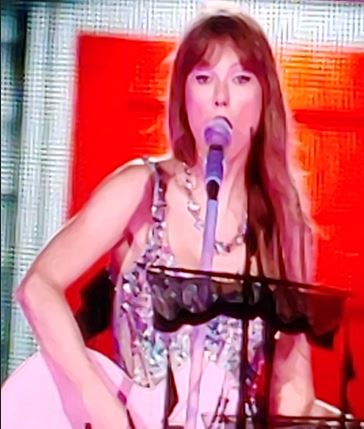
Taylor Swift performing in Tampa during the Eras Tour

She’s a master of writing and marketing.

I’m not the biggest Swiftie out there, but I did take the above jumbotron photo when I saw her in concert during the Eras Tour, and now I’m doing a heavy listen of the new album, “Life of a Showgirl.” Mulling over the lyrics, the storytelling, the marketing and the work ethic, I’ve come up with 10 things memoir authors can learn from Taylor Swift.

  1. Supply details that create a visual. I’m just using other words for “show, don’t tell.” This is probably the biggest takeaway from Taylor’s music. You don’t need the video, because you can picture every moment of the story she’s telling. And the descriptive details she supplies are not cliché or tired, old descriptions you’ve heard a million times, something such as, “Her eyes, the clear blue of a quiet lake, held the promise of a better tomorrow.” No, they’re surprising but precise:
    “She wears high heels, I wear sneakers. She’s cheer captain, and I’m on the bleachers.”
    “Spinning like a girl in a brand new dress.”
    “I can see us twisted in bedsheets.”
    “I was walking home on broken cobblestones.”
    “The dominoes cascaded in a line.”
    “See me nervously pulling at my clothes and trying to look busy.”
    “I’m drunk in the back of the car and I cried like a baby coming home from the bar.”
    “When we’re on the phone and you talk real slow ’cause it’s late and your mama don’t know.”
  2. Bring readers into your life on an emotional level. And this is the second most important lesson. From listening to her songs, Taylor’s fans feel as if they’re her friends; she shares her thoughts and her experiences with them directly. From reading your book, your readers should feel that they know you well and have an emotional connection with you. These lyrics from Taylor give you an idea of how language facilitates that:
    “Well, you stood there with me in the doorway. My hands shake. I’m not usually this way. But you pull me in and I’m a little more brave.”
    “In a box beneath my bed is a letter that you never read from three summers back.”
    “When my depression works the graveyard shift, all of the people I’ve ghosted stand there in the room.”
  3. Be authentic. I think most memoir authors understand this one. Most likely you’re not writing a memoir to prop yourself up or establish some version of yourself that isn’t true. Just the opposite—most writers I know find that memoir brings them closer to their most authentic self. Through the research and soul-searching that memoir requires, you may feel that you’re in touch with parts of you that either had never before surfaced or had been long forgotten or neglected. Taylor is so overly authentic that conjuring up stories about completely fictional characters in the “Folklore” album introduced a new angle to her music.
  4. Build suspense or anticipation, and later reveal the outcome. One of my favorite Taylor Swift songs, “The Last Great American Dynasty,” tells the story of a quirky woman who, after marrying her way into wealth and real estate, “ruined” the last great American dynasty, according to the townspeople. Her house sat idle for 50 years until, Taylor tells us, “it was bought by me.” And then she had a good time being loud and scandalous and ruining things all over again. So that was a surprise ending. Readers will turn the pages of your memoir to find out what happens. Write your story in a way that makes readers unsure of how precarious situations will turn out.
  5. Drop “Easter eggs” along the way. In building that anticipation, you can mimic Taylor’s habit of hiding clues or what’s come to be called “Easter eggs.” Taylor’s fans are always on the lookout for any hint of what’s next, because she’s become associated with this device. Let’s say in your teens you meet someone who many years later becomes your spouse. You can write something like:
    In the group of friends was a guy who caught my eye for just a moment. At the time, we didn’t have a conversation, but somehow I knew I’d run into Paul again someday.
  6. Invent new metaphors and conflate idioms to create a mashup. “I’m a mirrorball,” Taylor sings. “I’ll show you every version of yourself tonight. I’ll get you out on the floor. Shimmering, beautiful. And when I break it’s in a million pieces.” You don’t hear someone comparing herself to what I picture to be a disco ball every day. But I think it works, perhaps not as easily in a memoir as in lyrics, but my point is to take risks with your writing. In Taylor’s song “Cancelled” from the new album, she asks whether you brought a tiny violin to a knife fight. I really like that mashup. In my own writing, I frequently take a common saying and either twist it or mash it up with another one. What I mean is something like:
    The prodigal daughter had become a son of a gun. Or:
    After a while, I started arriving at work right on time like the rest of the staff, accepting that all being an early bird would ever get me was the promised worm.
  7. Use humor. Many authors write about a dark time in their lives and the redemption that followed. Humor seems out of place in that type of memoir. But if there is a way to inject even a little humor, try doing that. It gives the reader a break from the heavy subject matter. The lyric I’ll cite from Taylor Swift is from the new album’s song “Actually Romantic.” She’s talking about how someone has been throwing shade at her on social media, and it’s sort of cute—“like a toy Chihuahua barking at me from a tiny purse.” Well, it made me laugh, anyway.
  8. Create a brand. Engage with potential readers even before your book comes out. Publishers today are risk-averse and more likely to offer you a contract if you already have a definable following. Taylor understood fan engagement while still a teen, and obviously it’s served her well.
  9. Capture your genius moments. According to numerous reports, Taylor was riding in a car with her then boyfriend, now fiancé, Travis when their conversation about a particular late great actress inspired the song “Elizabeth Taylor,” now track three on the new album. So they parked the car, and she popped out to get some quiet in her head so she could sing a tune into her phone. That’s how she began to write that song. If you’re writing a memoir, it’s always on your mind. Whether you’re daydreaming some lines in the shower or an interesting aspect to your life story wakes you up in the middle of the night, don’t lose the opportunity to grab some paper or your phone and get your thoughts down. They can be fleeting!
  10. Be fearless. Look, you’re writing a memoir. This is not a project born of timidity. You’re already doing something very bold. Don’t be afraid of the writing, don’t be frightened of the ordeal of finding a publisher, and don’t fear the reaction from family or the public. You’ll never finish this project if you glance over at Fear Fiend. So take that lesson. From the name of one of her albums to the way she manages her career, “fearless” is an apt label for Taylor Swift and can be for you, too.

Is Memoir Really Your Book’s Genre?

A library with signs for each book's genre

Maybe it belongs in another section of the bookstore or library.

Today it’s not easy to sell any book, but memoir is a particularly challenging and competitive category. So ask yourself: Is memoir really your book’s genre?

Authors can start out thinking they’re writing about their life, but sometimes a book has a mind of its own. The narrative can be leading the author rather than the other way around, and you can find yourself flowing into another section of the bookstore altogether.

Perhaps your book is more authentically:

  • Self-help. Some authors wonder whether it’s okay to devote a chapter or more, usually at the end of the book, to straight advice. While they want to document whatever hardship they experienced, they’re even more determined to offer help to others facing that same situation. If your book ends up at 60% memoir and 40% self-help, you might do yourself a favor and fashion your text to swap those figures, because self-help is an easier book to sell to a publisher and likely to appeal to more readers.
  • Fiction. Maybe you’ve changed people’s names, represented them as composite characters, switched story locations and disguised details of events. At what point does memoir cross over into fiction? If you’re that concerned about getting sued or just hurting people’s feelings, it may make more sense to write a novel “based on a true story.” Then it’s not even about you or the people in your life. I think some authors want to have it both ways. They want to write out their life story to have their voice heard, but without risk or retribution. I think that does justice to neither truth nor great, imaginative storytelling. Opting for the latter might make help you write a really good novel.
  • Op-ed. Let’s say your book centers on your escape from an abusive marriage. As you share your experiences, you may have a lot of opinions at every turn. Maybe your state’s restraining orders aren’t enforced well enough or the divorce laws favored your spouse or your children’s school failed them in some way—you could have a lot to say, along with research, about how to improve matters to make it easier for people like you. If you find yourself interrupting your personal narrative to share your views on the topic, and if that’s the aspect that is taking your writing energy, perhaps you’d be better off writing a book or magazine article that merely references your own experiences in primarily advocating for the societal improvements you have in mind.
  • Travelogue. If you’re writing an “Eat, Pray, Love” type of memoir, obviously this is not an original idea. Maybe your book will benefit if you focus more on the travel than the travail. A book of travels can be informative and helpful to the next traveler who will just skip over the chapters telling one more “finding myself” story. But no judgment!
  • History textbook or how-to. Similarly, if your memoir theme is so narrow that you’re educating the reader in-depth, maybe you’re actually writing a textbook for college majors in a particular discipline. Or it’s a nonfiction book about the history of an era, event or location. Maybe it’s lighter reading—a how-to guide in gardening or diet and fitness or following some obscure philosophy. Or you start out with the premise that it’s not quite a cookbook, but it has so many recipes that maybe it turns out to be a cookbook after all.
  • Poetry. I’m surprised at how many people want to include poetry or song lyrics in their memoir. In this case, keep the “memoir” label. Poetry is nearly impossible to get published.

Or it could be a memoir

A book stands on its own merits, your memoir is fully yours to cross genres or create your own hybrid if you like, and for general reader enjoyment it doesn’t matter what category the book falls under. But for marketing, sales and just getting published to begin with, you have to identify what you have there. So give it some thought before slapping “memoir” on your cover.

Still, I don’t want this to discourage memoir authors. If I’m the reader, give me a memoir every time. I think they’re cool and fascinating, and they’re always as unique as the individuals who have written them.

Memoir is All About the F’s

Man thinking about the letter F

(Not That One)

In light of my last piece, I was thinking about the different topics and themes that frame people’s stories, and it occurred to me that a lot of memoir subject matter begins with the letter F. I’m not referring to the one-time unmentioned but now ubiquitous F word, although I’m not judging you if you find yourself uttering it quite a bit during your memoir journey.

There are lots of other words beginning with F. Here’s why memoir is all about the F’s.

  • Freedom. There’s a tremendous freedom involved in the process of writing about your life and perhaps even more in completing the project. Once you have your book in your hand, you’ve accomplished a life goal. That’s freedom enough. For trauma victims, the freedom comes in closure and letting go. With or without trauma, “getting it off your chest” brings freedom as well. A memoir is the gift you give yourself of sharing your perspective, in your voice, for friends, foes and strangers alike. The freedom you sense is from finally feeling heard.
  • Facts. Along the same lines, your truth is what matters in a memoir, and truth translates to facts. You most likely will do some research and share factual data and information, but your memory is a source for facts as well—even if other people in your life have, in your mind, twisted the facts to skew them in their own favor. This is your book, and you get to write down the facts as you see them.
  • Family. Many memoirs center around a relationship with a spouse, parent, child or sibling. But no matter what the main topic or time frame of your memoir, it’s likely that you’ll devote some pages to your family. Your childhood influences the choices you make throughout life, so typically your early life with your family is relevant. In your adult years, marrying or becoming a parent also plays a huge role even if it does not directly fit into your theme.
  • Fortune. You may be writing about an aspect of your professional life, the way you started out having very little money, or a pivot that changed your direction in life. Your fortune isn’t just about how big a bank account you’ve built. It can be the fortune of happiness or fulfillment. Certainly it can be misfortune, or you can include how luck played into your life.
  • Friends. This one’s a little weaker. Some memoirs focus heavily on one or more friendships, but many do not. Still, a memoir typically will mention some friends who played significant roles at some point in the author’s life. Including your friends in your memoir can give the reader a lot of insight into your personality. Also, crafting dialogue between you and a friend is a great alternative to simple description in letting the reader know what you were thinking and how you were feeling.
  • Fate. Did you direct your own life, or was it all fate? No one knows the answer to that age-old inquiry. Your memoir explains what happened and how you navigated the situations you encountered. No matter how you interpret the concept of free will, either fate placed you where you ended up or you chose your own fate.

Your memoir might be Fabulous and Fantastic, include sections that are Funny or Fantasy, plague you with Frustration, challenge you with necessary Formatting or eventually bring you some Fame. There’s an F left—Future—that I can’t contrive to make part of memoir. You can apply various lenses in documenting your past but, as Natasha Bedingfield sings, the rest is still unwritten.

Categories of Common Memoir Themes

Woman holding two books titled "Memoir"

Really, there are only two categories with multiple versions of each.

If you want to write a memoir rather than a full autobiography, what might you focus on that will resonate with readers? When you get down to it, there are really only two categories of common memoir themes.

Category 1: Triumph

Feeling you’ve overcome some adversity can be so life-changing that you want to not only share it with others but use your experience to help the next person facing the same problem. You may even help people avoid falling into the trap of whatever tripped you up.

Within this broad category, there are subsets:

  • Illness. A rare illness introduces readers to something new, which always makes for good reading. On the other hand, more people will relate to a common illness. This means that no matter what health challenge you faced, including mental illness and depression, you can write a memoir about it.
  • Trauma. From living with an abusive parent or spouse or experiencing extreme bullying to growing up in a country at war, trauma is a frequently explored misery. Escape tends to be the resolution, but there are many directions this can take, and not all tales of trauma are alike.
  • Addictions and vices. With all the groups available to help people quit drugs, alcohol, gambling, shopping, compulsive sex and more, it’s no wonder that former addicts want to write memoirs after believing they’ve kicked the habit. Matthew Perry is a sad example of how difficult this is to achieve, even if at the time you write your memoir you think you’ve gotten there.
  • Identity and insecurity. The path to figuring out who you truly are can obviously fill a book. Gender confusion, body shape issues, learning challenges, cultural blurriness, even career indecision—people spend many years on choices and self-acceptance. Once you’ve come to terms with your authentic self, it’s understandable that you want to provide a path of information and encouragement to people just beginning the journey.
  • Spiritual awakening. The outcome of any of these challenges can come through a new spiritual awareness, but the awareness itself also can be the main topic of a memoir. Perhaps you just didn’t feel whole until you let God in your life. It’s a common theme, but everyone’s discovery is unique.

Category 2: Time period of your life

While the triumph category may end up covering only certain years of your life, this second category focuses specifically on a slice of time with the theme inherent in how you spent that time. Again, there are sub-categories:

  • A geographic location. It can be very interesting to read someone’s “my time in” an unfamiliar culture. Perhaps you lived part of your life in an area that was exotic, isolated, poverty-stricken, dangerous or even privileged. Or maybe you simply took a trip that you describe in an extensive travelogue.
  • A relationship. Mitch Albom’s Tuesdays With Morrie is a well-known example of chronicling time spent with a special person. Albom revealed the myriad topics of discussion during his weekly visits with his dying former professor, opening readers’ minds to life’s richness. If the movie Beaches had been based on a memoir instead of a novel, which of course is fiction, it would be another good example of a friendship memoir. Some relationships last a lifetime, but if you’re writing a memoir about it you probably had a beginning and end.
  • Coming of age. Somehow we have a timeless fascination in exploring the bridge between childhood and adulthood. Perhaps it’s because then we remember our own coming-of-age years, when we had our whole lives ahead of us, lots of options and endless new experiences.
  • Drastically changed circumstances. Perhaps there were some months or years that, for whatever reason, were completely different from the rest of your life. Joan Didion explored grief and loss in The Year of Magical Thinking. Maybe you spent a couple of years working as a firefighter or fostering dozens of children or running an unusual company. It can be worth writing about.
  • A project. Whether you took three years to sail around the world or you set out to visit every major league ballpark in the country, you may have a memoir there. White journalist John Howard Griffin wrote his 1961 best-seller Black Like Me to enlighten people about how race impacts everyday life after he managed to pose as a black man in the segregated South.

Once Again: Autobiography vs. Memoir

If you’re a celebrity, you can get away with writing a full autobiography, cradle to present day, and still call it a memoir, not to mention still get it published. If you’re an ordinary person, only your family will be interested in your autobiography. And that’s fine. In fact, that’s our typical customer at Write My Memoirs.

Just don’t expect, as a non-celebrity, to have high book sales without a theme. Often the theme is the catalyst for writing the memoir. But let’s say the motivation to write about your life comes first, and then you go looking for a theme that will be compelling to readers. You want to write about something, with you as the major player. That’s a memoir.


Author Shares Memoir Journey of Reliving Trauma

Writing Through the Wreckage: The Unbearable Weight of Telling My Story

by our guest contributor Adriene Caldwell

Writing Unbroken: Life Outside the Lines has been the most harrowing journey of my life—more painful, more vulnerable, and more exhausting than I could have ever imagined. And that is saying something, considering the life I’ve lived.

Brutally Honest Overview

This book is not a story. It is a reckoning. It is a coffin I’ve had to reopen again and again, not to bury what happened but to breathe through it—to make space for the wounds that never stopped bleeding and the girl inside me who never stopped screaming.

Writing this memoir meant returning to the scenes of the most unthinkable traumas: witnessing the sexual assault of my young friend, seeing a child drown, surviving foster care so abusive it bordered on sadistic, growing up in extreme poverty and mental illness, battling addiction and bulimia, and being raised in the aftermath of a home ruled by violence and untreated psychosis.

These weren’t chapters to be revised. They were ghosts I had to confront to stay alive.

Memory as a Battlefield

There’s a particular cruelty in trauma that lives in your nervous system rather than your memory. You forget what happened, but your body remembers. Your breath shortens. Your hands shake. You cry and don’t know why. Writing each chapter felt like plunging into freezing water with no guarantee I’d come back up.

I didn’t just survive trauma—I bore witness to it. I saw my young friend sexually assaulted. I didn’t have the power to stop it. I didn’t even understand what I was seeing until years later, when the guilt caught up to my understanding. That memory alone could have unraveled me. But it was only the beginning. I watched a little girl drown. I remember the chaos, the silence that followed, the disbelief.

It wasn’t a movie moment; it was slow, confusing, and then over. But it stayed in my body. And writing about it meant sitting with the realization that I would never unknow what it looked like to watch life slip away.

The Shame that Shadows the Page

Of all the emotions I expected to encounter while writing this memoir, shame was the most persistent and the most venomous. The drug use, the desperation, the people I gave myself to in hopes of feeling something other than emptiness—it all painted a version of me I had spent years trying to erase.

But that’s the lie trauma teaches you: if you admit what happened to you, you become what happened to you. And I believed that lie for far too long. Every page I wrote, I felt shame whispering: Who are you to share this? Who will love you when they know? Yet I kept writing. Not to silence the shame, but to exhaust it. To give it a voice until it had nothing left to say.

Grieving in Real Time

Some traumas are decades old. Others still burn like fresh wounds. Writing about the deaths of people I loved, as well as my own suicide attempts, meant confronting a different kind of violence: the one we do to ourselves when we believe we are unworthy of life. I didn’t write about suicide from the sidelines. I wrote it as someone who attempted it. More than once. I had to revisit the scenes: the overdoses, the razors, the gun, the stillness, the moments I hoped would be the last. I had to write about the part of me that didn’t want to be here. And then I had to write about why I stayed.

I also wrote about being homeless—when my mother, brother, and I lived at the Salvation Army shelter in downtown Houston. Each morning, the shelter would evict its occupants onto the blazing hot Houston streets. The pavement scorched the soles of my shoes. The sun was merciless. I carried my childhood in a plastic bag and my shame in my throat. Writing those scenes meant remembering the sting of invisibility, the constant fight to simply endure the day.

And always, in the background, there was my mother. She was schizophrenic. Unmedicated. And she was physically abusive. Her rage was untethered, and her mind was often lost in a world I couldn’t access. But her beatings were all too real. The last one came with a wooden dowel rod—the kind you hang clothes on in a closet. Thick. Heavy. Unforgiving. A makeshift bat in her hands. I remember her swinging it with precision. I remember the bruises that didn’t fade and the realization that I had to leave or I would not survive.

Telling the Truth When It Could Ruin You

Some truths are not just difficult—they’re dangerous. Writing about pedophilia, abusive foster homes and family secrets meant risking everything. I worried about legal fallout. I worried about people I once loved reading their own reflections in the mirror of my pain. I worried about being disbelieved—again.

But writing this memoir wasn’t about revenge. It was about reclamation. And I had to ask myself every day: Am I willing to be free even if it costs me everything? The answer, eventually, became yes.

The Loneliness of Writing What No One Wants to Hear

Writing a trauma memoir is a solitary act. It’s not a trending genre. There is no applause for this kind of vulnerability. People will say it’s “too much,” “too graphic,” “too hard to read.” And to that, I say: Imagine how hard it was to live.

I didn’t write Unbroken to entertain. I wrote it because the silence was killing me. I wrote it because too many people are still living what I survived. And someone needs to go first.

The Unexpected Grace

Despite all the pain, there have been moments of light. Writing has allowed me to meet the girl I was, the one no one protected, and offer her what she never had: truth. I’ve written prayers into paragraphs. I’ve stitched together sentences that somehow made my brokenness feel sacred.

When I wrote about choosing not to die—when I reached for life even in the depths of despair—it didn’t feel like writing. It felt like remembering. Remembering that I am not just what happened to me. I am what I survived. I am who I became.

A Memoir as a Mirror

Unbroken: Life Outside the Lines is not just a book. It’s a mirror. It reflects back the parts of me I tried to hide—the rage, the grief, the shame—and it allows me to say: I am still here. I am not clean. I am not healed. But I am whole, in the way a tree is whole after a lightning strike—scarred, yes, but alive.

This book cost me everything: my comfort, my certainty, my illusion of safety. But it gave me back my voice. And maybe, if even one person reads it and feels seen, it will have given something to them, too.

The Truth: It Was Never Just Writing

People ask what it’s like to write a trauma memoir. I wish I could say it was cathartic. Sometimes it was. But mostly, it was excruciating, like pulling out a knife still embedded in the wound, over and over, until I remembered that I was the one holding it now.

This book wasn’t therapy. It was survival. It wasn’t healing. It was truth. And I am not the same woman who began it.

Hobbies and Memoir

Woman getting ready to run a race on a track

Are your pastimes and passions worthy of inclusion?

Typically, in your memoir you’ll write about your career and family, but what about hobbies and memoir—are they compatible? If you decide that your pastimes and passions worthy of inclusion, how do you present them?

The quick answer is yes, anything about yourself that you want readers to know can be appropriate to include in a memoir. However, memoirs typically have a theme. It’s tempting to shoehorn your favorite stories about your life into that theme, but the reader may not support such indulgence, even if you successfully pull off the justification you contrive for the inclusion.

But let’s say you decide to take that chance. Then you have two choices: dedicate a separate chapter, or sprinkle the hobby throughout the book.

A Dedicated Chapter

Dedicating a chapter to your hobby is the simpler of the two options. Find a place for that chapter that feels organic and doesn’t stop the action. Let’s say you’re an avid tennis player in a memoir about surviving domestic abuse. You’re going along chronologically without mentioning sports. But there’s one tennis game you remember playing against the abuser—a parent, spouse or partner—and during the game the person criticizes your abilities or yells at you, or maybe the game itself is the trigger for intensified abuse. That’s where you can insert the chapter.

Start this chapter either by setting the scene for that game or introducing your love of tennis to the reader. I’d lean toward the former. You set the scene, and then you spend a few paragraphs or pages on your tennis experiences. You go over the background of why you started playing and also can go into the future with information about later tennis achievements. Then come back to where you are chronologically in the book, at that game with your abuser, and describe that scene.

Recently, I helped a memoir author do something like that. I’m currently coaching an author who is writing mostly about her paranormal experiences and theories but wanted to include her love of opera. We crafted a chapter that picked up where her story was chronologically and linked her attendance at an opera at about that time with a paranormal experience she had. Then we traced other operas she’d attended both earlier and later in her life, describing her travel to cities to see them and any odd occurrences that took place.

A Sprinkle Throughout the Book

If you go in the opposite direction, by the time you get to the story of playing tennis with your abuser the reader already knows about your love of the game. One advantage of this is that you can build suspense about the eventual scene of your tennis match. You can have a paragraph like this:

“He suggested a game of tennis to see whether, at my young age, I could beat him. Since I’d already made plans to play with Lily that day, I had a legitimate excuse to turn down the invitation. The last thing I needed was for him to ruin one more passion for me. But I knew that, sooner or later, the invitation would morph into a command, and I’d have to face him on the tennis court. Once he got an idea in his head, he never let it go.”

Helping the Reader to Know You

Now let’s say you love to read. A lot of your down time has found you on a sofa or in a hammock, on a beach or in your bed, with a book or Kindle in your hands. You follow certain authors and feel that for people to really know you, they have to be aware of your taste in fiction. Does that belong in a memoir?

With skillful writing, you can get away with a lot. You can tie in your favorite books with events in your life or your introversion or what you had in common with the person you married. It can be enough for the reader to accept it as a way to fully know you.

I understand. Above you see a photo of me preparing to run a race in Senior Games track and field just last week. If I wrote a book about my later years, no matter what the theme, I think I would have to include some mention of how I transformed from a never-athlete into a senior quasi-athlete.

There are lots of ways to sneak in your hobby. Just be careful not to alienate your reader!

How Much to Explain in Your Memoir

Woman writing in a book with a pen

It’s not easy to figure out where readers need background info.

Knowing how much to explain in your memoir is one of the trickiest aspects of writing it. You may be humming along in a chapter about working at your first job when you hit a roadblock simply because you don’t know whether readers will need background information to fully set the scene.

The level of detail involves three areas: specifics about you personally; information that enriches the reader’s knowledge about a broad topic such as a period in history, a location or a famous person; and a quick reference to a phrase or pop culture tidbit that someone might google if you don’t supply it—or the opposite and get kind of insulted if you do.

Let’s take them one by one, using that example of the chapter about your first job, teaching high school history. It’s important to your story because you moved to the city to take that job, and the school is where you met your spouse, who also was teaching there. You want to talk about the courtship, but the job wasn’t very significant because after two years you moved on to a different line of work.

Personal Details

If your whole point is to include this job because it’s where you met your spouse and the city is where you decided to live, you may feel that you’re going down a rabbit hole to explain why you took the job to begin with. And is there any use in comparing your own high school with this one? Talking about the memories it brought back? Should you bother saying that the principal reminded you of your uncle because of some quirk they had in common? And if you wouldn’t otherwise mention your uncle, do you have to explain a little about him?

These decisions are a good example of the difference between a first draft and a final manuscript. Throw it all in there at the beginning. Then in subsequent drafts, surrounded by all the other chapters in your book, this first job will feel either substantial and worthy or distracting and off-topic—content a reader might just skim.

This also is an example of what “they” mean when they tell you to kill your darlings. You may get a lot of satisfaction from reminiscing about this time in your life, but if it doesn’t serve the plot or delight the reader, cut it out. You may find your memories of your uncle to be amusing, even to a stranger, but does it have anything to do with your theme? There’s no right or wrong here, but don’t waste readers’ time or risk boring them.

Encyclopedia-level Information

Then there’s the information that isn’t really about you or your life. With the high school as the setting for dating your future spouse, what should you say about the school itself? You might describe walking through the halls just as you remember. Readers have been to high school and will be able to picture it without any description, so I wouldn’t go overboard. But when you walked into your future spouse’s classroom, what was on the wall? Or in your own classroom, was there a map? A screen of any sort? It’s helpful to supply some of that detail

You spent only two years in teaching. Should you educate the reader on the history of the teaching profession and what it means to people? No. What if your whole career was in teaching? Still no, not unless your book’s theme is you as a teacher.

But you moved to the city in which the school was located, and that became your permanent home. Talking about the city, from its geography and history to the climate, business community and people, could be germane to your topic.

Common Knowledge—or Not

There was a time when we all read newspapers and watched the same three television channels. Common knowledge was universally common knowledge. With that no longer true, it’s hard to know what references in history or pop culture will go over readers’ heads. How much explanation do you owe your readers? When does it become condescending?

I was reading a book review in The New York Times that mentioned Andy Warhol and then said the book’s prose style was “unlikely to be anyone’s cup of soup.” To smile at that, you have to be familiar with Andy Warhol’s painting, “Campbell’s Soup Cans,” you have to know the phrase, “Not my cup of tea,” and you have to pick up on the way the writer conflated the two. You can’t get away with explaining a joke, so the reviewer here did not offer the reader any help. You either got it or you didn’t. Readers of NYT’s Sunday book review section probably need no backup on this one, but it’s still an assumption on the reviewer’s part to include the reference at all. For readers who get it, though, it’s fun.

Conversely, I just finished the audiobook memoir All About Me! by Mel Brooks, and when he talks about being served Limoncello in a restaurant, he explains what Limoncello is—a lemony liqueur—because when he drank it someone had to identify it for him. He doesn’t mention that Limoncello is generally served between courses to clear the palate, which is the only important thing about Limoncello. So I’m not sure his explanation served any purpose at all. Since Brooks was 95 when he wrote his memoir, I’m not going to pick on him for this.

Customize for YOUR Books

From these examples, you can see that you must have a reader in mind to take an educated guess about how much explanation readers will need about the common knowledge part and somewhat about the encyclopedia-type of information.

But also think about how your narrative is flowing. Does the reader need a little break from the drama? That might be a good time to describe the city in detail. Are you writing your memoir partially in the hope that you’ll educate readers? Then you need background on that illness or country, the science or history, a building or method. But if you’re writing to show off how great you are at descriptions, it’s better not to indulge in that sort of thing.

Login

Then just set up a chapter and start writing your memoir. Don’t worry about rules. There are no rules to writing your memoir; there are only trends. These trends are based on techniques and features identified in current top-selling memoirs. At best, they’re the flavor of the month. If you’re capturing your life in print for your family, for your own gratification or to inspire readers, rather than aiming to set off Hollywood screenplay bidding wars, these trends don’t even apply to you. You’ll write the memoir that suits you best, and it will be timeless, not trend-driven.There are no rules, but there are four steps:

1. Theme/framework
2. Writing
3. Editing/polishing
4. Self-publishing

You’ve researched this, too, and you’ve been shocked at the price for getting help with any one of those steps, much less all four. That’s because most memoir sites promise to commercialize your work. They’ll follow a formula based on current memoir trends, because they want to convince you that they can turn your memoir into a best-seller. These sites overwhelm you with unnecessary information not to help you, the memoir author, but to address Search Engine Optimization (SEO) algorithms so they can sell more.

That’s not what we do at Write My Memoirs. Our small community of coaches, writers and editors are every bit as skilled as any you’ll find, and we charge appropriately for their expertise and the time they’ll spend helping you craft a compelling, enjoyable read. But you won’t pay an upcharge for other websites’ commercialization, the marketing that follows, and the pages of intimidating “advice.” You can sell your book if you like—we have ISBNs available for you—but our organic process of capturing your story takes a noncommercial path.

If you want help with any or all of the four steps above, choose from our services or save money by selecting one of our packages. If you’d like to talk about what’s right for you, schedule a call. One year from now, you can be holding your published memoir in your hand. And at that point, it will be a big deal!